I'm sure it will come as a shock to many of you that Riss and I started brewing our own beer about a year ago. (Well, Riss started brewing and I started occasionally helping her brew and occasionally being greeted when I got home from work on a Sunday with a statement like, “You like, kolsch, right?”) It has been a ton of fun and the beer has been fantastic. The most powerful taste experience I've had happened fairly early on when I drank one of our saisons. It was towards when I usually go to bed, I was a little peckish and decided to have a beer instead of a bowl of cereal. Beyond how great it tasted, drinking that saison felt physically good, as if it were biologically, bodily beneficial; as if the usually very abstract sense of health and nutrition materialized as an actual sensation of flavor. And, being me, rather than just enjoying it, I thought about it.
Beyond, perhaps an extra level of vitamin-B from the yeast, can we prove that home brew is, in fact, better than commercial beer? Could we chemically analyze the ingredients to determine if a certain kind of hops or malts or grains or yeasts produces different tastes when processed at different scales? Of course, as is natural, thinking about beer got me thinking about everything else. There is evidence that today's vegetables, for a whole host of reasons, have less nutritional content than vegetables from a generation or two ago, so does that explain why my farm share vegetables taste so good that store bought vegetables now taste like styrofoam that's punching me in the eye? Perhaps we simply underestimate the value of “freshness” with vegetables and the actual determining taste factor is the extra day between being picked and being eaten that all store bought veggies have. Maybe all those pesticides, no matter how thoroughly washed off, affect flavor.
The questions of taste and quality are, of course, compromised by all the various “brown bag” tests, that tend to show that, without the suggestion of the label, it is very difficult for most people to taste the difference between great wine and good wine, meaning the actual chemical difference, the actual physical interaction between the wine and your taste buds, what we actually taste is not meaningfully different; meaning that the bulk of what we taste, at least when we're tasting wine, is the idea of what the wine should taste like. If this is true for wine, is it true for organic farm share vegetables and home brewed beer?
Of course, advertisers have known for ages that the suggestion of a food experience is almost as important as the actual food in how the food is experienced. A McDonald's hamburger isn't really flavored with a cliff's worth of sodium and the mysterious greasy remains its brethren leave on the flat top; it's flavored by a gagillion dollar relentless advertising campaign abusing the cultural consciousness of the world into believing its food. The same goes for any food that is advertised, in any way. Food producers have discovered that it is more profitable to suggest their food tastes good, than to go through the trouble of trying to make sure their food is actually good.
One current in the interpretation of this phenomenon is to argue that there really isn't actual “quality” in terms of taste. For the most part, if you believe your are in a super classy restaurant that makes fantastic food, the majority of the classy fantastic-ness of your meal will come from you believing it will be classily fantastic and not from the food having any actual, provable class or fantasy. Of course, there is more to food than just taste, and too often this idea is used to apologize for destructive and unhealthy food practices. If we can't definitively, scientifically, empirically prove that say, a burger a Craigie on Main is better than a burger at McDonald's, than McDonald's is free to continue doing whatever it is they call “making a hamburger.”
Yes, it is important for food to taste good, but it is also important for food to not give us Type-2 diabetes, for our food system not to kill all the bees and help destroy the world, and for the way we prepare and eat our food to help us feel like actual fucking human beings and not just cogs in a vast capitalist system that need occasional refueling.
We taste with our brains. Our entire brains. We all know that food is flavored by our ideas of it and our memories of it—which is why there is such a thing as “comfort food”--but we can also taste with our politics, taste with our ethics, taste with our identities. If the vegetables I get from Steve also come with the knowledge they are not contributing to the destruction of civilization as we know it by pumping vast amounts of carbon into the atmosphere and thus changing the climate, while representing a scalable business model for a more just, more healthy, more community-based food system, why shouldn't they taste better to me than the vegetables that are part of a massive agri-business complex thriving through destructive and totally unsustainable monoculture? Even if chemically, even if the actual substances that hit my actual taste buds are not actually different, they are politically, economically, and socially different, so why shouldn't my primary sensory experience of them be radically different.
Though I doubt it, I suppose there is a chance that I cannot prove the beer that started this whole though is physically much different from a Bud Light (I mean, except for the whole one being a saison and the other being a pilsner, but I don't think there are any mainstream commercial saisons and that's not really the point anyway) but that beer and a Bud Light have different meaning in my life, so, of course I would experience them differently. In the end, we don't taste with our tongues, we taste with our lives.

Showing posts with label Food. Show all posts
Showing posts with label Food. Show all posts
Wednesday, November 20, 2013


Thursday, November 29, 2012
Stewed Beef with Turnips or How I Got My Brother to Eat Tongue
As I mentioned in last week's post, Lucky Peach was in my reading pile, and also happens to have some of the best food, cooking, culture writing out there. Irreverent, edgy, interesting, I don't think it will be too much longer before it starts pulling in major magazine writing awards. I've been on board since the beginning, when the rep for the publisher told our buyer all about it, so I have every issue. And though every issue has recipes, we've only cooked from it once before, a noodle recipe that happened to be, also, the only recipe that contained a basic error. Until we came across the innocuously named “Stewed Beef with Turnips,” by Danny Bowien, the chef of Mission Chinese Food, in the current Chinatown themed issue. (DO NOT FORGET ABOUT IT, Jake!)
 As I mentioned in my post on tomatoes, one of the challenges with getting your food from a farm share is that it is real easy to get sick of certain foods. Climate, weather, bugs, deer, parasites, labor force, all of it can combine into years where you get a lot of one thing until you're sick of it. Never being a huge fan of turnips to begin with, Riss and I have been sick of them since about July. Not that I have anything against turnips, it's just well, really that says it all. And we still had a tongue in the freezer. When you come across a recipe that makes use of one of the biggest things in your freezer and one of the ingredients you're having a hard time getting rid of, well, I wouldn't go so far as to say you're spitting in the eye of god if you don't make it, but you're probably spitting in the eye of god if you don't make it. To further solidify our destiny, we had pretty much everything else for the recipe as well; pork bones left over from a roast, carrot, onion, bay leaves, ginger, cheese cloth, a big old pot. The only things we needed were short ribs--which gave us an excuse to walk up to the new locally owned, organic, pasture raised, grass-fed only butcher--kombu and tofu, which gave us an excuse to go to the Japanese market.
 The recipe also lets me return to one of my “overarching food themes;” the most important ingredient is almost always time. This is a three-day recipe with a fair number of steps. It looks daunting, but most of it is just waiting. Season the meat with kosher salt and let it sit in the fridge over night. The next day, sear it, put it in a pot with the bones and some of the other ingredients, bring to a boil, and then simmer for three hours, (For the complete recipe, buy a copy of Lucky Peach. Seriously, it's an awesome magazine.) during which, if you're me, you can watch college football, scratch out a few sentences in a novel, read a book you're reviewing, read a galley you've been dying to get to, and read a history book you've been interested in since it came out in hardcover. Then add the turnips, simmer until fork tender, let the whole thing cool and put it in the fridge, again, over night.
 According to Contemporary American Corporate Food Culture, this is a hassle. If you feel like Stewed Beef with Turnips, damnit the whole reason we fought the Cold War was so that you could eat it now. Time has somehow been equated with effort. But, most of the time, most of these time intensive dishes really only require you to let time pass, during which you can do whatever else you want. Most of the time when I'm making stock, smoking pork, or making this dish, I'm doing something other than cooking. You just have to get over the idea of eating the exact thing you want at the exact time you want it. Which, of course, has a socio-economic component to it. (Doesn't everything on this blog.) The massive carbon footprint of American eating comes from only eating what you want when you want. To eat a certain vegetable, out of season for your region, involves a massive economic structure, with a massive carbon footprint that combines commercial farming with commercial shipping. To only eat a certain cut of meat, creates this whole other economy, where shmillions more of an animal needs to be bred and slaughtered and something must be done with the rest of it that you don't want, in order for the rancher and butcher to make ends meet. The real mental/cultural breakdown here is that just about anything edible can be made delicious if you know how. And with the internet, you can find out how to make anything delicious. And, not every meal has to be delicious for you to survive. A decent tasting meal will get you through the day just as well.
But this was delicious. It's described as one of those restorative soups, and we ate it after this year's pick your own day at the farm share. It was restorative. Because the broth has a really clean, fatty flavor, you can augment pretty much at will. The recipe suggests a salty, fermented chili sauce which we didn't get to, but I ground up some of our radish kimchi and put it in and that was fantastic. You could easily add siracha or soy sauce. I also threw in some fresh mustard greens. Any fresh greens would do. You could definitely serve it with noodles too. Or extra tofu. And it's also a good starter dish for someone looking to eat a little more adventurously (or someone looking to trick someone else into eating more adventurously). Beef tongue tastes like really beefy beef, and if it's cooked in certain ways (including all the boiling it goes through in this dish), has this really nice, velvety texture. Throw in the cleanness of the broth and you have a dish that tastes very different from average American fair without being particularly challenging to the American pallet. My whole family, even my teenage brother, enjoyed it.
And let's face it, you should never pass up a chance to take a picture with a beef tongue.

Thursday, October 25, 2012
Tomatoes! Tomatoes!
The farm share is a
classic double-edged sword. Sometimes you get vast amounts of
certain vegetables for a whole host of environmental and
climatological reasons and the challenge of using them all leads you
to new techniques and new recipes and other times, Oh My God I cannot
eat another fucking turnip! This year we got a lot of tomatoes. Not
only did we grow them ourselves as we always do, but Steve had so
many he was selling them by the box on pick up days. We bought them.
Obviously, our experience with the tomatoes was more of the cutting
the other guy edge of the sword and less of the accidentally lopping
off your thumb edge, as tomatoes are a lot easier to use than
turnips, especially given that much of our home cooking is in the
Ameritalian tradition.
We had some typical
responses to the tomato avalanche. Of course there were lots of
salads, as there always are lots and lots of salad in the summer. We
also made sauce, diced them and tossed them with pasta, and canned
them. We also made salsa and froze it. (Yes, you can freeze salsa.)
Here are a few things we did that might not be as typical, including
the best fucking sauce I've ever fucking had.


Ingredients
A whole bunch of San
Marzano tomatoes. (You could use most other kinds, but I probably
wouldn't use a fancy heirloom and you’ll have to bake them longer
to condense the water.)
Salt
Pepper
Olive Oil
Half an onion, diced
2-4 cloves of
garlic, minced
Perhaps a dash of
dried oregano or any other herb of your choice (like the
overabundance of basil which coincides with tomato season)
Instructions:
Preheat the oven to
350
If using San Marzano
tomatoes, half them perpendicular so that when you open it looks like
each half has two compartments of tomato goo. If you are using
regular tomatoes, cut the horizontal, scoop out all the seeds with
your fingers and then cut them in half again, making quarters. Seed
the tomatoes and retain the tomato water, (a small mesh colander over
a bowl works great for this). Place the halved tomatoes face up on a
baking sheet or pyrex dish. We put them on a silicone mat to keep
them from sticking. Basically you want something that will be easy to
clean burnt tomato sugar off of, since there’s a lot of it tomatoes
and hot sugar is sticky. Sprinkle a little salt and pepper over the
tomatoes and drizzle the top with a bit of olive oil. Bake for about
an hour, rotating the pan in the oven halfway through to ensure even
cooking, unless you've got one of those schmancy ovens with even heat
all over. The astute recipe reader will probably notice that this
really just a slow roast. At the end, the tomatoes look almost
sun-dried. Given them a moment to cool and then extract them from the
baking sheet and peel the skin. If there is a little bit stuck on
the skin, it’s not a huge deal, you just want 85-95% of it gone so
you get a smooth sauce.
In a blender or food
processor puree the tomatoes with the retained tomato water. What
you've essentially made is something one step removed from tomato
paste. You've removed the water from the flesh in the tomatoes
through the baking and then added the more intensely flavored tomato
water to bring it back to sauce consistency. You can actually use
this as a sandwich spread (great with rabe and provolone) or freeze
it to use later.
Sweat the onion and
garlic over medium heat, in a frying pan with a whole bunch of olive
oil until the onions are softened and transparent but not browned.
The olive oil is not just for frying the onions and garlic but also
for thinning the puree to a sauce consistency and adding some fat to
interact with the umami of the concentrated tomato flavor.
Add the puree the
pan, whisking to combine it with the onions, garlic, and olive oil.
If it is too thick add a little water until you've reached your
desired consistency. Once at that consistency and warmed through
taste it and adjust the seasoning with a little oregano, salt and
pepper. You could serve this over an old magazine and a with a
little grated cheese, it would be delicious.
Alternately, if you
want to use it to make a vodka or wine based sauce, you put the
alcohol over the onions and garlic and let the liquid reduce by half
before adding the tomatoes. (Or perhaps even
some tomato infused vodka if you have any, which we do, because, if
you've heard, we got a lot of tomatoes this summer. How do you make
it? Vodka, cut up tomatoes, time and a strainer at the end.)
One of the great
downsides to our modern American food industry is that most of us,
most of the time, are never challenged by ingredients. We decided
what we want and then buy whatever is needed to make that from the
grocery store. But, none of the world's cuisines developed that way.
All the traditional recipes came from people coping with the
ingredients their climate forced on them. Furthermore, the greatest
recipes, especially when you start cooking animals as well, are
inspired by poverty, the need to make a tough cut of meat or a
strange looking vegetable into something delicious because you have
to eat it or starve. Obviously, ‘riss and I won't reach that
point, but having the farm share has replicated, at least in a small,
safe way, a part of that challenge, and I personally think our
cooking has improved because of it.
Thursday, July 19, 2012
Never Buy Whipped Cream

Water, hydrogenated vegetable oil (including coconut and palm oils),
high fructose corn syrup, corn syrup, skim milk, light cream, and
less than 2% sodium caseinate (a milk derivative), natural and
artificial flavor, xanthan and guar gums, polysorbate 60, sorbitan
monostearate, and beta carotene (as a coloring).
Or nonfat milk, cream, sugar, corn syrup, maltodextrin, inulin,
(chicory extract), cellulose, mono and diglycerides, polysorbate 80,
artificial flavors, carrageenan, with nitrous propellant.
Or whipping cream or heavy cream and a little bit of effort.
The next installment in my internationally acclaimed (on the internet
now, so it's true) series about food to never buy in the store for
various reasons, is whipped cream. One of the biggest challenges
American convenience food producers faced in developing their
products is that most food doesn't have a shelf life. It comes from
a plant or an animal that has been killed, and the second that living
thing dies, it begins to degrade. The longer its dead, the less of
what makes it food, instead of trash, remains.
Humans
throughout history have been dealing with this problem and have
solved it in various (and sometimes delicious) ways. Salting,
smoking, and fermenting came first, followed eventually by freezing
and pressure canning. However, all of those techniques have
limitations, and once you add in the desire to grow the food in
Nebraska, process it in Pennsylvania and eat it in California, the
challenge becomes that much greater. The chemicals and procedures
become more drastic, and, as a result of those chemicals and
procedures, the amount of sodium and sugar you need to add to the
food to make it taste like food becomes even greater. Though we can
forgive early food scientists their ignorance, it's now clear our
food system is creating at least as many, if not more problems than
it solves.
But in some ways whipped cream stands out. It is air and cream and,
as you can imagine, a fragile mixture of the two does not keep well.
The first list of ingredients is for Cool Whip and the alphabet soup
at the end of the ingredients list are the chemicals needed to make
it seem “whipped.” The second list is for Redi Whip, which uses
nitrous oxide, to essentially whip the contents as it distributes
them. In truth, the convenience whipped creams aren't nearly as
terrifying as I feared; the stabilizers aren't particularly bizarre
so the only stand out is the corn syrup. But as with all food
convenience food products, both of these promise to save you tons of
time. Because of them you'll have to time play with your children or
something, but if you've got a hand mixer, those products save you
five minutes at best. (And, if we're talking about quality time with
the kids, you can totally make them do it.) They save a bit more
time if you have to hand whip the cream as that requires a whisk and
damn near ten minutes of vigorous whipping, but most of us could use
the exercise anyway.
Not only does the whipped cream you make from scratch taste better,
it can taste anyway you want it. We add some confectioners sugar and
vanilla extract, which is delicious, but you can add pretty much any
extract. Almond. Hazelnut. Mint would be very nice. You could
also add a little brandy or Cointreau or some other liqueur. If
you're about to top a pie, grating some nutmeg in might be lovely.
Or you don't have to add anything at all. If you're not a fan of
sweets, don't add anything sweet. Once you decide to not open a tub,
you're free to flavor pretty much any way you want.
There's a lot of
talk about freedom these days, which is somewhat ironic to me, given
how many Americans pay for convenience with their personality. For
some reason, the ultimate American expression of freedom has become
owning a gun you have no use for and making a bad decision about
health insurance.

But with food, we're
willing to trade our individuality for a couple of minutes of saved
time. We choose pre-packaged, homogenous foods over stuff we could
easily make from scratch, ceding our “individuality” to massive
corporations many of which (Unilever, Nestle) gasp! aren't even
American owned. According to our blog commenting selves, it's all
about personal expression, but at dinner time it's all about
convenience and familiarity. We can do whatever we want, but time
and time again, we eat McDonald's or Applebees, instead of asking our
smart phones for something different. What does it mean to be free
if you're going to wear the same clothes, read the same books, watch
the same shows, and eat the same food? Is true freedom, the freedom
to just book a Disney tour and cede the experience of a foreign
culture and nation to a corporate monolith? Does freedom come with
any responsibility to use it? And if not, if we do have the right to
let somebody else handle the cooking for us, if freedom also means,
choosing to be free of responsibility, why exactly, are so many of
us, so angry, about a healthcare bill that does no more than gently
prod a few million Americans into a responsible decision? Or is this
just another example of Americans wanting all things all of the time,
without shouldering or even confronting the burden of creating all of
those things all of the time?
Sure, whipping cream
takes a few more minutes than opening a tub or depressing an aerosol
nozzle, but if freedom and individuality are so damn important in
this country, I'm pretty sure those few minutes are worth it.
Thursday, June 28, 2012
Craft Beer and the Next Economy
 | |
| Picture from Brewfest Link |
A couple of
Saturdays ago I went to the Hyperlocal Brewfest at the Somerville
armory. It was a dozen or so area craft, micro, and other (the other
being Sam Adams & Narraganset, which was nice because I'd been
intrigued by the Sam Adams Porch Rocker, but wanted to try some
before committing to a six-pack. Verdict: It'd be perfect if I'd
just mowed a lawn, but I think I'll fill my fridge with other beers)
brewers giving tall pours and unlimited samples of their wares. I
tried beers from Cambridge Brewing Company, Watch City, Backlash,
Idle Hands, Jack's Abby, Somerville Brewing Company, and Night Shift.
The CBC, Jack's Abby (which I didn't realize was local) and
Somerville Brewing Company, had the best individual beers, and the
pims beer (which really tasted like a pims cup, meaning it was
cucumber beer) from Cape Anne was really interesting, but the best
beverage I had was a combination of Night Shift's Taza Chocolate
Stout AND! Viva Habanero, a rye malt with habanero peppers. (For the
love of peace and justice and the children and puppies, put that in a
bottle!)
Of course, this is
all part of the growing localism trend, the absurd belief that life
is better when you give enough of a shit about the town or city you
live in to shop in a way that supports said economy of said town.
(Aside, I wonder how strong the locavore movement is in this
small-town value-driven, um, towns, that people keep telling me are
the real America. What? Wal-mart put all those stores out of
business? OK then.) But with the national unemployment rate
hovering around the 8s and looking like its going to stay there for
awhile, and the growing concerns around global warming and climate
change, I wonder if, more than just producing a delicious, delicious
beverage, local-focused craft beer might be leading the way to the
next American economy.
In general, locally
owned businesses hire more people per dollar of sales than national
and international businesses, at least in terms of retail. Part of
this employment difference, of course, has to do with duplication of
services. A thousand different locally owned businesses will all
have their own marketing coordinator, personnel manager, receiver etc, while a
large national chain will only have one or a small group meeting those responsibilities. (Part of this difference
might also be that locally owned independent businesses don't usually have
some rich asshole at the top demanding shmillions of dollars a year
in earnings.) And, of course, the other benefits of shopping locally, such as tax revenue, property values, and general economic activity, are
well documented, but I think the craft-micro-local beer industry
might have even more to teach us.
What about an
economy of small-scale manufacturing and production? When we think
about restoring manufacturing in America, we tend to think about car
factories, and other massive endeavors, the kind of industry that
defined the, um, industrial revolution, but maybe the answer to our
manufacturing deficit is to go small. Thousands of small operations
around the country, hiring people with a productive level of
redundancy and, perhaps, making high quality goods in an
environmentally rational way at reasonable prices to boot.
Beer, of course, is
the perfect product for sustainable small-scale production. You can
start your business in your kitchen. If things go well you can
be a tenant brewer as Pretty Things did, renting space in existing
breweries to make your beer. And even if you end up owning your own
brewery, you don't need a huge space for it. And there seems to be a
range of economic sustainabilities in making beer; you've got your
Sam Adams and Harpoon, and you've got your Peak, Notch, Cape Ann,
Ipswitch, and you've got your Night Watch, Pretty Things, and
Somerville Brewing Company.
 In
metro-Somerbridge, we're seeing a little bit of this, especially in
terms of various food products, but is there a way to develop,
small-scale clothing, appliance, home goods, electronics, and other
manufacturing? Cities, towns, and state subsidize businesses all the
time, usually through tax breaks and low interest loans, but nearly
all of the time these subsidies go to big national chains. Wal-Mart
walks into the local city council meeting promises adding 500 jobs by
building a warehouse in the town and then casually hints they suppose
they could build that warehouse in the next town over unless they
don't have to pay property tax on the warehouse for ten years.
(Then, because this is Wal-Mart, they deliver half the jobs they
promised generally at a non-liveable wage, and if a few local
businesses go out because of this, the city's tax base usually erodes
even further, but I doubt I needed to tell you Wal-Mart is bad.)
Millions or perhaps billions of dollars in local funds have been
poured into massive and already successful and profitable businesses.
It's kind of like the steroid era in baseball, the strongest are
just getting stronger. (A couple places for all the data: The Institute for Local Self-Reliance and The 10% Shift)
But what if towns,
cities, and counties, started subsidizing small-scale manufacturing
and production? You would probably create more jobs
for less money and, in terms of the city's investment, jobs that
aren't going to up and relocate to Bangladesh. It would be
investments in business owners who are themselves specifically
invested in the well-being of the city. And this wouldn't have to
mean the end of large-scale production.
Some products, cars,
solar panels, wind turbines, etc. just can't be produced at the local
level and that's fine. There can be room in our economy for the
large-scale and the small-scale, the local and the international, the
big and the small. The only reason we don't see more of a mixed
economy is because big businesses tend to spend a lot of money on
getting bigger, usually in the form of lobbying the shit out of
Congress and local governments for tax breaks, subsidies, and lax
regulation that gives them economic advantages. Or, they just take a
6.025% price advantage by not collecting and remitting sales tax.
(AMAZON!)

But, as usual, it
starts with beer. By making home brewing legal Jimmy Carter maybe
have begun the process of the next American economy, a small-scale,
sustainable, productive economy that creates jobs and lowers our
carbon footprints. And delicious beer. Delicious delicious beer.
Thursday, January 5, 2012
The Golden Age of American Beer
I decided to check out a new-at-the-time bar and meet Riss after work. I went early, got a seat at the massive horseshoe bar and had a few beers while I was reading Under the Volcano. (Yeah, that guy.) In the quiet couple of hours between about 3 and about 5 it was a pretty nice experience. Not much to distinguish it, but the beer was good, the bar had enough light to read by, and it had the quiet atmosphere of people grabbing a couple of early beers.
As soon as 5 o'clock hit, it was like the Army Corps of Engineers ignored the disrepair the levies had suffered and Hurricane Yuppie washed my peaceful city away. All bars have multiple personalities, so that shouldn't speak too much one way or the other for the bar in question, but ultimately, I ended up not being too fond of this particular bar. But that's not the point of this post, the point is that I found myself assessing the bar in question, thus, “It just seems like they have the same hundred beers as everybody else.” That's right. We have reached a level of beer in this country, and in the Boston area that having 100 plus artisan, craft beers on tap, does not necessarily distinguish a public house. To me, that sounds like a golden age.
The roots of the Golden Age of American Beer lie several decades in the past when a President of this great land, in an act of governmental restraint and deregulation, freed brewing beer from the tyranny of Federal oversight. And that president was Jimmy Carter. (In direct contrast to Reagan, who raised taxes, and spent shmillions on a complete science fiction of a defense system, while negotiating with terrorists, which I guess is how you get an airport named after you.)
Home brewing eventually lead to a cottage industry, that lead to the early successful small brewers like Sam Adams, Magic Hat, and Sierra Nevada. Add in some politics of sustainability, the growth in the importance of local products and production, and the fact that many Americans now have a decade or more between graduation from college and having children, and you've got the Golden Age of Beer. Though we can never be certain, the argument could be made that America is the greatest beer nation on earth right now. But rather than making some kind of big argument about beer in America and the world, or playing out the idea of a “Golden Age,” (why gold and not platinum and how really gets to decided?) I'm going to highlight some of my favorite things happening in beer right now.
Harpoon Hundred Barrel Series. Not unlike a movie studio that churns out a rom-com every six months in order to fund its art films, many bigger brewers do special series along with their more popular beers. Harpoon now brews 100 barrels of some different, experimental, interesting beer every few months or so. I've tried just about every one and they have all been fantastic. Sometimes they're takes on less common styles of beer. Other times, they add an atypical flavor. Sometimes it's a twist on something traditional. Whatever the stated goal, they've all been interesting, delicious, creative express of beer.
Pretty Things. If you're into beer in the metro-Cambridge area, you've heard of Pretty Things. You've probably heard a lot about Pretty Things. You might even be sick of hearing about Pretty Things. But every one of their beers is good. Some of their beers are fantastic. And their English India Porter “December 6, 1855 EIP,” a historical beer not unlike the kind of stuff that made Dogfish Head famous, was the best beer I've ever had. But more importantly, I like the fact that they are tenant brewers, renting spaces in other brewers to make their beer. It means there is a system in place, in brewing, for people with great ideas and great recipes, to start a business without necessarily needing a ton of capital.
Mayflower. My favorite even newer brewery, their seasonal Summer Rye Ale, might be the most convincing proof that American beer is in a special place right now, because it is a high quality porch beer. You know what generally passes for porch beer and though I have a special place in my heart for High Life and PBR, the Summer Rye Ale, hits all the taste expectations you have for cracking a cold one on the porch, but at, like 11, without being “at 11.” All their other beers are great too and if the only “craft” beer you've tried in your life is Sam Adams, Mayflower would be a great next step.
Bombers. $5-$14, 16-24oz bottles give you the chance to try a lot of different beers without filling up your fridge with six-packs of stuff you might not end up liking. Some of them might seem a little pricey but so are high quality steaks, or wines, or bourbons, or, well, really anything that people put a lot of work into. In fact, the bomber itself might be a driving force in the Golden Age of American beer, because it gives small brewers an economically sustainable, marketable product.
You Probably Have a Friend Who Makes Beer. In a lot of ways, the renewed quality of American beer, has lead to a re-resurgence of the home brewing that started this age in the first place. As with well, everything, from baking bread to making clothes, there's a kind of extra flavor with home made beer. Sure, sometimes you or your friend mess it up, but it's still yours and that means something. Furthermore, whatever is produced, is something no one else will have ever had. Which I think is really cool.
Thursday, October 20, 2011
Cooking for Gamers: Stock
Making stock might be the perfect cooking activity for gamers, or really for anyone who has some hobby or enjoys some activity that keeps them in the house for hours at a time. It's easy in terms of technique, it's almost impossible to screw up, and, if you're in to the whole sustainability thing, it extracts the absolute maximum amount of food value from your vegetables and meat. And if you happen to not be the primary cook in your household, this is a great way to contribute to the overall health and quality of your food, because not only does homemade stock taste better than store bought, in liquid, powder, or cube form, there is so much less sodium in it that it actually lowers someone else's risk of heart disease while you eat it.
The first ingredient: a bag in the freezer. If you eat a lot of fresh vegetables keep the scraps. Stalks from greens like kale and chard, carrot tops (though we find the carrot greens give a swampy flavor to our stock), parsnip peels, onion skins, parsley stems, mushroom stems, etc. Nearly all vegetables that can be boiled, don't have really strong flavors of their own like peppers, or flavors you don't personally like, aren't so starchy they'll turn the stock into a sludge, like potatoes, and are not somewhat gassy like the various permutations of cabbage (I know, which is like half the vegetable world, but still) can be part of a stock. Just collect them all in a bag and stick it in the freezer. If you eat meat, keep the bones/carcass in a bag in the freezer as well. You can also just buy carrots, celery, and onions, or chicken wings, if you don't generate the raw materials on your own. When you can no longer fit Red Baron's Pizzas in the freezer, it's time to make stock.
Second ingredient: The biggest pot you have. Dump your bags in aforementioned pot with water, some fresh carrots, onions, and celery (everyone knows the French for that, right? Good.) a bay leaf or two and some garlic. Because we usually pressure can our stock in quarts and we've got a big old pot, we'll usually measure out six or seven quarts of water, but there's nothing wrong with just filling the thing up.
Then put the spurs to it and get your game started, but don't go on any quests yet. If you've got a big session planned, this would be the time to lay in supplies at the computer/gaming console, get connected to your teammates or search for any tips or cheats you might want to use. (Well, you might not want to use any, but I'm not very good at video games, so I usually keep a walk through handy.)
Once the stock has reached a boil, set it to simmer and go do something else for a couple of hours. No really. As long as you don't leave it unattended for so long that all of the water evaporates and you start burning the mass of disintegrating vegetation, you really can't screw this part up. Sure you can boil the stuff long enough that it breaks down more than you might want it do, but that just means you're straining will need to be more meticulous. When is it done? I don't know. When you reach a good save point. When you have to go to the bathroom. When you lose your internet connection. But seriously, folks, if the fresh carrots you put in are mushy, they have, in the words Saint Alton Brown (Hallowed be thy multitasker) “given it their all.” We'll often do two or three rounds of stuff in one pot, just to make the stock more flavorful and free up more space in the freezer.
Once the stock is done, fish out all the clumps of stuff and strain out all the bits of stuff. You'll need to cool it down before the next step. In a perfect world you'll be able to get the stock out of the “danger zone” (40-140 F) as quickly as possible. You can put it in a cooler with ice and then transfer it to your fridge. In my world, we have to leave it out overnight and then put it in the fridge to finish cooling. If you're making veggie stock, you'll need to do this in order to season it properly. If you've got meat in it, you'll need this so you can take the fat out. The fat will congeal in the top and you should just be able to pull it out with your hands. (And don't throw that out. It's useful. And healthier than margarine.) For the game, now you can really get into something involved and totally play all night. I guess everybody else can catch up on their reading, or Dr. Who, or sleep, or whatever it is the kids do these days.
Since our stock has been in the danger zone for, like ten hours, we bring it to a rolling boil for at least ten minutes before we do anything else to it. Then we season it. Salt (a lot more than you would think but still way less than store brought). Pepper. Herbiage, like rosemary, thyme, oregano, or really anything that isn't basil, sage, cilantro, or something with its own strong distinct flavor. (Probably would avoid mint, while we're avoiding things). Taste and adjust seasoning. Package how you see fit. You can can it, freeze it, or use it. I'd advise leaving the last 1/8-1/4 an inch in the pot, because there's probably a lot of detritus in it, that even the finest strainer or cheese cloth will have missed.
And there you have it. Your rice pilaf will be so much better. As will all your soups, or hot pots, or really anything that uses stock. And most of the time you were playing video games.
Thursday, July 21, 2011
What Went Wrong in American Food?
In some ways this essay is a little out of date. Over the past few years, American food culture (at least in some places) has slowly been drifting away from the steak, potatoes, and processed convenience food full of sodium, high fructose corn syrup, and chemistry sets of preservatives, that was contributing to our national epidemic of obesity, while having the added bonus of greatly contributing to climate change. CSAs and farm shares are becoming more accessible. Non-profit organizations are finding ways to bring fresh food to the poor, who too often have to eat the cheapest of the cheap. More restaurants are committing to seasonal sustainable menus. Foodieism has trickled down an increased focus on what and how we eat. But obesity is still on the rise, so, even though obesity has many sources, our food problems are far from solved.
And all of this is recovery from an unhealthy, unsustainable, practically joyless food culture that prized convenience over flavor, cost over quality, and predictability over passion. We became a nation of reheaters. My question has always been, what went wrong? We had the two fundamental sources of a great cooking culture; diversity and poverty, and though “America” is an extremely young culture, especially in terms of food, we had already developed some fantastic new foods, from barbeque to potato chips. But then, well, here's what I think happened.
Compulsory Education: For most human history, people (women usually) learned to cook by watching their mother cook, who learned by watching her mother cook. Recipes weren't passed down in books, but through apprenticeship. Techniques weren't taught, they were absorbed. But with the modern education system, mom cooked alone, because the kids were at school. Many recipes, techniques, and traditions were lost because there wasn't anybody in the kitchen to watch them enacted. So, when those children grew up, got houses, and found themselves in the kitchen, they didn't really know what to do. It's not hard to see the appeal of “heat and serve.”
Better Living Through Science: When the American dream included a car in every driveway, we didn't know our car culture would eventually wreck the environment. It is impossible to predict all the consequences of our actions. The convenience foods we eventually developed had the best of intentions; to give women a little spare time. And who could blame them for finally taking the opportunity to read every now and again. We didn't know then, the effects the amounts of sodium and high fructose corn syrup and other chemicals needed to make shelf-stable foods taste like something would come with such dire consequences for our nation's health.
The Great Depression (but not for why you think): A lot of people got out of the Great Depression determined to never eat poor people food again. Americans had the money to buy pretty much whatever cuts of meat they wanted and so they bought the best cuts. If they were going to eat chicken they were going to eat chicken breasts. If pork, chops or loins. If beef, steaks or roasts. The market responded and now we have chickens that are essentially engorged breasts on legs and cows pumped with more hormones than East German Olympic swimmers (speaking of out of date statements). As dire as the environmental consequences are from the shift to choice cuts, a lot of cooking was lost. The source of the world's great food traditions are disgusting looking potential foods made palatable through technique. Oxtail doesn't look too tasty when it's just sitting there, but for most of human history it was either eat what was there or don't eat anything at all. And now we have oxtail soup. Oh man. Oxtail soup. Because we stopped eating poor people food, a lot of great recipes and techniques fell out of general knowledge.
The Unequal Distribution of Domestic Duties: Social movements are funny things, especially when they succeed. Women joined the workforce, but, for the most part, men didn't really increase their domestic workload. One result of the womens movement is that many, many women got home from work and still had to make dinner, and when they did, they had much less time and much less energy to do so. Furthermore, no one was around to tend to the all day dishes or bake bread or make pasta, or do any of the other time or labor intensive cooking that used to define daily domestic life.
What might be most instructive about our transition to a convenience food culture is how little all of these changes had to do with food. For the most part, a more general structure of society changed, and how we made food changed in response. Furthermore, all of these societal changes were, at least in terms of their intentions, for the best. The plague of advertising and the corn-centric agricultural subsidies have done their part of course, but food scientists in the 50s didn't rub their hands together in malicious glee and declare “Ha, this will contribute to an epidemic of diabetes by the start of the next millennium.” Compulsory education wasn't a conspiracy of the burgeoning microwave industry, and the organizers and activists of the feminist movement didn't conclude their meetings by saying, “And just think of it, one day we'll have the fattest kids on the planet.” Our destructive food culture was a result of people trying to make the world a better place.
As I said at the beginning of the essay, our food culture is changing for the better, but unfortunately, the changes are almost all from the top down. It's people with enough money to dine at sustainable restaurants and shop for fresh, sustainable food, with the time to consistently make it. Unfortunately, truly changing our food culture for everyone, will require more general and more drastic socio-economic changes. However, I do think, there's one food based change we can make that would quickly and greatly improve our food culture. Teach cooking in school again.
An hour or so, every month, through middle and high school would provide students with many of the basic skills needed to cook healthy food for themselves. Maybe some schools could offer an elective as well for those students who might be interested in working in the food industry. It won't replace the lifetime apprenticeship we used to learn to cook through, but it will mean all American men and women will be able to cook for themselves. Furthermore, the kids would eat what they cooked, providing a stigma-free, free meal to many hungry students.
Our food culture is improving, but there are a lot of forces, spread out through our society supporting our sodium and syrup rich convenience food culture. The physical state of kitchens in low income housing. The corn-centric farm subsidy system. Massive agri-business. The advertising assault on our consciousness. There are big picture changes that can be made, like a redistribution of agricultural subsidies, but the most effective way to improve the country's food culture starts quite a bit closer to home. The problem is not the existence of heat and serve dinners and fast food restaurants, but how much we use them. There's nothing wrong with throwing something in the microwave when you've got tickets to a game and don't have time to make anything. There's nothing wrong with getting fast food while you're on the highway. But there is something wrong with always heating and serving and getting fast food once a week. All that is really needed to revolutionize our food culture is a rational relationship with convenience foods. And, for everyone to start making their own vegetable stock. But that's another essay.
Thursday, May 26, 2011
Never Buy from a Store Installment Number 2: Re-fried Beans
Every now and again, circumstance provides a vague insight into the workings of your own brain. Something happens that demonstrates, at least in some way, the mechanisms that lead us to hold beliefs about things we don't actually know about. Take re-fried beans. I always assumed there was something complicated about them. It's that prefix “re.” Seeing that my logic just kind of takes over. Ok, “re” means to do again, so re-fried beans must be beans that have been fried twice. But, of course, that doesn't mean you just fry them in a pan, turn the heat off for a bit, and then fry them in the pan again. That would be stupid. So, logically, there must be some additional atypical process involved in re-fried beans for the name to make sense. Maybe several components of the dished are fried separately and then fried again together. Maybe there is a long pause in the process; a fry, a three-day rest in the refrigerator, and then a second fry. Or maybe it's not even just a rest, but a soak, or a marinade, or even a dry. Or maybe there's something really counter-intuitive in there, like you need to roast dry beans first or boil them in some kind of special liquid. For some reason the “re” set my logic to figuring before doing anything like research and I deduced a process tamale-like in it's complexity. I mean, why would they call them “re-fried beans” if they were really just mashed fried beans.
They're really just mashed fried beans. It's fucking maddening.
Here's a recipe Riss found for re-fried beans.
Half an onion, minced
1 clove of garlic, minced
1-2 tablespoons of ground cumin, depending on taste
either olive oil or lard for frying
salt and pepper to taste
1 can of whatever beans are in the cupboard (probably not garbanzo beans though)
In the pan heat up enough oil/lard to coat the bottom. (you might need to add more oil later)
Toss in the onions and cook until slightly translucent, toss in the garlic and cook on medium for another 2-3 minutes until onions are soft. Be careful not to burn the garlic.
Toss in the can of beans (drained and rinsed of course) and heat. Mash the warm beans in with the oil/lard and veggies. A potato masher works well. If the mashing is hard, add more oil/lard. Add cumin and some salt and pepper. Cook the beans on one side for a few minutes until they get a golden crust. Flip them in the pan to fry the other side. Taste and adjust seasonings as needed.
That's it. This has both way less sodium than canned re-fried beans and way more flavor. If you're watching your salt intake, don't add any at all. Cumin not your thing? Add pretty much anything else (coriander would probably be good) or leave out the additional spice. A little cilantro might be nice as well. Lard is traditional (and tasty and a lot healthier than you might think), but pretty much any fat or oil will do, except for maybe butter. If you're up against a deadline, you could probably even get away with skipping the aromatics, but you'll probably have to add more spices of some kind to compensate for the loss of flavor. Furthermore, since this is really just a technique, fry and mash, you can flavor it to match whatever else you might be having, making it a great way to add protein to a vegetarian dish. It can be served on the side or spread on something as part of a sandwich, taco, wrap, whatever. If you don't create the crust, you could even use it as a dip.
Have you bought a can of beans lately? This is also a really freaking cheap dish. And if you buy bulk dry beans, it's essentially free. (Dry beans note: They don't take any more work to prepare just a lot more time, since you have to soak them overnight, or boil them for a bunch before using them. Not a great impulse food, but if you plan ahead they are a really, really cheap meal.) Given how cheap this is, re-fried beans are a great starter food if you don't really cook for yourself. So you added way too much salt and pepper. Big deal. Your mistake cost you, like, ten minutes and a dollar.
At the heart of the whole assuming re-fried beans are a hassle thing, is the core assumption that cooking is a hassle (which I've talked about before and will talk about again), that the canned, prepped version, will always save you a significant amount of time. But, to me, anyway, the ten minute difference between canned and homemade re-fried beans is more than worth it for the increase in flavor and the dramatic decrease in risk for heart disease.
Thursday, April 28, 2011
How I Stole Your Heart (And Ate It!)
Ok, so maybe not your heart in particular, and no, I didn't steal it, but bought it from Jim, along with a freezer chest full of other locally organically raised meat. It was a calf's heart. Riss and I had eaten heart at a couple of fancy restaurants and really enjoyed it, and in our persistent quest to prove to the world that we're not sissies, we felt we couldn't pass up the opportunity to make some at home.
 Perhaps the most distinctive aspect of heart at home is there is no hiding what it is. Most of the time the meat we eat at home looks like, well, “meat”, solidified animal protein that could have come from just about anywhere on just about anything. It's a very abstract experience. In general, and with no personal interest in learning butchering, I have no problem with this, but if you're going to eat meat, you should be comfortable with meat's status as former animal. Every now and again, just to maintain a meaningful relationship with your food, you should look it in the eye. And if you can't, well, you should make friends with Deborah Madison and Didi Emmons (they'll be good to you). When we unwrapped the package, there was no hiding that we had a heart on the kitchen table.
 Even though we were only going to cook half of it for the meal we cleaned the whole thing, but it was kind of a pain. The chef in the video makes it look fairly easy, but he's had practice, and what isn't easy with practice.
 But that effort is part of the point of cooking anything challenging. It obviously relates to flavor, but not inherently; complexity does not equal tastiness. But complex meals or cuts of meat that take 40 minutes to clean help build a relationship with food too many of us lack.
 Once cleaned, as with anything butchered, the heart looked like a really lean steak or perhaps venison. We used a basic recipe from Fergus Henderson's cook book “The Whole Beast.” Henderson is the head chef (and lead personality) of St. John's Bread and Wine, in London, the restaurant Riss and I were determined to eat at while we were in London. Here's the (abridged) recipe:

The heart, ultimately tasted almost like really good steak tips, or perhaps a beefier version of venison. It wasn't as good as the dishes we'd had at these restaurants, but for our first try, I was pretty proud with the result. What was perhaps most interesting was that the heart managed to be both rich and lean. This is probably why you generally see heart served as an appetizer (at least that's how we've seen in restaurants) as you don't need to eat that much of it to feel satisfied.

Here's the video we watched to learn how to clean it.


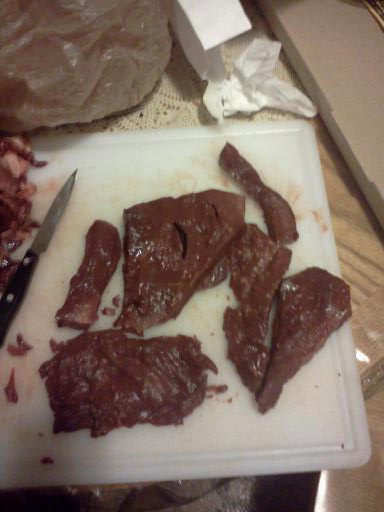
Cut heart into 1 inch cubes up to ¼ inch thick. Toss the pieces in a “healthy splash of balsamic vinegar,” salt, pepper, and fresh thyme. Marinate for 24 hours. Cook on a hot caste iron skillet for three minutes on a side.

The heart, ultimately tasted almost like really good steak tips, or perhaps a beefier version of venison. It wasn't as good as the dishes we'd had at these restaurants, but for our first try, I was pretty proud with the result. What was perhaps most interesting was that the heart managed to be both rich and lean. This is probably why you generally see heart served as an appetizer (at least that's how we've seen in restaurants) as you don't need to eat that much of it to feel satisfied.
With heart at home done, we have liver and tongue to try in terms of less than typical meats we've only thus far enjoyed in restaurants. Hopefully, I'll have come up with clever titles for each of those meals.
Friday, March 25, 2011
My First Meal at Toro
I now know the first time I went to Toro was an important event in my food life. It happened after we'd been watching Anthony Bourdain's No Reservations for a season or so, and long after I read his essays collected in A Cook's Tour (still my favorite collection of food and travel writing). It was about the time Riss and I were thinking about getting a farm share and also, about the time I was learning about the importance of buying local. Along with all of that, I was also cooking more, being more creative with my cooking, and being less afraid of messing up while cooking. In short, the first time I went to Toro coincided with the transition of food from fuel, to an aspect of my culture. It was also, about the time we finally discovered restaurant week.
Toro is a Spanish style tapas restaurant in Boston's Southish end that happens to sit about fifty yards from a rather stark gentrification border. (Guess which side it's on.) In general, it's far too expensive for us to eat there, but Boston (and many other cities) has a “Restaurant Week” (which is really two weeks, but I'm not going to complain) in which restaurants offer a prix fix menu at an alarmingly reasonable price, a little over $30 per person for dinner and a little over $20 per person for lunch. Riss and I chose Toro because we decided to be adventurous with our Restaurant Week meal and Toro offered the most adventurous menu in the city that year.
Looking back on it, this could have been a make or break meal for us, because everything else followed from it. For example, in London we ate at a famous snout to tail restaurant called St. John's Bread and Wine, where Riss and I shared appetizers of calf's heart and bone marrow, I had pan fried calf's liver, and Riss had tongue, all with a side salad that had the best dressing I've ever consumed. (One way to tell a good restaurant; try what they're not famous for. If that's still good, it means they're committed to a good meal, not just a signature dish.) I also had woodcock in London, which tasted a like a slightly leaner, but no less delicious, duck. I've eaten oysters, I've had pho (which might be the world's perfect breakfast) with tripe and cartilage (though, at least at Les, I prefer the standard issue pho with beef round), and squid. On a trip to Chinatown, Riss and I picked out, pretty much at random, a few pastries to try. (Did not go well, but you can't win them all.) At Craigie on Main, a snout to tail restaurant in Cambridge (which mixes some killer cocktails as well) Riss and I got a half a pig's head peking duck style. (One of the best arguments for an anthro-centric deity organizing existence on the earth is the pig. I mean, even it's face is delicious.) And in our freezer now, along with farm share veggies, chili, sauce, and the more traditional cuts of meat we have liver, heart, and tongue (all bought from Jim, I might add).
I have to wonder what my relationship to food would be if that first meal at Toro had been a bad one. Would I have had the conviction to be adventurous again? Would I have gotten something interesting or something safe at the next restaurant I went to? What would I have dared to try in a foreign country? One of the things I've learned since that time is that, if you want to eat interesting meals, you're going to have to bad meals sometimes. Almost by definition, an interesting meal is going to taste bad to somebody, and every now and again, you're that somebody. Even if I knew that then, would I have believed it, if my first adventurous meal was also a bad meal? Obviously, it was not a bad meal.
It was one of, if not the, best meal of my life.
We had tapas dishes featuring heart, tongue, bone marrow, and pork belly. When we finished ordering the waiter was pleased. He said we'd ordered all the good stuff. There is a strange thrill in impressing a server at a nice restaurant; it's like acing a quiz.
I'm going to be honest, I generally find descriptions of the actual taste of food inadequate. Most writers pile approximations on top of each other, hoping accuracy accumulates from equivalents and all writers assume that “buttery,” or “velvety,” or “savory,” or any other taste word means the same thing to everyone. We have an agreed upon linguistic definition for all of those things, but there really is no way to know whether the experiences we actually have are shared in any meaningful way. (A universal problem highlighted by food writing in particular.)
So I won't try to transfer the taste of the pork belly to you, but I will say that with the first bite I had, I thought, “I have to slow down. I have to make this last. This is the best bite of anything I've ever had.” I won't throw comparisons around about the bone marrow in the vain hope that a phrase like, “light smooth salty beef flavored butter” will have any accurate meaning for anyone else. I'll just toss out there that the heart felt like dissolving velvet on the tongue. Because really the particular tastes weren't the important part of the meal. The important part was that I chose to eat adventurously and was rewarded with my first ever food high.
I think the term food high is pretty self-explanatory, but I'll add the term “glowing euphoria” just to make it clear. I'd been a relatively picky eater when I was younger. For the most part, one bad experience could set me off a particular food for years. I don't think I ate hamburger for a decade because I once got something weird in a hamburger. I think by the time of that first meal at Toro, I had outgrown a fair amount of that pickiness. But still, I have to wonder if I would have been brave enough to rebound from a first bad adventurous meal. But I have the luxury of only wondering. Now, Riss and I got to Toro once a year.
Friday, February 25, 2011
Chili of the Americas
There are tons of benefits to getting a farm share; your food based carbon footprint drops, you get to know the person who grows your food, you support the local economy, you get high food value for your dollar, the food is fresher and, thus, tastier, than anything you can buy in the supermarket...but there are challenges as well. Most of the time, people decide what they want to cook and then buy the ingredients. With a farm share, you get the ingredients and then have to figure out what to do with them. Sure, it means that every now and again I wanted to set a pile of lettuce on fire and order a pizza, but sometimes Riss and I developed recipes that have become some of our favorite meals. This one Riss did that she calls “Chili of the Americas” because it's a chili recipe that uses the “Three Sisters” of North American cooking; squash, corn, and beans. (Though, chili itself is a North American dish, so the title is a bit redundant, but, hey, it's got to be something other than just “Vegetarian Chili.”) This is adapted from a meatified chili recipe (Double Beef Chili by Living Cookbook) we got from a friend.
2 tsp vegetable oil
2 onions, diced
2 cups shredded pumpkin or hard squash (butternut works best, but most others would be fine)
1 cup pumpkin or hard squash cubed
1 cup corn (frozen is okay)
1 cup potatoes cubed
1 cup medium to mild peppers chopped (I’ve used cubanos, poblanos and/or banana peppers, but you can use green ones as well)
4 jalapeno peppers, diced
3 cloves garlic, minced
1 Tbs cumin seed
1 tsp salt
1 tsp cayenne pepper
1 tsp oregano
1 tsp coriander seed
4 oz tomato paste
10 oz stock
1.5 Cups diced tomatoes
1 Cup Strong Coffee
1 Cup Dark Beer
38 oz kidney beans canned
38 oz mixed beans canned (black, pink, navy etc)
1/4 Cup brown sugar
1 Tbs cocoa powder
1 In a large pot heat oil over medium heat. Fry onions, all peppers, garlic, cumin, salt, cayenne, oregano and coriander until onions are softened, about 5 minutes.
2 Add shredded pumpkin, tomato paste, stock, tomatoes, coffee, beer, kidney beans, sugar, and cocoa. Bring to a boil. Reduce heat, cover and simmer, stirring occasionally for 1 hour.
3 Add all the remaining vegetables, simmer for 30 minutes
4Add remaining beans; simmer 30 minutes.
5 Serve with corn bread and shredded cheese.
(also makes amazing chili fries)
As long as you use vegetarian stock (and I highly suggest making your own, but that's another post) this is vegetarian, and if you leave out the cheese (though I'd add a little extra salt when serving) it's vegan, and if you simply must have meat in your chili adding some ground beast or cubed beast, browned first, during the first hour of cooking won't be bad, but might stand out texture-wise at the end. (And I think you can go without meat for at least one meal, especially one this damn tasty and hearty.) You can adjust the heat by adding more or less jalapenos, or by removing more or less of the white ribs on the inside of the jalapenos when you clean them (for that is where the heat lives).
This recipe is also easy to upscale. Riss and I tend to make in “vats” and freeze portions of it, so we make it one afternoon and it eat periodically for months afterward. It's a few hours total of cooking and prep, and we end up with a bunch of microwavable meals. (Which we sometimes, as noted above, slather over fries and under shredded cheese. Often late at night.)
Friday, January 28, 2011
Never Buy in a Store, Part 1
There are plenty of foodstuffs I would never consider making from scratch. Philo dough pops immediately to mind. The techniques required are too complex, the ingredients are too hard to find, and/or it would take just too damn long. However, for the past thirty years or so, advertizing has turned all cooking into an unholy inconvenience, making all food that requires preparation beyond “peel skin off banana” not worth your time. Like so much in this world, the problem is not that there is processed food, but that processed food dominates the market, even when the those foods don't actually save that much time. Simply put, there are some foods whose from-scratch preparation is so quick and easy, they might as well be “Open and serve.” One should never, as far as never goes, buy these from the store. Food number one in this category: guacamole.
The hardest and most time consuming aspect of making guacamole is extracting the avocado flesh. If you've never done it before, it can be intimidating, but that's what the internet is for.
At most, extracting the flesh of a couple avocados will take you five minutes or so, but it will take less time each time you do it. Then you mash up the avocado with some salt and lemon juice. Then you dip your chips in it. That's it. Watching your salt intake? Add less salt. Like a little heat in your dips? Add some cayenne pepper. By making it yourself you have complete control over the product. Furthermore, guacamole in the “wild” doesn't have much of a shelf life. I mean, if you delay in adding the lemon juice, the guacamole will go brown on your quickly (still edible just doesn't look as good). This means that something must be done to it, in order for it travel from wherever it was manufactured to the grocery store and then sit there long enough for someone to buy it. I'm not saying that anything dangerous is done or that you are automatically going to get cancer or autism or whatever from the preservatives, but I will say that none of those techniques and preservatives have flavor in mind. Your guacamole will absolutely taste better than anything bought at the store.
Some food takes a long time to prepare and buying processed versions of them can make sense. Furthermore, there are plenty of “processed foods” whose process is fairly mild. But with guacamole, and the other foods I'll mention in this ongoing essay series, at most, you save five minutes. And the better you get at dispatching the avocado, the less time store bought will save you. As I've cooked more, I've found more and more foods that aren't much harder to make at home than to buy from the store, and the homemade stuff is almost always cheaper and tastier.
At some point in our nation's history cooking turned into an inherent inconvenience. It's not that certain techniques are challenging, or certain dishes require specialized hardware, or certain foods demand lengthy efforts, but that all cooking is a hassle. (Don't worry, there's a big essay about how we got to this place in the works, or maybe, worry, there's a big essay about how we got to this place in the works.) Our ability to differentiate between “inconvenient” and “requires some effort” has been advertized out of us. The problem, then, is not picking up some guacamole on your way to the party because you forget to make some at home, but our attitude towards cooking in general.
We have a long way to go to free ourselves of this fetish for convenience. The real goal is not to always make everything from scratch all the time, but to get to a point where the convenience of a store bought food is a real value and not just a way to avoid the inconvenience of cooking at home. It's so that you feel positive when you throw something in the microwave and not a sense of obligation. We have a long way to go to reach that world, but it could certainly start with your homemade guacamole.
Friday, November 19, 2010
It's Food. You Eat. Why Not: Pick Your Own 2010
Any time you begin feeling smug about the accomplishments of humanity; space stations, microwaves, that kind of thing, remember, for humbleness sake, all of the activities in the world that are still weather dependent. There are the obvious ones like picnics, hikes, and spectating outdoor sporting events, less obvious ones such as long drives, job interviews (nothing like 95 degrees and humid to make anyone look disgusting) and commitments to reading major Russian novels over the winter (Just try it during a mild winter. It's possible but far from ideal.). For all our art and science, for all of our ability to control some of our environment, for all of our technological advancements, there are still events, essential or important, in our lives that can be dramatically affected by the weather.
Every year, at the end of the farm share season, our farmer (Steve) lets farm-sharers (?) pick their own vegetables on a Sunday after or around the last farmer's market at which he sells. It's a chance for us to see where our food comes from, to experience a sample-size of some of the toil that goes in to feeding us, and to take a whole bunch of food, essentially for free. Americans, in general, are so isolated from our food, that a yearly field trip to pick vegetables, whether you participate in a CSA or not, seems like something close to a civic duty. And it's a chance to eat a leaf of arugula you picked seconds earlier.
But, even though we've put a man on the moon, can accelerate particles to virtually the speed of light, and have most likely found water on Mars, the weather can really bring down a pick your own day. Nothing says “Let's just eat take out for the rest of our lives,” quite like a cold rainy day spent convincing yourself you have a political and fiduciary obligation to stay outside, be cold, and pick vegetables. This year, however, the weather was perfect. It was just warm enough that one (well, one with Viking heritage, at least) could get by without any heavy layers of clothing and cool enough that one could be comfortable in the pants and long sleeves that serve other vegetable picking purposes. Furthermore, the sun had reached at least the minimum level of brightness for the lizard part of my brain to believe it was a day worth leaving the den for, but it was never so bright that I wanted sunglasses. (Important, since I didn't have any.) I could certainly sympathize with our farmer if he spent most of the day grumbling about all the wet, dark, cold, miserable mornings he'd spent over the season picking our vegetables, while we come down for one day, one freaking day, out of the entire summer and get an absolutely perfect day.
I was sent off, with a shovel and a pair of shears as my particular implements of destruction, to the rented field a little ways off with the expressed goal of digging potatoes. At one point, I was actually running with the bucket and shovel, with the shears in my pocket, to hop in the back of a pick-up truck for a ride over to the field. I was willing to go alone because I had a great ambition to think while digging potatoes. I'd never thought while digging potatoes and since I'm an intellectual, and one way to define an intellectual is as an individual who finds new situations in which to think, I was oddly excited by the possibility. (Anything can be romanticized if you have enough time to prepare.) I had hoped that, much like the vibrant intellectual productivity of the long walk or at least the active stillness of splitting wood, digging potatoes would provide me with some kind of ancillary intellectual productivity; maybe formulating a few topics for this very blog, or solving some problems in other writing projects, or maybe some kind of intellectual progress with the books I was reading. Such was not the case. Though my brain was not a void during the harvest; I spent about an equal amount of time concerned with the practicals of digging potatoes (is that mold or intransigent dirt?) and thinking about what I should be thinking about since I'd been thinking for a week about the chance to do some thinking while I was digging potatoes.
If there is one empirical, unquestionable fact one learns from a pick your own day, one life lesson that persists in the varying circumstances of existence, it's this: the volume of your vegetables is variable. You'd think, being physical objects (massive in the particle physics sense) they'd stay the same size regardless of time of day, state of pickedness, size of your car's trunk, or capacity of your freezer. Vegetables are not supposed to change size, unless something dramatic involving blades and heat is done to them.
But they do. When you're in the field staring at the bounty of a farmer's labor stretching for lush yards around you in the knowledge that nearly all of that food is slated for compost, it looks like one could always use another bag of chard, another few potatoes, another stalk of Brussels sprouts. At the car, it looks like either one of your friends or one of the buckets of parsnips will have to be left behind. Of course, once you've Tetrised everything into the trunk, the vegetables shrink again and you consider, just for a second, running back for another handful of carrots or another bunch of beets. It's food. You eat. Why not.
It would be a far cry from exaggeration to say that the vegetables simply triple in size once they get to your kitchen. Vegetables you don't even remember picking appear at the bottom of bags and buckets. You didn't even see fennel anywhere and there some is, right under some turnips you're already regretting. You start to feel that particular strain of melancholy that mixes regret with exhaustion. However, a little blanching and freezing and a couple of beers later it seems like there were hardly any vegetables at all and you feel that particular strain of melancholy that mixes a resurgence of vitality with regret. Newton was wrong. Everything is quantum. And picking the cilantro leaves off their stems after all that damn near killed me.
Whether it's the weather (Everyone catch the Simpsons reference? Good.) or the labor, there is something primal in the satisfaction nestled in the soreness in one's lower back after a day spent picking the vegetables one plans on eating for the next six months. One has taken active, direct responsibility for one of the few things one absolutely needs to do. I'm sure I'll have a slightly different perspective after another bag of frozen kale for dinner in February, but then I'll dig up all the political, cultural, and socio-economic reasons for getting a farm share. For now, the greens are still fresh, my back is still sore, and pick your own 2010 was still a good time.
Subscribe to:
Posts (Atom)
