Showing posts with label Recommendations. Show all posts

Wednesday, September 13, 2017

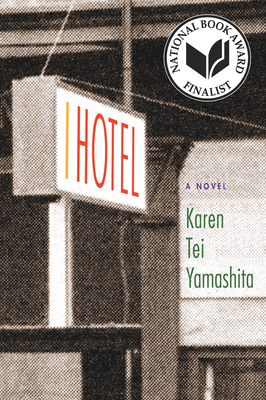
I Hotel and the Canon of Massive Postmodern Novels


When I create canons in my head (you all do that, too, right? Build hypothetical syllabi as a way to organize all the books that are special to you?) I have a category for the great Massive Postmodern Novels, that particular type of doorstops of stylistic experimentation, paranoia, bombastic imagery, and existential unease written in the late 20th and early 21st century. Given that you can draw a pretty straight line from some of my all-time favorite books (Don Quioxte, The Life & Opinions of Tristram Shandy, A Gentleman, and, of course, my good friend and yours, Ulysses) to the Massive Postmodern Novel, and that I generally like a challenge in my reading, it makes sense that I would have an affinity for this sub-genre. And I doubt my personal canon is all that different from other fans of the genre. I think there would be broad agreement that, if we're working in trinities, the holy trinity of Massive Postmodern Novel would probably be something like Gravity's Rainbow, Infinite Jest, and Underworld. But, really, who needs trinities?

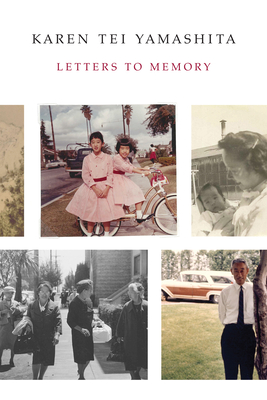
With re-issues of her books Through the Arc of the Rain Forest, Brazil-Maru, & Tropic of Orange and a new book exploring her personal history including her family's internment during WWII, (which is stunning and brilliant. More on that in a Reading is Resistance post later) I think it is now time to elevate Karen Tei Yamashita's I Hotel to that pantheon of great massive postmodern novels. It has everything those other great novels have. Like Life: A User's Manual (which would probably be in my top five of massive post-modern novel), it uses a building, rather than a series of events or the arc of a character's life, as its center of gravity; like Gravity's Rainbow and Underworld, it uses its center of gravity to explore a rapidly changing society, and the political and cultural conflicts such change creates and/or is driven by; like Infinite Jest and much other postmodern literature, it experiments with the format and style of storytelling with sections formatted as comics, plays, film scripts, philosophy, textual representations of dance and jazz performances, and more. Finally, like nearly all of postmodernism, I Hotel also explores how meaning is made, directly concerning itself with not just telling a meaningful story, but exploring how stories become meaningful. And, as should be obvious by now, its massive. And it's brilliant.

I think there are a lot of reasons why postmodernism lent itself to these massive novels and exploring those reasons a bit will, I think, only heighten our sense of the importance of I Hotel.
Without conventions of plot and character, authors can explore just about anything; they can delve into ideas, they can play with images, they can follow digressions. They are allowed to fall into the black hole of human consciousness and root around for a while. (Sometimes is seems like about half of Gravity's Rainbow is just Pynchon seeing how far he can push an image.) That stylistic freedom also allowed writers to include experiments in form, style, and content in addition to the main plot of their book. To put this another way: a massive amount of exploration is possible when you are no longer beholden to move the plot or character development from point A to point B and some writers put as much of that exploration into single works as they could.

Furthermore, after WWII, artists found themselves, very suddenly, with an entirely different world than was known, experienced, and explored by even just the previous generation. 1927 and 1947 might well have been different planets (at least in the industrialized world) and the same for 1947 and 1987. The nuclear age. The age of mass communication, mass media, and mass entertainment. Electricity in nearly every American house. The shrinking of the globe through advances in transportation. Not only did writers find themselves with a freedom to explore longstanding universal aspects of the human condition in totally new ways, they also found themselves with entirely new human experiences to try and wrap their minds around and then present to the public. And, of course, the technology and economics of writing and publishing massive works changed. Especially in the postwar boom in the United States, publishers could afford to publish 900+ page books and many readers could afford to buy them.

One of those new conditions, at least for the authors of the books I mentioned in my trinity, was that, with the atom bomb and the Cold War, white dudes found themselves existentially vulnerable to distant powers fundamentally indifferent to their personhood.

In some ways, the massive post modern novel (as it has been generally discussed at least) is the story of white men discovering and processing the kind of vulnerability everyone else dealt with forever. This isn't “I might get killed in battle,” or the “I might be killed by the elements” that men have fetishized over the years, but the “I might be just minding my own business and have my life ended or destroyed,” kind of vulnerability that creates a persistent sense of dread that enshrouds nearly everyone else's lives. With the earlier conflicts, ma dudes felt an inherent element of agency in the risk that surrounded their stories and themselves. If they died in the wilderness, it was because they went into the wilderness and if they died in battle, it was because they went to war, and if they were assassinated by their government, it was because they were revolutionaries. Even the randomness of dying from disease you can at least partition into forces beyond humanity. But with the nuclear bomb, the Cold War, and the paranoia from the Red Scare forward, ma dudes found themselves in a world where another human could cause their meaningless death, where the mistake of another dude could kill them, where they had no agency whatsoever in the vulnerability that surrounded them. Person-driven impersonal death was something new to them. Essentially, they found themselves in an entirely new environment of personhood at the exact same moment when they were also free to write about that new environment without any stylistic or material limitations. There is a reason why DeLillo constantly returns to the image of Lenny Bruce screaming “We're all gonna die,” during his stand-up sets during the Cuban Missile Crisis in Underworld.

Narrative and economic freedom plus a slow-motion apocalypse following WWII and Ulysses plus a new world of technology is bound to produce a trend of doorstops.

Everyone experienced that radically changing world, not just the white people who had control and access to those changes but, those changes meant different things and felt differently to people outside the hegemony. (I mean, in terms of daily, personal, emotional experience, how different is the dread of being beaten to death because someone thought you looked at a white girl for too long from the dread of wondering if Russia would launch a nuclear attack?) For example, The Cold War between the United States and the U.S.S.R looked a lot different to those living within the United States who did not benefit from those freedoms capitalism was supposed to enshrine. Despite the atrocities committed by the U.S.S.R and communist China, you can see why there would still be appeal to the idea of an international union of those oppressed by colonial and capitalist systems for those who were still essentially experiencing colonialism. WWII made a certain kind of democracy safe for a certain population of people (I might have to add “for a certain amount of time” but our descent into fascism isn't certain yet), but if you were not a beneficiary of kind of democracy or a member of that certain population, the conflict you faced was not between “communism and capitalism” or “communism and democracy” or even “fascism and democracy,” but, quite often, between “racist and colonial systems of power and your own life and the lives of those you love.” Perhaps this is one reason the massive postmodern novel tended to be written by white dudes: that mode of expression just fit their experiences in way that it did not necessarily fit the experiences of other people. (Makes me wonder what would come from an examination of the differences between Baldwin's essays and Wallace's essays.)

I Hotel hits every aspect of the massive post-modern novel; the massiveness (600+ pages but at a large trim size), the stylistic experimentation, the presence of the Cold War and its attendant paranoia, the interaction with new technology, the referencing and re-mixing of existing myths and works of literature, and even an exploration of that new Cold War vulnerability, but it hits all of those aspects from a different perspective than Pynchon, Wallace, and Delillo. It's also, just like these other three books, a lot funnier than you would expect and far more heartfelt than a lot of readers expect from postmodernism. There are love stories. There are family stories. And, just like the others, there are stories of regular people trying to figure their shit out in this crazy ass world.

But that different perspective makes I Hotel especially important as Yamashita writes from a long standing awareness of that environment of personhood. Which is also, probably why the politics of I Hotel, unlike the swirling diffuse explorations in Gravity's Rainbow, Infinite Jest, and Underworld, are direct and overt. I Hotel explores the Civil Rights movement directly from the Asian American perspective, depicting the intellectual exploration and activism of various Asian-Americans (a term she also explores) and their allies in San Francisco in the 60s, 70s, and 80s. Where ma dudes approached politics obliquely or through strange lenses and situations, Yamashita interacted with it head on. Which, of course, is part of why I Hotel belongs in this canon. For as much, as the 20th century was defined, for certain populations, by new technology and Cold War paranoia, for many other people those currents were subplots in the story about the fight for Civil Rights. I Hotel is intellectual and stylistic free play with the other major story of the 20th century besides Cold War paranoia and technological advancement beyond the human spirit: the postwar fight for Civil Rights.

Finally, one of the defining techniques of postmodernism is significance through juxtaposition. Whether it is through painting a soup can, remixing a song, or creating a pastiche through references, part of what made and makes postmodernism important is it's ability to bring disparate images, ideas, and experiences together to reveal underlying similarities and create new meaning. In many ways, I Hotel's fundamental technique is juxtaposition. Not only does she put different styles next to each other, and different life experiences next to each other, she also frequently juxtaposes other materials with her original work. In one particularly effective passage, Yamashita frames the story of a young, revolutionary couple as the woman dies of cancer with passages from Ferdinand Marcos's declaration of martial law in the Philippines and excerpts from an interview with Imelda Marcos. Cancer as an easy metaphor is completely re-appropriated into something that speaks to the internal tension of scales of injustice, to be blessed and burdened with a body while being blessed and burdened with a revolution, to know you are just one person living one life while also knowing that everyone is just one person living one life. Through this Yamashita is able to question and confront some of the stereotypes of “revolutionaries” without apologizing for the consequences of devoting your life to “revolution,” whatever that is.

When done well, juxtaposition as a literary technique turns a work into a sort of apartment building. Through the coincidence of place, with every incident being a story in and of itself, apartment buildings juxtapose the lives of strangers, creating a space that speaks to the shared experience of being a human being. By making juxtaposition a central technique around a central image of itself, and by setting those juxtapositions within the Civil Rights and revolutionary movements of the late 20th century Yamashita creates one more powerful juxtaposition, a juxtaposition sorely lacking from the other books in my canon, that speaks to a much broader human experience than is represented in ma dudes' great works, and that, potentially, paints a different way forward, both in terms of society and in terms of whatever follows postmodernism: vulnerability and power. There is probably a way to describe I Hotel as the story of the fraught love affair between vulnerability and power.

Canons are strange things. For most of our history they have been weapons, tools to assert the dominance of a certain type of expression by a certain type of person and hide everything else from the public view. They have been soldiers for hegemony. But at the same time, there is value in sorting, organizing, and even classifying human creation. There are too many brilliant, worthwhile books for any one person to read them all, so we must create tools that help us choose what work of genius to read next. Canons can be tools for the moment of selection. Furthermore, though I think there is value in reading as diversely as possible as an individual, I think there is also value in widely shared books that can act as cultural touchstones, books that, when we meet new people, we can be fairly confident they've read or are at least aware so we have something of substance to talk about.

That our current canon is so skewed by white supremacy and misogyny does not mean there is no value in an “American canon” or, even better, “American canons,” but that we must continue the process of rebuilding our national, mainstream, literary culture to better reflect the diversity of identity, style, and expression actually produced by our culture. A lot of this work has already happened and continues to happen and we have already seen great changes in what is considered “American Literature.” But the work continues. I hope elevating Yamashita's I Hotel can be part of that work.

Tuesday, August 2, 2016

Three Books in the Postmodernism's New Playground: Luiselli, Velazquez, Boucher, and the New Postmodernism of Play

Literary movements have fuzzy edges. For all the time-lines, significant events, and multiple choice tests, it is almost always impossible to say when a movement begins and ends. You can find traces of it (modernism for example) decades before it arrives as a coherent movement (in say, Emily Dickinson's poetry) and it's primary characteristics can continue long after the movement itself is formally over. (There are plenty of writers still writing Romanticism.) The fuzzy-edge-ness of literature is even more pronounced in postmodernism because, in a way, its entire purpose was to fuzzy the fuck out of those edges until all borders, definitions, forms, and assumptions were destroyed. So it's natural that, even after its reported demise and even after artists, writers, critics, and scholars have begun building the literature that will replace it, postmodernism is still being written.

Perhaps my favorite idea that came from postmodernism, and deconstruction specifically, is “freeplay;” Derrida's idea of the motion and tension among the various elements of existence once the assumed centrality of humanity is removed. To Derrida this wasn't exactly “everything's fucked so now we can do whatever we fucking want,” but it was close. To me, the important part of the term isn't the “free” part, but the “play” part. The way I've come to think of the term (apologies to the critical theorists who have studied this way more than I have) is that we are now allowed to interact with the substances of creation in much the same way children do; by trying different things, assigning opposed uses to objects, shuffling identities, sticking weird shit in our mouths and, in general, joyfully fucking around with whatever comes to hand.

Now that we're firmly on the other side of the Cold War and its paranoia, have shifted irony from a fundamental building block to a tool in the writer's arsenal, and started listening to new voices and new experiences besides those of white men, we can finally start playing in the space postmodernism opened up in literature. There are three books in particular that I've read recently, that I think exemplify the new postmodern playground; The Cowboy Bible, Golden Delicious, and The Story of My Teeth.

It's hard to say what The Cowboy Bible is. There are good reasons to call it a short-story collection, though I think there are better reasons to call it a novel. It is a chaotic assortment of events and characters of places and foods. I imagine Velazquez standing in the middle of a tornado naming everything that whirls by his vision and calling the resulting list a book. But, of course, sometimes he doesn't feel like giving the real name to a person, place, or entity, and so he assigns the phrase “The Cowboy Bible,” to various disparate narrative entities.

I'm writing as if I understood The Cowboy Bible, but I really didn't. It's one of those books that you just let wash over you, almost an ambient reading experience where you don't enjoy the specifics so much as you enjoy the sense of being washed in words. I'm sure there are ways to sort through the burritos and the luchadores, to assign systems to the bars and eating contests, to develop a symbolism structure for the boots and the bibles, but Velazquez creates an experience where understanding, reading, and critique can be distinct from sense and logic.

You could describe Golden Delicious by Chris Boucher as the book Jasper Fforde (author of the Thursday Next series) might have written if he got super into Borges and Calvino, but desperately wanted to write the next Revolutionary Road. In another way, Golden Delicious is a fairly straight-forward story of coming of age in suburbia; the narrator is born into a nuclear family with a mother, father, and older sister, and, as he grows up, the family changes, erodes, and breaks down while economic forces produce a similar decay in the town itself.

Except this town is made of pages, is tended by The Memory of Johnny Appleseed, the houses have personalities and so do the cars, the figures of authority are traffic cones, sentences run wild, Reader ends up being the hero, and the narrator's name is “_____” pronounced “Underline.” The result is a dire whimsy. Or perhaps a whimsical malaise. Boucher is able to describe the kind of urban decay you see in a work like Matt Bell's Scrapper, but give it a sense of playfulness. To the characters, the described events are just as dire and depressing as any gritty urban crime story, but, because of the lexicon Boucher applies, to the reader (and “Reader”) it is something quite different. Which is exactly the point of freeplay. An artist can now bring together entirely opposed ideas; she can put her GI Joes in dresses and pretend they're professional ballroom dancers.

I've written about Luiselli's work before and if all goes well, I'll write about her work for a long time. Even though we all know about self-plagiarism now, I need to include The Story of My Teeth in this post as well, because its sense of utter joy in the act of arranging language for readers inspired my sense of freeplay in this new postmodernism and it's through my attempts to describe Luiselli's freeplay that I began to think about the new postmodernism as a playground.

I often wonder how useful the idea of literary movements actually is to reading. The more you study or explore a literary movement, the harder it is to create stable definitions. The closer you look, the more fractures you see. As your circle of reading widens over the course of your life, you find books that should belong that don't, books that don't fit neatly into any one category, and books that predate the movement they most resemble (sometimes by centuries, hi, Tristram Shandy!). You can have multiple movements running into each other, overlapping, in direct conversation, sometimes in the same writer or even in the same book. Though movements can be handy when trying to reduce the scope and diversity of human literary experience to multiple choice questions with stable answers, I think we have to wonder whether they actually help readers experience the actual books they are reading.

When thinking about this before, I wondered if it makes more sense to understand literary movements as cities; spaces in which writers and readers can mix and move with a level of freedom, but the more I think about it, the more it seems that the term “literary movements” actually means two very distinct ideas: the experience of the writers themselves and the critics and readers actively engaging in the avant garde and the experience of readers looking for a foothold into understanding a particular work or author.

For the first use of the term, the image of the city works well enough, but for the second, I think of the wooden scaffolding used to support arches and other buildings during the construction. The wooden arch is not the real arch, just like saying a book or an author is “Romantic” or “Modernist” is not a real understanding of the book or author, but it can be a support that lets the reader move on to a deeper understanding. Just because the wooden arch was removed, doesn't mean it was pointless.

When I think about what it means to be a reader and a writer, “freeplay,” is all about how I build my understanding of the world, how I gather the resources of my belief, and how I try to make words do and say things that words really aren't capable of doing or saying. In a way, you could say that all writing is a struggle to express those ideas, emotions, and experiences that are, inherently, beyond our outside of language. From that perspective all books are failures, but they can be productive failures. In this new and chaotic world of literature, these three books are the best kind of productive failures; you have so much fun, you don't really care about reaching the goal at all.

Tuesday, July 5, 2016

New Galleys June 2016

Some day I will be able to read all the galleys I want to read and give the appropriate attention to all the good books that cross my path, but that day will probably require feats of science that spit in the eye of god, and though, I'm as into abominations of humanity's hubris as much as the next guy, that day isn't coming any time soon. But every now and then I can let you know about the galleys I've come across that I'm excited about, even if I never get around to reading them and even if I don't write about them as much as they might deserve. So, for those of you versed in the dark arts of Netgalley and Edelweiss, or really into adding stuff to your various TBR lists, here are some recent galleys to look for. 


The Hidden Keys by Andres Alexis

Andres Alexis' previous book, Fifteen Dogs, was just about the most critically acclaimed book in Canada when it came out and The Hidden Keys is his follow up. Some keywords in the plot summary: expert thief, dive bar, stolen diamond, hidden fortune, mementos, fake-German artist, a detective, philosophical concerns, Treasure Island. I assume I'm not the only bookseller who scanned the publisher copy and said, probably far too loudly for the comfort of those surrounding them, “Holy fuck! Well, then...”


Ema the Captive by Cesar Aira

Aira is on my personal Nobel Prize shortlist (with Anne Carson, Sherman Alexie and a few others) so I always look forward to his next book. At 128 pages, this is a hefty work for Aira, whose books usually clock in well under that. According to the summary, this also seems to be a bit darker than Aira tends to be, centering around a kidnapping, rape, and then sex work. But, of course, with Aira, the summary generally tells you nothing of importance about the book. Perhaps more than any other writer, Aira captures the logic and motion of dreams; where you begin has nothing to do with where you end and somehow it all fits together.


The Poem is You: 60 Contemporary American Poems and How to Read Them by Stephen Burt

Some day, when I'm an eccentric millionaire and I have the time and money to write whatever I want whenever I want, I'm going to write books like this. There are some mildly grandiose claims on the back of the book about how it will guide readers through the fractious world of contemporary poetry, but I bet Burt just loves these poems and thought it would be rewarding to write about them.


And that is fucking awesome. Criticism isn't always about applying some preexisting theory to some work; it's also about how people read books and poems and the processes through which those poems become a part of someone's life. Furthermore, people are reading new books now, and so there should be criticism about new books now, beyond the initial reviews and the Amazon rating. New books deserve serious, book-length criticism as much as the old standards (do we really need another book about Jane Austen?) so, regardless of what happens next, I'm psyched to see this book exists.


Sirens by Joshua Mohr

I'm not much of a memoir reader. It's not that I have anything against memoirs per se, I'm just not much of a memoir reader. But I am a Joshua Mohr reader (Once you've finished noting down all these galleys go get yourself Damascus.) and so have read some of his personal essays already. And they are great. So that tells me his memoir is a book to be excited about.


Thrill Me: Essays on Fiction by Benjamin Percy

“There really should be a collection of craft essays by someone who wrote a literary werewolf novel,” is something that all of us should have been saying for a long time. It is really interesting watching some very old, obsolete zombie ideas finally trundling towards the whirring chainsaw of progress, and the idea of “literary” and “genre” as qualitative rather than descriptive terms is one of them.


The distinction between “literature” and “genre” writing hasn't been meaningful, well I was going to say “since at least critical theorist Umberto Eco's The Name of the Rose,” but the more I think about it, the more “literature” and “genre” writing have always co-existed (Hey, look everyone, it's Frankenstein and "The Murders of Rue Morgue!") and the distinction seems to have been created mostly as a way for certain people (you know who) to justify their favorite books as factually better than other books.


Which is a long way of saying Thrill Me sounds awesome. Literary nonfiction is having something of a moment and I'm glad that moment is beginning to encompass more than just the personal essay. (Which is not a knock against the personal essay. You've all read Jamison, Nelson, and Als, right?) As I mentioned above, there is so much room for criticism to grow into the conversation among readers, writers, and texts it was always meant to be, and Percy's Thrill Me might be a part of that growth.


The Story of a Brief Marriage by Anuk Arudpragasam

This debut novel is set during the course of a single day in an evacuation camp during the Sri Lankan Civil War and follows a young man who has been asked to marry an old man's daughter. This was personally recommended for me by Michele Filgate, who I will always think of as a fellow member of the Valeria Luiselli vanguard, so obviously it needs to go on this list of new galleys.


Scratch by Steve Himmer

Fram managed to blend the spy novel, adventure novel, office novel, and domestic drama into a delightfully quirky tale about following your dreams that is also, in a way, one very long pun on the phrase “The Cold War.” (And I am a big fan of the dark art of the longform pun. See also: Tristram Shandy.) With a stranger coming to town only to discover said town featured a shapeshifter known as Scratch, Himmer's new book seems like it's aiming for that similar interstitial ground, with perhaps and extra dash of Victor LaValle and maybe a pinch of Tristan Egolf as well.

Thursday, June 23, 2016

Massive Books Addendum

Oh cruel fate, who waits until I have composed and posted a piece about massive books to put before me a massive book that I had been, lo these many long years, in search of for my own edification. The worst thing about blogs (Twitter, Facebook, self-publishing, etc.) is that bloggers can just put up whatever they feel like and the best thing about blogs is that the bloggers can just put up whatever they feel like. So here is my one book addendum to my massive books post from last week.

The Mysteries of Paris by Eugene Sue

When I realized I was writing a mystery/detective novel, I started digging deeper into the genre, learning more about its roots and reading more the pulp fiction that drew me to the form in the first place. I was already a fan of Edgar Allen Poe's detective stories (which are fucking quicksilver), the hardboiled Americans and Sherlock Holmes, but I wanted to know more. I wanted a deeper well to draw from as I played with the genre.

One book kept coming up as being a major early influence in mystery, detective, and pulp fiction, a serial novel set in the Parisian underworld: The Mysteries of Paris by Eugene Sue. But, despite being a smash bestseller in France (think of it as the equivalent of Dickens' serials, but perhaps even more popular) a major influence on Victor Hugo's Les Miserables, a fundamental work in terms of politics (again, much like Dickens) and a major part of French literature, including (I suspect at least) influencing Jean Genet, it wasn't available in English.

On the one hand, it was kind of shocking to be unable to find a reliable edition of what was so clearly an important book, but on the other hand, part of its importance made it particularly difficult to translate. Sue included argot, the dialect of the Parisian underworld, a dialect so distinct, he included footnotes to translate the argot for his French readers. Essentially, the translator has to translate two entirely different versions of French and to somehow do it while communicating how foreign each of the Frenches is to the other. It is a daunting task that forces a number of difficult decisions. Oh, and as, you've gathered, it's massive. As I finished the research for my detective novel and moved on to other projects, The Mysteries of Paris slipped to the back of my consciousness. And then, right after I post about massive books, there it is in the store's mystery section. There might have been a yelp of joy.

So, if you're a fan of pulp fiction, social realism, Les Miserables, slang, argot, crime fiction, stories with characters named Slasher and Schoolmaster and Songbird and Rudolphe (think you can spot the rich one?) that opens with a fight in an alley, and, of course, massive books, The Mysteries of Paris is another to add to the tower.

Wednesday, June 15, 2016

Five Massive Books to Have on Your Radar

Though I can't say for sure why, I love massive books. They're so ambitious and so labor intensive that I'm automatically rooting for them to be good. Furthermore, there is something, almost comforting to me, to read a book over a long period of time rather than just crashing through it, to have it weave its way through my life. In some ways, a massive book is like you're favorite diner, you don't necessarily eat there every day, but it's nice to know it's there for you. Some of my favorite massive books, I've been reading for years, sometimes going months without picking them up (Parallel Stories, Earthly Powers, The Dying Grass, Ulysses) but always eventually returning to them, either as palliatives between other books or just because I feel like it.

I don't always need to be reading a monstrosity, but I'm glad I live in a world where writers are writing and publishers are publishing cinder block sized novels. So, here are four new and forthcoming massive novels (in ascending order) to keep on your radar.


The Last Samurai by Helen DeWitt

If there can be such a thing as a “buzzed about out-of-print book” then DeWitt's 2000 debut is a “buzzed about out-of-print book.” Her second book Lightning Rods is a deeply unsettling, pitch-perfect satire of corporate culture. She had another book called “Your Name Here,” that may never have found a publisher that was a stylistically chaotic post 9/11 novel. So it was somewhat baffling that her absolutely adored cult classic would remain out of print. And yet it still took a few more years for New Directions to finally bring The Last Samurai back into print.

In The Last Samurai, Sibylla makes three fateful decisions regarding raising her son Ludo; to raise him without his father (and with good reason if she's to be trusted as a narrator), to use The Seven Samurai as her short term solution to the absence of positive male role models in Ludo's life, and to educate him (roughly) in the tradition of John Stuart Mills and Mr. Ma (famed cellist Yo Yo Ma's father). The result, so far, is somehow, Helen DeWitt is able to cast a kind of literary side-eye at those few pedants for whom the recitation of a catalog of esoteric data counts as knowledge while celebrating the real joy and fun that comes from knowing things. The narrative voices are infectious and the style and formal inventiveness are just familiar enough, that I think this might be the perfect book for someone who doesn't read a lot of experimental fiction, to try to stretch themselves a bit.


Gesell Dome by Guillermo Saccomanno

I had just gotten back from BEA, so the last thing I needed in my life was another galley. But then I got back into the bookstore and saw this massive galley described as “True Detective through the lenses of William Faulkner and John Dos Passos. Throw in “dozens of sordid story lines...various murders, corrupt politicians and real-estate moguls, and the Nazi past,” and the fact that Guillermo Saccomanno is a two-time winner of the Dashiell Hammett Prize and “Argentina's foremost noir writer,” and well I had no choice but to add this 616 page doorstop to my pile.


The Familiar: Vol 3 by Mark Z. Danielewski

After having read the first two volumes I am still on board with Danielewski's massive serial novel. Near the end of volume 2, there were some signs of the various threads of the story being slowly woven together and I'm excited to see how (or even if) that continues in vol 3. One advantage The Familiar has in this list, because of Danielewski's particularly visual style, for being as massive as they are, the volumes in The Familiar read rather quickly.


Jerusalem by Alan Moore

So far, Alan Moore, one of the greatest comic book and graphic novel writers, seems to be expressly writing against the visual limitations of sequential art. The imagery that he is using (and there is a lot of it) is driven by the fluidity of the reader's imagination, aiming for a dynamism and expansiveness that is just not possible when a visual image is fixed on the page by an artist. At times, it feels like Jerusalem is a collection of everything he tried to do in comics that his artists or editors told him was impossible.

Though I can see some (maybe even many) readers not having the patience for his philosophical flights of imagist fancy, to date I find the style oddly intoxicating. To me there is an almost thrilling beauty in images I can barely wrap my mind around, so a strange emotional and intellectual state is created in my mind when faced with image after image that strains my ability to visualize.

The problem with massive books, of course, is that it takes a long time before you know if they were worth the effort. So, though there is a chance my opinion could change by page 900 or so, at the moment, it seems as though Jerusalem is a work of genius.


Bottom's Dream by Arnot Schmidt

Here's a sentence you probably didn't expect: Look forward this fall to a 1,496 page German Finnegans Wake by way of House of Leaves who's titular concept is the subconscious processing of magical transformation. This translation, the first in English, has major literary event written all over it. As you may have gathered from this post and my criticism in general, I have a soft spot for wildly ambitious works of art and, in some ways, Bottom's Dream is two wildly ambitious works of art; the German novel and the English language translation that had to deal with neologisms, idiosyncratic punctuation, colloquial contractions, warped idioms, and how knows what else the 1,493 pages I haven't read yet contain. I mean, I think in a three-column format, one column is the thoughts of the farm animals that I think were around at the start of the scene, but honestly, I can't be sure.

Bottom's Dream, like Finnegans Wake, House of Leaves, even Infinite Jest in some ways, is so different from most other books that you essentially have to learn to read it as your read it. And at 1,496 pages, you'll have plenty of time to study up.

Thursday, May 19, 2016

Books for the Weird Kids

I was reading Jesse Ball's forthcoming novel, How to Set a Fire and Why and a phrase flickered through my brain, “This is the perfect book for weird kids.” Once the phrase hit me, the list followed. Not all of these books feature “weird kids” as protagonists and only one or two of them were written specifically for young adults, but I think all of them touch on the bravery and creativity that I think define the idea of “weird kids.” So, thanks to the book that I hope will finally make Jesse Ball the international literary superstar that I think he deserves to be, here are some books that are perfect for the “weird kids.”

Lucia's father is dead, her mother is essentially catatonic in a mental institution, her elderly caretaker aunt is just barely scraping by, and she is far, far too smart for her own damn good. A sharp wit, an aversion to the bullshit society asks of us, and exactly zero fucks to give, Lucia is your new favorite character. Though Lucia is very much a teenager—Jesse Ball does an excellent job not forcing adultness on her—it's a few moments scattered throughout the book where her insight breaks through the adolescent doldrums to reach profoundly human, and yet realistic insights or phrases that makes this book so special.

Every brilliant book Jesse Ball writes I think will finally bring him the fame that he deserves. Given that How to Set a Fire and Why is Ball's most realistic and straightforward work, with YA crossover potential that still maintains the sense of wisdom, radical politics, and wonder that defined his early works, and an intoxicating narrator I think this might finally be the book.

Lord of the Barnyard by Tristan Egoff
John Kaltenbrunner is a genius of self-sufficiency. From a young age, he has the knowledge and the aptitude to run his family's farm without any help from the outside world. His is a genius that makes the rest of society (maybe even civilization) irrelevant to him. There are few things society hates more than being ignored and so all the forces of school, government, and religion converge on a young John Kaltenbrunner to take away everything that was important to him and crush every resource he once used to sustain his independence. His farm is taken and he gets sent to jail.

When he returns to his hometown, he ends up on the lowest rung of society that can be occupied by a white man; garbage collector. (Among other things Egoff does brilliantly, Lord of the Barnyard confronts directly the classism and bigotry of our still severely stratified society.) But he eventually gets his revenge by organizing a garbage collector strike that results in massive city-wide riot that is one of my favorite scenes in all of literature.

Grace Krilanovich's novel of drugs, drifting, and language is the thinking goths vampire novel. This dark and moody novel is drenched in language and imagery and manages to portray it's drug-addicted drifting hobo vampires beautifully without glorifying them. (Romanticizing, maybe, but it's not like Krilanovich is the first to romanticism marginalized lifestyles. Actually, now that I think about it, that's pretty much the entire point of the Romantic movement.) In a truly just world the phrase “The Orange Eats Creeps,” would be scrawled on the inside of locker doors as a code to fellow travelers all across the country.


A Visit from the Goon Squad by Jennifer Egan
A lot can happen when you start a band in high school. It could be your foot in the door to the music industry, or lead to fame the long way around, or create nothing more than some good memories of thrashing on instruments in a garage and dreaming of far more than your talent and/or work ethic could ever accomplish. But none of it can happen without that first spark, that first whatever it is you feel in your bedroom or in the back of your friend's car, or during gym class or whatever, that lets you imagine you could be doing something else. You could be in control. You could express yourself. You could be exploring fashion and identities. You could discover yourself. You could be an artist.

Egan's masterpiece is about a lot more that just the music industry and its style looks forward to the next great movements/developments in English language literature, but, with all of its wide ranging brilliance and stylistic innovation, A Visit from the Goon Squad is about that spark that keeps the goons of time at bay.

Flight by Sherman Alexie
No other book I've read so perfectly captures the contradictions and complexities of adolescent male anger and how that force, often most mysterious to the young men who feel it, can lead both to tragedy and to growth. The protagonist, Zits, is about to shoot up a bank, but in the instant before he makes the biggest mistake of his life, he goes on a vision quest in which he inhabits the bodies and minds of people across history.

Ultimately, what Zits discovers is that there really is no such thing as an “individual,” just moments temporarily sliced out of the continuum of human life and human decision by the limitations of perspective. Zits discovers he is a part of something that stretches back in time and, if he stops himself now, forward into the future. And Alexie does an amazing job of communicating those ideas through the diction of a teenager, making this one of the books I often recommend to teenagers. And it even has a happy ending.

How I Became a Nun by Cesar Aira
As a rule, Aira writes weird books. Some of the weirdest in fact. How I Became a Nun starts when a sour tasting cone of ice cream leads to a murder by arsenic poisoning. (As happens.) Naturally, that leads to the impossibility of identity and gender in centralized power structures.

There are many things that Aira does well as a storyteller, but, perhaps what he does better than everyone else is maintain a tense but perfect balance between rational techniques for storytelling and utter batshit insanity, so that it is often impossible to tell when a scene has transitioned from realistic to flat out bonkers. Whether they feature weird characters or not, all of Aira's books celebrate the freedom and fun of being weird.


Maclane was the first queen of that magical, wondrous, rainbow dedazzled kingdom of not giving a fuck. A literary sensation and scandal when she was alive, Maclane was an amazing cross between Fredrich Nietzsche and Annie Oakley, with a dash of Whitman and Dickinson's impossible love child. I Await the Devil's Coming is something of a memoir, something of a journal, and something of a manifesto. Maclane herself became one of the first sexually open, feminist superstars, with this debut book selling 100,000 copies in its first month. (So naturally, the patriarchy did their best to erase her from our cultural memory.)

Her prose can be raw, even desperate as she dreams of a freer life than the one she leads in Montana, but despite its volatility, her prose is also intelligent and perceptive. If Lucia from How to Set a Fire and Why came to Porter Square Books, I'd give her I Await the Devil's Coming. McClane is the patron saint of everyone looking to leave this shit town to become a fucking legend.

Geek Love by Katharine Dunn
And, of course, a list of books for weird kids wouldn't be complete without Katharine Dunn's classic. To me, the important idea in Geek Love, at least for this list, is that “normalcy” and “freakishness” are constructions. Whether it's through breeding experiments or the accumulation of social mores or the calculated and intentional marginalization of identities that threaten homogeneous power structures, the ideas of “normal” and “weird” are movie sets, creations that can be built, torn down, replaced, and modified both at the societal and the individual level. Once you see that, and weird kids do see that, the world of potential identity and experience opens up before you.


I was weird kid adjacent growing up. Though I hung out with some of the artists, started a lit mag (that had a shockingly long life), took AP classes, and dabbled in one-act theater, I also played football and hockey and felt comfortable being and looking like an affable cisgendered straight white man. My parents even supported my dream of being a writer. Which is a long way of saying that, though I had my adolescent struggles as everyone did, I never learned the bravery that weird kids learned.

Given that bravery, is it any surprise that weird kids make our art, design our fashion, drive our culture, and invent our great technological breakthroughs? We clearly learn something when socially and sometimes even official outcast from society, something that can help us grow into the world's most successful and important adults. Perhaps the title of this list is something of a misnomer then. I hope that there will be comfort in these books for the weird kids now and maybe even some pride. But I also hope those of us who weren't weird, either by choice or by social pressure can get a lot of out of the books as well. I hope we can see how valuable those risk-taking kids really are to our world, how much joy and beauty their weirdness adds to the world, and perhaps even, try out a little of that bravery for ourselves.