Thursday, May 26, 2011
Never Buy from a Store Installment Number 2: Re-fried Beans
Thursday, May 19, 2011
Convergence of Disparate Books
Then Amazon released the book on or around March 30, 2011, despite all of the months of publicity that went into the tax day release and all of the independent bookstores that had organized events, release parties, and readings. I thought about blogging my outrage at the publisher, through neglect I would guess, throwing another bone to Amazon, but I decided not to. Simply put, I didn't feel like going into all the issues around strict on sale dates.
And I didn't think I needed to add my particular take on the book to the massive amount already being written about it. I think my image of the book as a circus with all the act apparatuses set up and no one to do the tricks is a good description of the book's state, and when people ask me about it at the bookstore, I'll say that if he finished it, it would likely have been one of the greatest American novels of the 21st century, and my roommate Nick is right to describe it as a kind of contemporary retelling of The Grapes of Wrath (as we said, Steinbeck wrote about The Great Depression and Wallace wrote about The Great Depression), and when asked, (as I have been) how finished I think the book actually is, I think my point that it lacks a kind of meta-balance amongst the events and characters that Infinite Jest has is accurate, but the book is an Indie Bestseller and there are plenty of other brilliant things being said about it all over the place. You don't always have to tell the internet what you're thinking.
I'll get to why I'm writing about it, but first I need to tell you that one of the central themes of the book is boredom. Where frontier Americans struggled with starvation, we struggle with tedium. Our normal response to boredom is to entertain ourselves somehow. What is “blowing off steam” on the weekend but an overt and intense version of sneaking five minutes here and there to play Farmville at work? If Infinite Jest was partially about our addiction to entertainment, then The Pale King is partially about what drives us to need entertainment. I think DFW's goal might have been even loftier, going beyond simply exploring the ideas and experiences of boredom. (Which is pretty lofty in and of itself, considering how rarely boredom has been written about.) On p438 Wallace writes, “It is the key to modern life. If you are immune to boredom, there is literally nothing you cannot do.” To put it another way, there is no limit to what you can accomplish in our contemporary society when you do not need to to pepper your day with boredom relieving bouts of Farmville, or whatever. Wallace's ultimate goal for The Pale King, may not have just been to understand boredom, but to give his readers a vaccine against boredom.
I've been fascinated with Ferran Adria, chef at elBulli, for a few years now. His book A Day at elBulli is one of the most interesting works of food/creative writing I've ever encountered, and he is rightly considered one of the most creative people working today. So I was really excited to get a review copy of The Sorcerer's Apprentices by Lisa Abend from the bookstore.
The Sorcerer's Apprentices is about the stagiaires, the cooks who volunteer for a season or so at the lowest rungs of the elBulli kitchen, working long, strenuous hours for free, all for a chance to experience elBulli and say they worked with Ferran Adria. Many of the world's other great chefs spent a season in Adria's kitchen. The book is a well-written and fascinating look at the highly organized, highly effective, creative food machine that Adria developed and a good read for anyone interested in the creative process as well as people already interested in food. In some ways, this is the best book on the writing process that's come out this year (maybe in the last few years.). But that's not why I bring it up.
This is:
Now switch the frame. You are standing shoulder to shoulder with thirteen other cooks, laying cold rose petals on a plate. You've been standing there, with only one thirty-minute break, for the past six hours. You are not allowed to talk to anyone else on the line, so any jokes or wisecracks are issued in whispers. You have been chastised before for not focusing, so for the most part you keep your eyes on the plate in front of you. But it's impossible to ignore the flash of bulbs as the cameras go off, one every few minutes for about an hour and a half, from in front of the pass. You steal looks at the clients, posing there with Ferran, dressed in their formal evening wear on their jeans and sandals. Even from a distance you can see that their faces fairly shine with anticipation. You wonder what their meal will be like. After all, you wouldn't know: neither you nor any of the other forty people you work with has actually eaten at elBulli. And thus you don't know that the servers will take the machta tea powder you set out when you're plating the shrimp and whisk it with the straw brush until it turns into a bright green broth whose slightly bitter herbaceousness will play lightly off the sweetness of the crustacean. You don't know what it's like for a server to pour the bowl of fois gras ribbons, frozen with liquid nitrogen, over the plate of lulos, so that smoke billows over the table in clouds and the tartness of the fruit is mellowed by the richness of the liver as it melts. You don't know what it's like to have a magic box of chocolates placed before you and open drawer after drawer to find only more. You only know what it's like to fill that box, piping one perfect mint leaf after another with melted chocolate for elBulli's take on an after-dinner mint.
This is the great paradox of elBulli: that the most exciting dining experience in the world depends on the most extreme absence of excitement. It depends on the rigor, the discipline, and, to be honest, the utter boredom of the men and women who are standing in those two straight lines, laying cold rose petals on plates. Like all great restaurants, elBulli's dazzle rests in large part on the willingness of its apprentices, in the name of education, to do the dreary work no one else wants to do—and to do it for free. It's just that here the equation—learning for drudgery, learning through drudgery—is different.
Two completely different books. One is fiction. One is non-fiction. A novel of towering ambition. A book committed to journalistic storytelling. Taxes. Food. And yet in both, the vital and potentially creative role of boredom. For a moment, a picture of the world clarifies. The thematic convergence of distant books is one of the great joys of reading.
Thursday, May 5, 2011
Revenge Politics and the Fading of One American Way of Life
What has actually happened, I did not expect. Imbuing state regulators and emergency financial managers with heretofore unseen executive power. The introduction of flat out misogynistic abortion legislation. The threatened defunding of NPR because of a heavily edited video, after NPR rolled some heads in response. The threatened defunding of Planned Parenthood. The Paul Ryan, or as I like to think of it “Mad Max,” budget that somehow manages to find more tax breaks for the rich while gutting the most popular social programs our country has ever come up with. The state by state crusade against unions that has gone so far in my home state of Maine, that the governor (on whose authority?) removed a mural depicting the history of the labor movement in Maine from the Maine Department of Labor. It would be stupid to assume that Republicans in power would not try to change policy to match their ideology, but the speed, vehemence, and dramatic nature of these policy changes is a surprise. So, I asked myself, why are they acting like this?
We've all seen this particular plot in movies, TV shows, and books. Someone kills the protagonist's brother and the protagonist responds by killing said killer's entire family. Revenge is an exponential emotion. To me, Republicans are acting like they are getting revenge. This doesn't mean I believe Republicans, in general, are saying to themselves “Oh, you see, we'll get all those Democrats and progressives for what they did to us since 2008, we'll get them good,” but the policies we're seeing being enacted and attempted have the passion and radicalness of a counter-attack.
But what was the attack? The Bush Top 2% spending program was extended (more commonly referred to as “the Bush Tax Cuts”). There were no new regulations on gun ownership and no changes in federal policy on stems cells or abortions. After the bank bailout money, the domestic stimulus spending was relatively restrained and no particularly rigorous regulations were imposed on the financial institutions at the source of the financial crisis. And Obamacare did almost nothing to change the day-to-day lives of most Americans because the public option was nixed early in the process and the most important remaining mechanism for lowering healthcare insurance costs, the state to state insurance exchanges that would allow customers to (gasp!) shop around for the best price, hasn't gone into effect.
Many people have a very specific picture of what the “American way of life is;” that utter illusion of the the 1950s two-car garage suburban living of landscaping, sitting up straight at the table, vacationing at lodges in national parks, etc, all in a strong America fighting around the world against the enemies of freedom. It was a stable picture built on how some Americans saw themselves at the height of American wealth and power in the world. And that way of life is crumbling. Terrorism is a very different enemy from the Soviet Union and “Communism.” Very few jobs actually pay enough for those houses, cars, garages, and vacations. Our car culture is destroying the environment. Our food is making us fat. The economic power of China and India continue to grow. More women are getting college degrees than men. Demographically, America is becoming less white. To someone whose identity is based on that image of the strong father in a strong America, this can feel like an attack.
And since you can't counter-attack the world, many of them congealed their emotional need to defend their way of life into an attack on “Obama,” an emotional response that was manipulated and exploited by politicians and interest groups to secure major conservative gains in the 2010 elections. But I think it's incorrect to completely separate the “public” from the “politicians.” Especially at the state level, many of politicians elected on this wave of misplaced revenge are people who truly believe this way of life is under attack from specific democrat policies.
I, personally, don't know why this counter-attack has taken the form of union-busting, wrong-headed attacks on public education, and misogynistic legislation. It could simply be that these are old standard topics for conservative politicians and, in the absence of tangible policy alternatives, they have fallen back on those standards. They believe abortions are wrong, and unable to identify the source of the attack on their way of life, they intensify their efforts to ban (rather than reduce, but that's another essay) abortion. They believe collective bargaining rights limit the economy's ability to grow, so, with no other apparent targets, they intensify their efforts to limit collective bargaining.
Emotions have always been a part of politics; have always been a part of human decisions. What's different now is the sophistication of techniques for manipulating emotions. Politicians and interest groups can draw on decades of advertising expertise (you know, the people who convinced us McDonald's serves food) and use mass media to project their manipulations to the public. Furthermore, the media moves through news items so quickly, that we rarely get the chance to rationally examine an event or policy after we've gotten over whatever emotions those events or policies generated. By the time you've calmed down enough to think about something, a new outrage is being paraded through the news.
The thing is, though, none of these backlash policies are going to stop the eroding of that particular way of life. The environment is changing. The global economy is changing. The power dynamics between the US and the rest of the world are changing. The structure of American society is changing. The problem is that every government policy designed to preserve this declining (if it ever really existed) way of life, renders us less able, as a society, to cope with new challenges. In trying to force America into a certain image, these conservative policies will create an America no one will recognize.
Thursday, April 28, 2011
How I Stole Your Heart (And Ate It!)
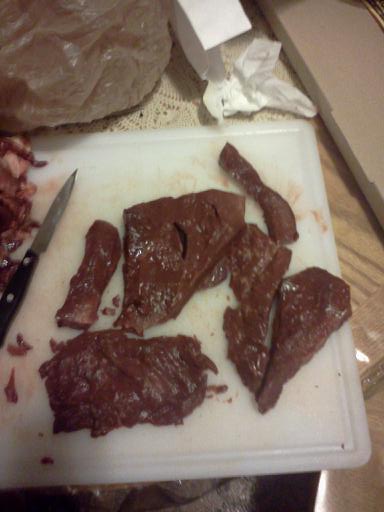
Perhaps the most distinctive aspect of heart at home is there is no hiding what it is. Most of the time the meat we eat at home looks like, well, “meat”, solidified animal protein that could have come from just about anywhere on just about anything. It's a very abstract experience. In general, and with no personal interest in learning butchering, I have no problem with this, but if you're going to eat meat, you should be comfortable with meat's status as former animal. Every now and again, just to maintain a meaningful relationship with your food, you should look it in the eye. And if you can't, well, you should make friends with Deborah Madison and Didi Emmons (they'll be good to you). When we unwrapped the package, there was no hiding that we had a heart on the kitchen table.
Here's the video we watched to learn how to clean it.
But that effort is part of the point of cooking anything challenging. It obviously relates to flavor, but not inherently; complexity does not equal tastiness. But complex meals or cuts of meat that take 40 minutes to clean help build a relationship with food too many of us lack.
Once cleaned, as with anything butchered, the heart looked like a really lean steak or perhaps venison. We used a basic recipe from Fergus Henderson's cook book “The Whole Beast.” Henderson is the head chef (and lead personality) of St. John's Bread and Wine, in London, the restaurant Riss and I were determined to eat at while we were in London. Here's the (abridged) recipe:
Cut heart into 1 inch cubes up to ¼ inch thick. Toss the pieces in a “healthy splash of balsamic vinegar,” salt, pepper, and fresh thyme. Marinate for 24 hours. Cook on a hot caste iron skillet for three minutes on a side.
The heart, ultimately tasted almost like really good steak tips, or perhaps a beefier version of venison. It wasn't as good as the dishes we'd had at these restaurants, but for our first try, I was pretty proud with the result. What was perhaps most interesting was that the heart managed to be both rich and lean. This is probably why you generally see heart served as an appetizer (at least that's how we've seen in restaurants) as you don't need to eat that much of it to feel satisfied.
With heart at home done, we have liver and tongue to try in terms of less than typical meats we've only thus far enjoyed in restaurants. Hopefully, I'll have come up with clever titles for each of those meals.
Friday, April 22, 2011
There's More Than One Way to Read
But not all books fit in this cycle, or rather, my standard reading cycle doesn't work for all books. Two of the books I haven't finished, I didn't finish because they demanded reading styles that didn't fit with mine at the time I tried to read them. The thing is, they're both good books (one of them might have been the best novel of the year it was released) and the problem was not with them, but with me. I applied the wrong reading technique and my struggles came from that.
Wtiz by Joshua Cohen is a big, challenging, brilliant, wonderful novel. It's the story of Ben Israelian who is the last remaining Jew after a mysterious plague wiped out all of the others. He is eventually taken by a shadow government cabal whose plans for him include marrying him off to the daughter of the current President of the United States. Cohen does a lot with this conceit, examining politics, celebrity, the tension between ethnic and religious identity and other big topics, but even with the plot, the real force of the novel is the language. Wild, vibrant, chaotic, (in the scientific sense) challenging, beautiful sentences. With a book like Witz, two reading styles really work; either you give your life to the work and completely inhabit the language, learning its idiosyncratic structures and rhythms the way you would memorize the lyrics of your favorite new album and immersing yourself in the world and the characters that inhabit it (and Witz is a world); or you wander in and out, pick it up, read a few pages, in chronological order or not, and then put it down again, keeping it always within reach, but never on your reading schedule. Witz should be read either as one moves to a new city or as one flaneurs through their neighborhood.
Of course, I was over halfway through and exhausted with it, through the application of my standard style before I figured out what I was doing wrong. I haven't given up on it though. It's within reach if not on my schedule and every now and again I move the bookmark a little further in the story.
Teju Cole's Open City is another book that is best read as one wanders around a city. You see, the protagonist is a Nigerian immigrant working as a psychiatrist in New York City, who finds himself coping with the challenges of his job by taking long walks. Essentially, we should read the book as it is written, like meandering wanderlustful walks. Pick it up, read it, and then take the ideas and images in the passage for a walk. Sometimes it's a quick stroll around the block and sometimes its an epic walk you need to call a cab to get home from. Regardless, it shouldn't be read with an eye towards “finishing” it. Luckily, I spotted the appropriate method before I'd invested too much ill-advised effort. Unluckily, it was a library book on a 7-day loan and there was no way I would be able to wander through the book in 7 days. (Incidentally, great book for an intelligent teenager. The English-as-second language diction means the prose is very accessible, but the thinking the narrator does is intelligent and compelling. It's perfect for a young intellectual still discovering how to use their intelligence.)
It's one of those statements once said, looks obvious; there are many different kinds of books, so there should be many different ways to read. But when we learn to read, that range of reading is drastically limited by the structure of our schooling. You can't really wander through a novel when you have a reader response due on Wednesday about chapters 1-5. Nor can you create an idiosyncratic order for your reading as, rather practically, the teacher needs everyone on the same page to teach. (Which makes Unfortunates, one the 20th Century's great works of English language fiction unteachable as it has no stable page numbers.) And some works are too long to fit into the semester or quarter schedule, especially given that nearly all literature courses demand the teaching of multiple works. And then there are the works that really need to be re-read to be appreciated, leaving teachers and professors scrambling to convince their students of a depth that is inherently invisible to them. ("Waterproof!") And as anyone who's gone to school knows, you can't give your intellect to a single work without really hurting your grades in other subjects.
Great works of literature find ways to tell readers how to read them. Whether it's a line about interacting with art, something even more direct like a character talking about reading, or an aspect of style, great authors find ways to suggest the best perspective from which to view their work. But sometimes its a process of discovery and sometimes that discovery comes later than others. But part of the joy of reading for yourself is the freedom to discover, not just new books, but new ways of reading. In that case, you're not just transported to a new world, you're transformed into a new person.