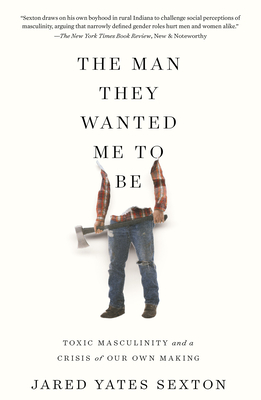
Click here for the formal review in The Los Angeles Review of Books.
I wrote a formal review of The Man They Wanted Me to Be here, but, my source material for that review was a lot bigger and a lot messier and, well, not really a review at all. Sexton's book hit a bunch of issues and ideas that I have been thinking about and struggling to write about for several years now. (Not nearly long enough.) That bigger, messier first attempt at assessing Sexton's work ended up interacting much less with the question “Is this a book you should read?” and much more with the question “How does this help me understand toxic masculinity and through that understanding, help me help push the conversation about ending it forward?” Even though that process didn't fit in the format of a book review, I still think I hit on some important ideas through it, ideas that, at least to me, are important enough to make public, even if I don't have the resources at the moment to turn them into something worthy of the scrutiny of an editor and a publication.
But, that's what blogs are for, and, oh look, I happen to have my own blog series on my own blog about using books and reading to push the world a little closer to justice. Below is that bigger, messier attempt to better understand toxic masculinity through The Man They Wanted Me to Be and to find a way forward. It has been lightly edited for typos, mistakes, and shitty first draft prose. An edit or two I grabbed from the finished review. (Might also be interesting to other writers to compare the two versions, to see in this longer, messier version, where I'm trying to aim for the prose and construction of a review and where I miss badly.)
If it were a virus it would be an epidemic. If it were a foreign country we would be at war. If it were an alien from another planet it would be the villain in a movie. American men are dying and killing. They are suffering and making others suffer with them. Men are letting it happen. We are letting people die and kill. In Jared Yates Sexton's insightful and important book The Man They Wanted Me to Be: Toxic Masculinity and a Crisis of Our Own Making, toxic masculinity is a system of absolute taboos and impossible expectations imposed on men—and through assertions of male power on everyone else--through physical and emotional abuse. Over the last few years—not nearly long enough—I've struggled directly with my own relationship to toxic masculinity and specifically with how to write about it and write at it, in ways that reduce its power. No matter where I start my floundering efforts or what angle I take into the project, I always run up against the same barrier: the men who most need to read about toxic masculinity are the least likely to. I don't know if Sexton has solved that particular problem or if that problem is solvable, but he has made an important contribution to the conversation around toxic masculinity that offers at least a starting point for our recovery from it.
The Greatest Generation is toxic masculinity's masculine ideal; they endured The Great Depression, defeated the Nazis and the Japanese Empire in military combat, and provided for their families often (if they were white of course) earning enough to buy a house and a car, feed their family, and take the occasional vacation, from a job in a manly industry like manufacturing. But this veneration of The Greatest Generation is a destructive force, one that hurts those it is supposed to celebrate and now hurts their descendants.
One of the tropes of The Greatest Generation is “Dad doesn't talk about the war.” As we learn more about PTSD, it's clear that thousands of American men returned from WWII (and Korea and Vietnam and the First Gulf War and the war in Afghanistan and the war in Iraq...) with PTSD and lived with it untreated for the rest of their lives. We celebrated their stoic silence as they suffered in silence. Or rather, we watched their attempts to cope with their suffering but refused to see it, interpreting three-martini lunches, late night poker games, spending all Saturday alone in the garage, corporal punishment, and demanding their injured sons “walk it off,” as inherent masculine traits rather than as inadequate coping mechanisms, as living up to an ideal rather than suffering from a mental illness. Toxic masculinity predates The Greatest Generation, but Sexton shows The Greatest Generation gave toxic masculinity a core to metastasize around and the fuel to supercharge its transmission.
Sexton argues The Greatest Generation's achievements were weaponized. “If our fathers and grandfathers could survive a depression, ship off to Europe or Asia, and fight the forces of fascism, then we should be capable of conducting civilian lives without complaint.” Sure, your job batters your body and mind so you feel like a crushed can every night, but your grandfather saw his best friend step on a landmine outside of Berlin and he never complained about it. But, of course, it's not enough to suffer in silence; any weakness, any failure, any instant in your life when you are not George C. Scott's General Patton is fundamental proof that you are not a real man like your grandfather. This masculine ideal has always and will always be impossible to achieve, as Sexton summarizes the work of Dr. Joseph Pick, “because gender roles are social constructs and thus impossible to fulfill, the inevitable failure to live up to them can result in psychological damage,” but the lionizing of The Greatest Generation created a specific ideal to fail against, while at the same time many of its members literally passed on their trauma through emotional and physical abuse.
Physical and emotional abuse that Sexton himself suffered at the hands of a number of the men in his life. A key part of the book is Sexton's description of this abuse as well was how he struggled to define himself against it and how, ultimately, he embodied many of the traits he tried to resist until he finally hit rock bottom and sought the professional help he needed to begin healing from his trauma. The arc of Sexton's story feels familiar. It is a narrative arch we've seen in dozens of memoirs and movies about addiction, but this is not the appropriation of a popular form. Sexton's story feels like an addiction memoir because toxic masculinity is an addiction. Sexton writes, “It permeates everything, reverberating throughout our language and tainting our power structure; it plagues every action and thought...Toxic masculinity is a chronic illness, and once we're infected we always carry it with us.”
But rather than consuming a substance, toxic masculinity, as addiction, manifests itself in performance, poses and postures of physical endurance, of willingness to engage in or actual violence, in a stoic absence of any emotion, except for anger. “John whipped and beat me when I didn't fulfill my end of the masculine bargain. If I cried, if I complained, if I was sick or if I simply felt short of his expectations, that's when I received punishment.” As children, men learn the poses and postures that get them hit or insulted and the poses and postures that don't and perform those “until there's no performance any more. There's just a man who knows no other way.” The performative nature of toxic masculinity truly hit Sexton in a breakthrough moment with his father. “The life he'd been living all these years had been one where he'd had to carry himself a certain way lest he got shit from his friends and family. Deep down, the person he was didn't look at all like the one he pretended to be.” Toxic masculinity is not something men cling to because they enjoy it; it is imposed on them by the world and their fathers until it is just easier to become that man than the person they might more honestly be, until they are addicted to the performance. /they defend it because, by the time they have their own children, they know of no other way to be.
Like many men of his generation, Sexton sought refuge from this process on the blogs and message boards of the young internet. But few, if any of those young men had the emotional tools to protect that refuge from the forces of toxic masculinity that drove them there in the first place. On the internet, no one knew how physically strong you were, if you were an athlete, if you had ever cried at a family reunion or on the playground, but instead of using that anonymity to find value elsewhere, they exploited it to ease their performance of those toxic poses and postures, creating “their own patriarchal reality that not only reinforced the old expectations but superharged them.” Instead of feeling free from expectations, they could not even stand the idea that someone might consider their anonymous online avatars effeminate, and so they used that freedom from physical limitations and consequences to relentlessly verbally one-up each other in a contest that no one could win because it could never end, performing an increasingly extreme toxic masculinity, “punishing the world while laughing to prove they're stronger than humanity,” and becoming the trolls that haunt the internet today.
Sexton's ability to perform toxic masculinity gave him access to Trump supporters that few other journalists had. At campaign rallies for Trump, attendees did not see Sexton as a journalist but as another dude and so were open around him in ways they were not for other journalists. Sexton was horrified by the racism, homophobia, and misogyny that he saw and heard at these rallies and his op-ed about his experiences at these rallies brought him to the public eye. The quality of a work of nonfiction, whether it's memoir, journalism, philosophy, cultural criticism, or whatever, is the material it gives its readers to form their own conclusions, whether readers are able to extend their understanding of the world beyond the limits of the book itself. Applying his other insights to his experiences at Trump rallies, we can reach a potentially surprising conclusion; some of that vitriol was performative, spewed by men who did not believe it, or at least not with that intensity, but were afraid their masculinity would be questioned if they didn't. Some, if not many, of Trump's supporters engaged in the same kind of pissing contest that trolls do, where the point was not to actually advance an idea but to prove how tough you, personally, are. To put this another way, there are members of Trump's base, especially men, who don't really believe in him, but feel obligated to attend his rallies, shout his slogans, and even vote for him to prove their masculinity. This is not to absolve them of responsibility for their actions and votes, but to try to define the relationship with toxic masculinity in our search for a solution.
Sexton wants to change the world. A perfect review of a book like this would be able to look into the future and see if he has. I don't know if Sexton solves that fundamental problem of audience. I don't know if the men who most need to read it, both for their own health and for the health of society, will read it. But their sons might. Their daughters might. A new football coach might. And they might find a path forward.
The first step is to just stop. Just stop beating your sons when they cry. Stop using feminine and homosexual descriptions as insults. Believe yourself when you feel like something isn't right. Believe yourself when you feel like you are acting or performing something that is not true to you. Preserving toxic masculinity takes work; relentless physical and emotional work that must envelop a child until the man they want you to be is extruded. Just stop. Just fucking stop. And the thing is, masculine men can still have everything they like about traditional masculinity. Throwing hits in hockey. Shooting powerful guns at a gun range. Pushing your body, taking some risks, late night bullshit sessions with your buddies. All of it will still be there, we just won't be able to snatch those activities from other identities who might want to enjoy them or punish our sons if they don't. And we get the ability to opt out. And we get the ability to try other activities, fashions, and experiences. And we get the ability to ask for help. Seeing toxic masculinity as a performance men are addicted to points towards the ideas needed, not just to prevent its transmission, but to enable our recovery from it. There are millions of people who have learned how to manage their addictions. We can take our knowledge of addictions, our awareness of toxic masculinity, and our growing understanding of PTSD and build something much better than we have today. The only thing we give up is the power to control what other people want from life. A power that, in truth, doesn't exist.
The Man They Wanted Me to be is limited in scope. It is rooted in Sexton's personal experience and uses that experience to guide what science, research, and other observations he brings into the book. This means the book says very little about how people of color experience toxic masculinity or about the experiences of women and people of other genders and sexualities. Sexton is open about the limits of the book and frequently clarifies when an experience is unique to white men while being careful to never center men and white men in particular as “the real victims of toxic masculinity.” But, in many ways, an important book about toxic masculinity, written by a straight white man, needs to be limited in scope because it needs to be personal.
There is a fundamental taboo against sharing anything personal, especially your feelings. In toxic masculinity, men are supposed to be invulnerable and expressing any pain (and even joy) is an act of unacceptable vulnerability. As important as the data is and as insightful as Sexton is with that data, the most important thing he does in The Man They Wanted Me to Be is break that taboo. He shares his alcoholism. He shares his eating disorders. He shares the abuse. He shares his pain. He shares the help he received, including therapy. Ultimately, this book is a permission slip. It says you can explore your own toxic masculinity. You can interrogate the men in your life. You can do the research. And you can get help in the process and that help can include professional help from a therapist or psychologist. And you can share this process with others. Through this process, unlike your father and grandfather and great grandfather who suffered in silence, forced the rest of the family to suffer with them, and passed on the suffering to their descendants, you will become a better human being, a healthier man, and help break the cycle of toxic masculinity.
Showing posts with label Reading is Resistance. Show all posts
Tuesday, July 16, 2019
Wednesday, May 22, 2019
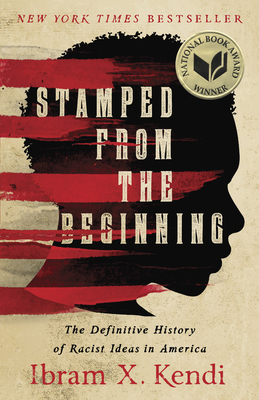
Reading is Resistence: Stamped from the Beginning and Why You Should Ignore Republican Arguments About Abortion and Pretty Much Everything Else
Every now and then you read a book and the world snaps into place. What was confusing and chaotic is clear. You cannot fathom why someone would do or say something like that and suddenly you see it clearly. Your frustration and anger build, as mine has throughout the course of the administration, and especially in the last few weeks as Republicans across the country attack legal abortion, and then a book gives you a direction, gives you an explanation, gives you a technique, gives you, if not a solution, then a place to start. Stamped from the Beginning: The Definitive History of Racist Ideas in America by Ibram X. Kendi did that for me.
Kendi's powerful insight is relatively simple: the desire to protect and expand chattel slavery drove the racist ideas that became American white supremacy, not the other way around. To put this another way, slavery came first and those who benefited from it created racist ideas to justify its existence and expansion and defend it against those would abolish or even just restrain it. White supremacy then isn't really an ideology based around core ideas that then inform goals, actions, and priorities, so much as it is a system of power based around protecting and expanding the power of the descendants of slaveholders. (I'll get to how this connects to the recent string of forced-birth legislation.)
As a system of power, its ideas do not have to be logical or internally consistent. They don't have to be based in facts. They don't even have to make sense. They just need to provide enough cover to keep the system going. For example, one of the most common racist ideas created to defend slavery was that black people are naturally docile and obedient, that they actually need and love the strict leadership of their masters and that, therefore, freedom is actually bad for them. And when the Civil War started and the Union began to recruit black soldiers, a racist idea was created that black people inherently lack the discipline needed to be effective soldiers. These two ideas are mutually exclusive, but, being an internally coherent logic system was never the point; preserving the system of slavery was and if calling black people docile out of one side of your mouth and calling them undisciplined out of the other helped preserve the system of slavery, you did it. You could do it in the same sentence.
One of the questions I had, when I started Kendi was, essentially, “What the fuck is up with the 3/5 compromise? I mean, seriously, fuckin' A.” One the one hand chattel slavery was built on the idea that black people were not really human (sometimes that argument was based on the Bible and sometimes on “science.”) and thus absolutely not deserving of citizenship in any way shape or form. Every other racist idea was drawn from and circled around that core, because it is very difficult for one human being to treat another human being as a slave or to allow such treatment to happen. So, logically, given that chattel slavery rested on the idea that black people were not really human, they should not be counted towards political representation, right? Only if logic is the point. The point was protecting and expanding slavery and counting slaves towards representation did just that by creating an over-representation of slaveholders in Congress. 3/5 was just the most the slaveholding states could get out of the Northern states and still ratify the Constitution.
When Richard Nixon succeeded through the Southern Strategy he formally transformed the Republican Party into the party of white supremacy and in doing so, he transformed Republican ideology (which, honestly, was pretty fucking racist, misogynist, theocratic, and autocratic already) into an expression of that system of power. The purpose of the Republican party changed from enacting Republican policies, to expanding and maintaining Republican power. This means the only question Republicans (in power at least) pose when deciding on a strategy or policy or evaluating an idea is “Does this protect or expand the power of the Republican party?” Everything else is irrelevant.
So it is not hypocritical for them to oppose every Democrat social spending program that would uplift Americans who are not white men by claiming the federal debt and deficit are existential threats to the economy and then radically increase the debt and deficit when they hold power. The deficit isn't the point, the power is. Nor it is laughably unprofessional for them to spend 6-7 years holding show votes to repeal Obamacare without every actually creating a workable policy replacement. Obamacare as a policy was completely irrelevant. The only thing that mattered was “Obamacare” as a tool to undercut the Democrats and inspire white supremacists to vote. Nor is it preposterously short-sighed and embarrassingly uninformed about the state of the criminal punishment system to respond to the idea that prisoner should have the right to vote with “Do you want the Boston Marathon bomber to vote?” Nor is it 3/5-Compromise level illogical to count inmates who have no connections to and are denied political engagement in the communities where they are detained towards those communities' proportional representation. Does denying prisoners and other people who have been in the criminal punishment system the right to vote protect and expand Republican power? Yes, so say whatever the fuck it takes to keep preventing those votes. Does counting prisoner populations as residents in the districts the prison happens to be in protect and expand Republican power? Given that prisons are often in more white, rural, and Republican spaces and especially given that prison populations are disproportionately drawn from poor, urban, POC and Democratic spaces, hell yeah, you do.
Which brings us to the latest assault on abortion rights. Initially, the Republican party, under Nixon, embraced the forced-birth movement as a way to pull Catholic votes away from Democrats. It eventually solidified into a core current in their base, one they leverage to keep people who disagree with them about nearly everything else, checking the “R” box in every election. But at a more fundamental level, at a level beyond turning out the base, it is a way to control women and especially women of color, who, unlike white women, will be less likely to afford illegal abortions. It will trap them in unsafe domestic relationships. It will restrict their economic mobility. It will drain them of the physical, emotional, and financial resources to be politically active. It will kill them. And given that women and especially women of color vote more Democratic than men, controlling women is the goal.
The reason why none of these new forced-birth bills have any funding for say, free contraception, sex education, or childcare is that reducing the number of abortions isn't the point: controlling women is. The reason why none of these bills make any medical sense is that medicine has nothing to do with it: controlling women does. The reason no one writing these bills seems to have any understanding of the actual biological processes of birth is that actually giving fucking birth is totally irrelevant to the goal, which is controlling women. These bills don't hold men responsible for their part in unwanted pregnancies, in any way shape or form, not because the bill writers don't understand that men are responsible for unwanted pregnancies, but because they don't care: controlling women is the point.
And if this process of proposing logically incoherent, radically ignorant, and wildly unpopular policies looks familiar to you, that's because it is. The Republican party is using the 3/5-Compromise technique again, presenting absurd, nonsensical, and overtly cruel policies so that, in the end, they get as much of that control as they can.
Ultimately, until the Republican party separates itself completely from white supremacy (I, for one, am not holding my breath) you don't actually need to listen to single argument a Republican in power makes, because it is not really an argument; it is a rhetorical device employed to preserve a system of power. That's why exposing their hypocrisy doesn't work. That's why refuting their statements with facts doesn't work. That's why showing logical inconsistencies doesn't work. That's why they don't even bat an eye when they line up to call for Al Franken's resignation and then put Brett Kavanaugh on the Supreme Court. That's why it's all “free speech absolutist” until it comes to people protesting them. That's why it's all “states rights” until a city acts against their racist immigration policy. That's why it's all “fiscal responsibility” until it is time to conceal the damages of your trade policies with subsidies or write a blank check for war. That's why Republicans in certain places can say “Roe vs. Wade is settled law” while watching Republicans in other states explicitly create challenges to Roe vs. Wade as established law. That's why the party of family values and christian evangelicals can elect AND celebrate Donald Trump. And that's why for ever loving fuck's sake, it is not worth it for Democrats in power to court Republican votes or defend the systems and institutions that Republicans have been exploiting for decades.
The only meaningful, effective solution to the problem contemporary Republicans in power pose to our nation and the world is to completely remove them from power at every level of government and you don't do that by playing along with their systems of power. You don't do that by working within the legislative, executive, and electoral norms they have been exploiting for decades. And you sure as fuck don't do that by treating the humanity of women and people of color as a negotiable policy. You do that by expanding the electorate, turning them out to vote, and following the leadership of those who have already succeeded at both.
It is hard to fight when it feels like you're fighting against chaos. Fuck, it's hard to do anything when it feels like you have no fucking clue why all this fucking shit is happening. And it can be even harder to pull all of that rage into something actionable when you are watching powerful white men threaten the lives of people you love. And Republicans are threatening the lives of people you love. In fact, they have already taken some. And they will take more. Luckily, we still live in a world with Stamped from the Beginning. We still have authors, historians, and thinkers like Kendi who do know why this fucking shit is happening and can explain it to us in a way that snaps all that chaos into focus. And it's not that far from focus to action.
Kendi's powerful insight is relatively simple: the desire to protect and expand chattel slavery drove the racist ideas that became American white supremacy, not the other way around. To put this another way, slavery came first and those who benefited from it created racist ideas to justify its existence and expansion and defend it against those would abolish or even just restrain it. White supremacy then isn't really an ideology based around core ideas that then inform goals, actions, and priorities, so much as it is a system of power based around protecting and expanding the power of the descendants of slaveholders. (I'll get to how this connects to the recent string of forced-birth legislation.)
As a system of power, its ideas do not have to be logical or internally consistent. They don't have to be based in facts. They don't even have to make sense. They just need to provide enough cover to keep the system going. For example, one of the most common racist ideas created to defend slavery was that black people are naturally docile and obedient, that they actually need and love the strict leadership of their masters and that, therefore, freedom is actually bad for them. And when the Civil War started and the Union began to recruit black soldiers, a racist idea was created that black people inherently lack the discipline needed to be effective soldiers. These two ideas are mutually exclusive, but, being an internally coherent logic system was never the point; preserving the system of slavery was and if calling black people docile out of one side of your mouth and calling them undisciplined out of the other helped preserve the system of slavery, you did it. You could do it in the same sentence.
One of the questions I had, when I started Kendi was, essentially, “What the fuck is up with the 3/5 compromise? I mean, seriously, fuckin' A.” One the one hand chattel slavery was built on the idea that black people were not really human (sometimes that argument was based on the Bible and sometimes on “science.”) and thus absolutely not deserving of citizenship in any way shape or form. Every other racist idea was drawn from and circled around that core, because it is very difficult for one human being to treat another human being as a slave or to allow such treatment to happen. So, logically, given that chattel slavery rested on the idea that black people were not really human, they should not be counted towards political representation, right? Only if logic is the point. The point was protecting and expanding slavery and counting slaves towards representation did just that by creating an over-representation of slaveholders in Congress. 3/5 was just the most the slaveholding states could get out of the Northern states and still ratify the Constitution.
When Richard Nixon succeeded through the Southern Strategy he formally transformed the Republican Party into the party of white supremacy and in doing so, he transformed Republican ideology (which, honestly, was pretty fucking racist, misogynist, theocratic, and autocratic already) into an expression of that system of power. The purpose of the Republican party changed from enacting Republican policies, to expanding and maintaining Republican power. This means the only question Republicans (in power at least) pose when deciding on a strategy or policy or evaluating an idea is “Does this protect or expand the power of the Republican party?” Everything else is irrelevant.
So it is not hypocritical for them to oppose every Democrat social spending program that would uplift Americans who are not white men by claiming the federal debt and deficit are existential threats to the economy and then radically increase the debt and deficit when they hold power. The deficit isn't the point, the power is. Nor it is laughably unprofessional for them to spend 6-7 years holding show votes to repeal Obamacare without every actually creating a workable policy replacement. Obamacare as a policy was completely irrelevant. The only thing that mattered was “Obamacare” as a tool to undercut the Democrats and inspire white supremacists to vote. Nor is it preposterously short-sighed and embarrassingly uninformed about the state of the criminal punishment system to respond to the idea that prisoner should have the right to vote with “Do you want the Boston Marathon bomber to vote?” Nor is it 3/5-Compromise level illogical to count inmates who have no connections to and are denied political engagement in the communities where they are detained towards those communities' proportional representation. Does denying prisoners and other people who have been in the criminal punishment system the right to vote protect and expand Republican power? Yes, so say whatever the fuck it takes to keep preventing those votes. Does counting prisoner populations as residents in the districts the prison happens to be in protect and expand Republican power? Given that prisons are often in more white, rural, and Republican spaces and especially given that prison populations are disproportionately drawn from poor, urban, POC and Democratic spaces, hell yeah, you do.
Which brings us to the latest assault on abortion rights. Initially, the Republican party, under Nixon, embraced the forced-birth movement as a way to pull Catholic votes away from Democrats. It eventually solidified into a core current in their base, one they leverage to keep people who disagree with them about nearly everything else, checking the “R” box in every election. But at a more fundamental level, at a level beyond turning out the base, it is a way to control women and especially women of color, who, unlike white women, will be less likely to afford illegal abortions. It will trap them in unsafe domestic relationships. It will restrict their economic mobility. It will drain them of the physical, emotional, and financial resources to be politically active. It will kill them. And given that women and especially women of color vote more Democratic than men, controlling women is the goal.
The reason why none of these new forced-birth bills have any funding for say, free contraception, sex education, or childcare is that reducing the number of abortions isn't the point: controlling women is. The reason why none of these bills make any medical sense is that medicine has nothing to do with it: controlling women does. The reason no one writing these bills seems to have any understanding of the actual biological processes of birth is that actually giving fucking birth is totally irrelevant to the goal, which is controlling women. These bills don't hold men responsible for their part in unwanted pregnancies, in any way shape or form, not because the bill writers don't understand that men are responsible for unwanted pregnancies, but because they don't care: controlling women is the point.
And if this process of proposing logically incoherent, radically ignorant, and wildly unpopular policies looks familiar to you, that's because it is. The Republican party is using the 3/5-Compromise technique again, presenting absurd, nonsensical, and overtly cruel policies so that, in the end, they get as much of that control as they can.
Ultimately, until the Republican party separates itself completely from white supremacy (I, for one, am not holding my breath) you don't actually need to listen to single argument a Republican in power makes, because it is not really an argument; it is a rhetorical device employed to preserve a system of power. That's why exposing their hypocrisy doesn't work. That's why refuting their statements with facts doesn't work. That's why showing logical inconsistencies doesn't work. That's why they don't even bat an eye when they line up to call for Al Franken's resignation and then put Brett Kavanaugh on the Supreme Court. That's why it's all “free speech absolutist” until it comes to people protesting them. That's why it's all “states rights” until a city acts against their racist immigration policy. That's why it's all “fiscal responsibility” until it is time to conceal the damages of your trade policies with subsidies or write a blank check for war. That's why Republicans in certain places can say “Roe vs. Wade is settled law” while watching Republicans in other states explicitly create challenges to Roe vs. Wade as established law. That's why the party of family values and christian evangelicals can elect AND celebrate Donald Trump. And that's why for ever loving fuck's sake, it is not worth it for Democrats in power to court Republican votes or defend the systems and institutions that Republicans have been exploiting for decades.
The only meaningful, effective solution to the problem contemporary Republicans in power pose to our nation and the world is to completely remove them from power at every level of government and you don't do that by playing along with their systems of power. You don't do that by working within the legislative, executive, and electoral norms they have been exploiting for decades. And you sure as fuck don't do that by treating the humanity of women and people of color as a negotiable policy. You do that by expanding the electorate, turning them out to vote, and following the leadership of those who have already succeeded at both.
It is hard to fight when it feels like you're fighting against chaos. Fuck, it's hard to do anything when it feels like you have no fucking clue why all this fucking shit is happening. And it can be even harder to pull all of that rage into something actionable when you are watching powerful white men threaten the lives of people you love. And Republicans are threatening the lives of people you love. In fact, they have already taken some. And they will take more. Luckily, we still live in a world with Stamped from the Beginning. We still have authors, historians, and thinkers like Kendi who do know why this fucking shit is happening and can explain it to us in a way that snaps all that chaos into focus. And it's not that far from focus to action.
Thursday, December 6, 2018
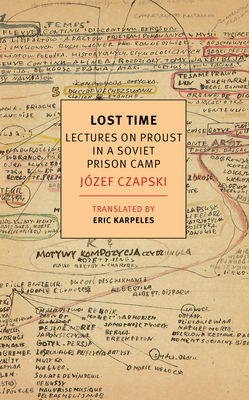
Reading is Resistance: Lost Time
What would you do if you were in a prisoner camp of some kind, cut off from the world, with no way to entertain yourself, nothing to do with the adrenalized energy that can often keep us awake even after the most exhausting days of labor and stress and trauma? How would you pass the time? What would you do to stay sane? How would you feel human when everything around you is designed to make you feel like an object, something discarded, a piece of trash those in power saw fit to “rehabilitate?” Jozef Czapaski and his fellow prisoners in a Soviet War camp organized a lecture series, with each participant sharing something they were passionate and knowledgeable about, something that connected them to the outside world, something that shared the depth of themselves with the compatriots in incarceration. Czapski, a painter by trade, chose to lecture on In Search of Lost Time by Marcel Proust.
Despite giving the lectures by memory, with no copies of the book or any scholarship of the book to reference (or any books at all), and working from schematics that he created himself in preparation for the lectures, Czapski's presentation is extremely insightful, distilling the very essence of Proust into something that can be communicated verbally to those with no familiarity with the work. I doubt serious scholars of Proust will find anything earth shattering in Czapski's interpretation, but he does an amazing job of bringing the biggest and most important aspects of the book to his listeners. For example, he (correctly I think) describes that famous madeleine as, essentially, a set up or a foreshadowing for the moment the narrator stands on a pair of uneven paving stones and the mystery of memory—and the power that mystery generates—reveals itself to him. He also spends a fair amount of his time on what could be considered the climax of the novel, when, late in the final volume, after years of being out of society, the narrator attends a party with all of his old friends. As I remember it, the scene starts with the narrator feeling as though it is a costume party, and all of these people who were so important to his past, had come dressed up as old people. And then it hits him; they aren't in costume. They had just, like we all do, aged.
Czapski identifies something I'd forgotten about this amazing moment: the narrator sees the transience of life, sees mortality, understands at a profoundly emotional level that soon, all of these people will be gone and those who remember them will be gone and there will be essentially nothing left of the people he cared about. But he can do something. He can use his own memory to create something that immortalizes them, not as idealized images, or even as characters in the usual sense of the word, but as flawed, complicated, fascinating, and important people. And through this, after floundering around for years, the narrator discovers his purpose in life, the action that would make his life meaningful. He would save his friends and, through his exploration of memory, give us the tools we need to save ours. And, in an indirect way, give Gzapski the tools to save his own sanity and perhaps his own life.
Given the importance of memory in Proust, in some ways a lecture series based entirely on how the speaker remembers Proust might be the highest expression of the book. If memory were perfect it would be meaningless. Everything in our lives would have the same value or at least take up the same space in our brains. As the translator points out in his introduction, forgetting is what makes memory powerful. It would also be a very different presence in our lives if it were controllable, if we only remembered the memories we were specifically looking for and only when we were specifically looking for them. But memory is not perfect and often we cannot control it. The triggers that elicit certain memories are hidden from us until they happen. And it is exactly those undbidden memories that create the most powerful experiences. We are most moved and in many ways most able to learn when something we had completely forgotten comes flooding back as if we were experiencing it again. This is how we are unmoored from linear time. But that doesn't mean memory is completely chaotic or completely unresponsive.
One of the things that Czapski notes is that he remembered more and more of the book as he worked with his schematics and as he gave his lectures. The more he looked for Proust in his memory the more he found Proust. What follows is another idea about memory, different from anything directly expressed in Proust (at least as I remember it, though it's probably in there somewhere) but still akin to the madeleine and the uneven paving stones: we store much more than we realize. We don't know how much we know until we really start digging into our own memories. Fascism (and in many ways capitalism) argues that, as individuals, we are simply incapable of grandeur, of excellence, of power, of brilliance, of completeness, and it is only through the state (or through the purchase), only through giving ourselves over to the state, that human greatness is possible. But Czapski and his comrades made a powerful counter-argument in their lecture series. They proved that, even in a situation designed to crush them into a kind of singularity, they all still contained multitudes. And the point is not to admire Czapski and his comrades for their series, though it is admirable, but to realize that you are also capable. You can remember more than you think you can. You know more than you think you know. You are capable of more than you think you are. You could put up a fight in a prison camp. You can fight fascism so there are no more prison camps.
As much as the lectures themselves are about Proust and memory, Lost Time is a story about self-care. It is an artifact of survival. It is a statement of defiance. The lesson from Lost Time isn't really one about Proust or In Search of Lost Time, but that being passionate about something is a survival technique. Developing an expertise in something, in anything, is a bulwark against systems of power and powerful individuals who prefer compliance above all, who value those who do what they are told, who find ways to eliminate the asking of questions, because those systems of power cannot take your expertise, they cannot take your knowledge, they cannot take your memory. They can take everything else from you, but they can't get in your mind and excise what you know. That knowledge of furniture restoration, of string theory, of Buffy is yours forever.
What would you lecture on? And if you can't think of something, there are worse ways to spend a few weekends than developing an expertise in something that interests you.
Readers have an extra privilege. The point of books is to encapsulate our humanity in ways that make it easy for us to share with others what makes our lives worth living. Those of us who develop an expertise in books or in a specific book, also develop a constant reminder of what we put in the work for, of why we fight, of what makes life valuable, and also of how we work, how we fight, and how we make life valuable. Czapski is discussing Proust in particular, but his summation of what he believes Proust accomplished is a beautiful summation of what literature aspires to do and what we can achieve or access when we interact with literature: “With his revelatory form, Proust brings a world of ideas, to the reader, a complete vision of life that, by awakening his faculties of thought and feeling, requires the reader to revise his own scale of values.”
This post would have a very different tone if Democrats had not flipped the House of Representatives, if they had not taken back state houses and state legislatures all across the country, and if they had not succeeded with referendums as well. This sense of what we need to do, what we can do when all hope is lost is different when we have been given such tangible and immediate reasons to hope. But you could tell the history of America in the 20th and 21st centuries through the battles we assumed were over. At time of writing, Republicans in Wisconsin and Michigan are using their lame-duck sessions to completely undercut the Democratic gains in their states and further disadvantage Democrats in 2020. All of our great victories and all of our great progress has eroded without our constant attention. Our gains were chipped away, our progress diminished, the passions of radical reactionaries loud enough and inconvenient enough to extract concessions from those of us who felt we had better things to do with our time and now we find ourselves in a new version of the early 1900s; African-Americans and many other people of color live in a new Jim Crow, a handful of super-wealthy people control almost the entire economy with nearly everyone else in too precarious personal circumstances to put up much of a fight, and fascism is a threat here and around the world.
I have said this in other contexts, but while I think about Czapski and his comrades in a prison camp and I think about the children and families in concentration camps, complete with numbers being written on their arms, today in the United States, I remember that we have the privilege of memory. We are not yet Germany in the 1930s in large part because we can remember Germany in the 1930s. We are pushing back against the rise of white supremacy because we remember Jim Crow and we remember the lynchings. We can remember what happened and actually do something to stop it and to change it.
And one election is not going to save the world. We have to see the 2018 mid-terms as the very first step, not just in defeating Donald Trump, but in remaking American society to live up to the promises it made after World War II and to live up to new promises we can make with our new imaginations. We have to take Czapski's lessons about books and reading and maintaining your personhood in an impersonal world, not as just a kind of defense against the dark arts, not just as a barricade against those who would invade our minds, but also as the basis for what we build next, for seeing who we can be in the future and finding a way to get there, and for describing a new and better world and what we'll do to create it.
Despite giving the lectures by memory, with no copies of the book or any scholarship of the book to reference (or any books at all), and working from schematics that he created himself in preparation for the lectures, Czapski's presentation is extremely insightful, distilling the very essence of Proust into something that can be communicated verbally to those with no familiarity with the work. I doubt serious scholars of Proust will find anything earth shattering in Czapski's interpretation, but he does an amazing job of bringing the biggest and most important aspects of the book to his listeners. For example, he (correctly I think) describes that famous madeleine as, essentially, a set up or a foreshadowing for the moment the narrator stands on a pair of uneven paving stones and the mystery of memory—and the power that mystery generates—reveals itself to him. He also spends a fair amount of his time on what could be considered the climax of the novel, when, late in the final volume, after years of being out of society, the narrator attends a party with all of his old friends. As I remember it, the scene starts with the narrator feeling as though it is a costume party, and all of these people who were so important to his past, had come dressed up as old people. And then it hits him; they aren't in costume. They had just, like we all do, aged.
Czapski identifies something I'd forgotten about this amazing moment: the narrator sees the transience of life, sees mortality, understands at a profoundly emotional level that soon, all of these people will be gone and those who remember them will be gone and there will be essentially nothing left of the people he cared about. But he can do something. He can use his own memory to create something that immortalizes them, not as idealized images, or even as characters in the usual sense of the word, but as flawed, complicated, fascinating, and important people. And through this, after floundering around for years, the narrator discovers his purpose in life, the action that would make his life meaningful. He would save his friends and, through his exploration of memory, give us the tools we need to save ours. And, in an indirect way, give Gzapski the tools to save his own sanity and perhaps his own life.
Given the importance of memory in Proust, in some ways a lecture series based entirely on how the speaker remembers Proust might be the highest expression of the book. If memory were perfect it would be meaningless. Everything in our lives would have the same value or at least take up the same space in our brains. As the translator points out in his introduction, forgetting is what makes memory powerful. It would also be a very different presence in our lives if it were controllable, if we only remembered the memories we were specifically looking for and only when we were specifically looking for them. But memory is not perfect and often we cannot control it. The triggers that elicit certain memories are hidden from us until they happen. And it is exactly those undbidden memories that create the most powerful experiences. We are most moved and in many ways most able to learn when something we had completely forgotten comes flooding back as if we were experiencing it again. This is how we are unmoored from linear time. But that doesn't mean memory is completely chaotic or completely unresponsive.
One of the things that Czapski notes is that he remembered more and more of the book as he worked with his schematics and as he gave his lectures. The more he looked for Proust in his memory the more he found Proust. What follows is another idea about memory, different from anything directly expressed in Proust (at least as I remember it, though it's probably in there somewhere) but still akin to the madeleine and the uneven paving stones: we store much more than we realize. We don't know how much we know until we really start digging into our own memories. Fascism (and in many ways capitalism) argues that, as individuals, we are simply incapable of grandeur, of excellence, of power, of brilliance, of completeness, and it is only through the state (or through the purchase), only through giving ourselves over to the state, that human greatness is possible. But Czapski and his comrades made a powerful counter-argument in their lecture series. They proved that, even in a situation designed to crush them into a kind of singularity, they all still contained multitudes. And the point is not to admire Czapski and his comrades for their series, though it is admirable, but to realize that you are also capable. You can remember more than you think you can. You know more than you think you know. You are capable of more than you think you are. You could put up a fight in a prison camp. You can fight fascism so there are no more prison camps.
As much as the lectures themselves are about Proust and memory, Lost Time is a story about self-care. It is an artifact of survival. It is a statement of defiance. The lesson from Lost Time isn't really one about Proust or In Search of Lost Time, but that being passionate about something is a survival technique. Developing an expertise in something, in anything, is a bulwark against systems of power and powerful individuals who prefer compliance above all, who value those who do what they are told, who find ways to eliminate the asking of questions, because those systems of power cannot take your expertise, they cannot take your knowledge, they cannot take your memory. They can take everything else from you, but they can't get in your mind and excise what you know. That knowledge of furniture restoration, of string theory, of Buffy is yours forever.
What would you lecture on? And if you can't think of something, there are worse ways to spend a few weekends than developing an expertise in something that interests you.
Readers have an extra privilege. The point of books is to encapsulate our humanity in ways that make it easy for us to share with others what makes our lives worth living. Those of us who develop an expertise in books or in a specific book, also develop a constant reminder of what we put in the work for, of why we fight, of what makes life valuable, and also of how we work, how we fight, and how we make life valuable. Czapski is discussing Proust in particular, but his summation of what he believes Proust accomplished is a beautiful summation of what literature aspires to do and what we can achieve or access when we interact with literature: “With his revelatory form, Proust brings a world of ideas, to the reader, a complete vision of life that, by awakening his faculties of thought and feeling, requires the reader to revise his own scale of values.”
This post would have a very different tone if Democrats had not flipped the House of Representatives, if they had not taken back state houses and state legislatures all across the country, and if they had not succeeded with referendums as well. This sense of what we need to do, what we can do when all hope is lost is different when we have been given such tangible and immediate reasons to hope. But you could tell the history of America in the 20th and 21st centuries through the battles we assumed were over. At time of writing, Republicans in Wisconsin and Michigan are using their lame-duck sessions to completely undercut the Democratic gains in their states and further disadvantage Democrats in 2020. All of our great victories and all of our great progress has eroded without our constant attention. Our gains were chipped away, our progress diminished, the passions of radical reactionaries loud enough and inconvenient enough to extract concessions from those of us who felt we had better things to do with our time and now we find ourselves in a new version of the early 1900s; African-Americans and many other people of color live in a new Jim Crow, a handful of super-wealthy people control almost the entire economy with nearly everyone else in too precarious personal circumstances to put up much of a fight, and fascism is a threat here and around the world.
I have said this in other contexts, but while I think about Czapski and his comrades in a prison camp and I think about the children and families in concentration camps, complete with numbers being written on their arms, today in the United States, I remember that we have the privilege of memory. We are not yet Germany in the 1930s in large part because we can remember Germany in the 1930s. We are pushing back against the rise of white supremacy because we remember Jim Crow and we remember the lynchings. We can remember what happened and actually do something to stop it and to change it.
And one election is not going to save the world. We have to see the 2018 mid-terms as the very first step, not just in defeating Donald Trump, but in remaking American society to live up to the promises it made after World War II and to live up to new promises we can make with our new imaginations. We have to take Czapski's lessons about books and reading and maintaining your personhood in an impersonal world, not as just a kind of defense against the dark arts, not just as a barricade against those who would invade our minds, but also as the basis for what we build next, for seeing who we can be in the future and finding a way to get there, and for describing a new and better world and what we'll do to create it.
Thursday, February 1, 2018
Reading is Resistance: Translation as Transhumance
Translation as Transhumance. That second word in the title. “Transhumance.” It seduced me from the moment I saw a picture of the cover on Twitter. I tried to deduce what “transhumance” meant from its component parts but I was wrong and only more invested in the book. I eventually reviewed it for the Los Angeles Review of Books, but found Gansell's memoir of her vocation as a translator had a much bigger impact on me than could be communicated in a review. It gave me new language for describing my relationship with works in translation. It gave me a new perspective on American English and an insight into its potential power. And, of course, because we read with our daily lives, it illuminated the political power of translation in the face of our growing fascism.
At some point in my bookselling career, I read one of those articles that talks about how little work in translation Americans read, how many Americans can go through their entire education and almost entire lives without reading a book written in another language. As a bookseller, I saw this as an opportunity to do some good in the world, to use my place in the community to move the needle a bit, and to help, in my own very small way, broaden the spectrum of reading for the American public. So, I committed to reading more translation, reading translation with more intention, and recommending more books in translation both through staff picks and in conversations.
In doing so, I learned of the joy of being baffled. It is a strange joy, one that you rarely encounter in your daily life, but one that is important nonetheless. Perhaps it is a joy unique to art, unique to moments we enter with intention. It happens in moments when I have absolutely no idea what is going on in the book, absolutely no idea how to interpret an idea or image or sentence, when I am thrown off the train of my own thoughts. Most of the time we read to understand, but there is real power in reading when you can't. Because when you encounter something another person made that is unfathomable to you, you also encounter the fact that you, as a person, are capable of creating the unfathomable. You are shifted and in the parallax between your new perspective and your standard perspective an entire world opens up. Gansel approaches this unsettling opening of perspective in a number of different ways over the course of her book, but saying a work “...allows us to see the familiar in the foreign, the foreign in the familiar, and thus to create a sanctuary where you are no longer foreign but someone who is learning.” is the best articulation I've read of reading works in translation. By baffling us, we are reminded that we spend our lives as students of the world.
In some ways, it can be easy to understand that sense of being baffled, that sense of being unsettled, that encounter with the unfathomable as an abstract, intellectual experience, one more relevant to the mechanisms of understanding, than understanding itself. Because it is an experience of intellectual difficulty, we're tempted to put it in the same mental space as the papers we wrote in college and distant from the political and emotional experiences of out daily lives. But that is to miss one point of being baffled and being unsettled. Or, as Gansel puts it: “I remember clearly how, one morning as the snows were melting, as I sat at the ancient table beneath the blackened beams, it suddenly dawned on me that the stranger was not the other, it was me. I was the one who had everything to learn, everything to understand from the other. That was probably my most essential lesson in translation.” Empathy, that building block of community and society, is rooted in the ability to displace your self, to de-center your self, to know at a fundamental level, that, from a different perspective, you are the other. Reading works in translation, especially those that are unfathomable to you, might be the easiest way to create that displacement and confront your own otherness.
And once you start seeing the otherness in yourself, once you begin to imagine how you might look to those who are not conditioned by their culture to understand you, it becomes easier to see the complexity and humanity that drive your decisions, in the decisions of other people. When you internalize how you can be misunderstood, your relationship to what and who you don't understand changes. By displacing your self, you create a new space or new perspective in which it is easier to see the humanity, see the universality in the actions of other people, even if you don't understand them. Through interaction with, even celebration of, that which makes us different, that which does not cross cultures or languages, we strengthen our understanding of what does.
But, at an almost more practical level, translation is an exchange of ideas across cultures. It opens up the possibilities for how you might solve a problem or describe an experience by showing you how others solve that problem and describe that experience, often in ways and in terms you never would have imagined. It is a constant conversation about all of the options we have for being human beings on this planet; which means, it is also a constant conversation about how some systems of power, some forces in society, and some people want to limit the options you have for being a human being. Even if the different options for living that you're reading about don't feel political, are concerned more with topics that don't seem to have direct applications, it introduces you to the idea of imagining a problem from a totally different perspective. It gives you the option of at least trying to consider a problem without all of your cultural baggage lashed to your answers. Asking how someone from China or Nigeria or Iran or Mexico might solve a problem, inherently creates the idea that the American way isn't the only way and (gasp!) might not even be the best way.
Fascism, in whatever form it takes, including the one Republicans in power are working directly towards, is rooted in homogeneity, in an erasing of difference and a reduction of the scope of human life to a small set of beliefs, actions, and thoughts. Even when it is practiced at a relatively tepid level, it is based in the idea that everyone should think and believe the same things and limit themselves to essentially the same behaviors, even if it is impractical to force them to. Ultimately, contemporary Republicans (or at least those in power) think everyone should be Republican, not even in an ideological sense, but in an identity sense, in a daily lived what they wear what they eat what music they listen to way, and, barring that, they will do everything they can to ensure that only Republicans are in power. To put this a slightly different way: the primary goal of the Republican party is to ensure that only Republican solutions are adopted.
Reading in translation is, essentially, an inoculation against this virus-like homogeneity, against the idea that there is one right way to be human, against the idea that you and those like you have a monopoly on ideal humanity. With our eyes open, looking at the world, watching people do different things, solve problems in different ways, think different thoughts, and take different joys, it is obvious that homogeneity is a fraud, that fascism is a lie, and that all those who fight for it, in whatever incarnation they fight for, do so out of fear that whatever their identity is, isn't as right as they claim. But that fear is still powerful. That illusion of safety and security that homogeneity promises is still compelling. The false equivalency of sameness with community is still alluring.
Finally, as we all know from Orwell, how we think is guided, in large part, by the language we use to think with. This is why so much effort, both in good and bad faith, is put into the terms we surround political ideas with. Often, controlling how we label something, like “pro-life” for example or “fiscal conservative,” or even more recently “chain-migration” goes a long way in advancing or hindering an agenda regardless of that agenda's merit. Language and rhetoric can be used to further or hinder a cause without actually making a point about what that cause is or what that cause would do. Furthermore, history adheres to language, allowing words to carry significance and implication that have nothing to do with the idea under consideration, but can greatly impact how we react to and understand an idea or a person. There is a reason why it was effective to refer to Hilary Clinton as “shrill.” The act of translation is a direct interaction, perhaps even confrontation with that limiting force of language. By pulling meaning from one language with one set of assumptions and one set of limits on thought into another language with a different set of assumptions and a different set of limits on thought, the translator makes us aware of these mechanisms, introduces us to the limits of our own thought, and deepens our own relationship with how language functions and how we use language to converse, argue, dictate, and think. And by developing that awareness, by building the particular skills needed to make sense of words from another culture, you also develop the skills to see through propaganda and to understand the mechanism behind an act of bad faith rhetoric and to counter it.
Ultimately, fascism has a grammar. It has a system of speaking that emphasizes fear and division and curtails curiosity and exploration. It displaces the context of the discussion so somehow, instead of arguing about the merits of an idea, you're arguing about your own patriotism or how much you value your heritage. The hyper-awareness of the mechanisms of language that comes from immersing yourself in a work whose ideas came from a different grammar also gives you the tools to see and dissect the grammar of fascism. To borrow another classic image from literature, fascism is the man behind the curtain. Reading works in translation isn't going to suddenly empower you to tear down the systems of power threatening our society, but it will give you the ability to see the curtain protecting those systems from scrutiny. And seeing the curtain is the first step in tearing it down.
Translation as Transhumance is one of those books that gets bigger the more I think about it. Even for this piece, as the core ideas have expanded as I've worked on them, I've had to discard my thoughts about the potential power of our international American English, the relationship between a language and a nation, the power translation has to dissolve political borders, and Gansel's own direct use of translation as a political act. (That last part I at least discussed in the review linked above.) Every time I took a step, the distance I could travel increased. Every time I got to the top of a mountain, I saw a higher mountain ahead of me. Every opened door revealed another room filled with more doors to open. For me, literature is an act of potential. It is an ongoing testament to humanity's potential to grow, to change, and to improve and to the joy of improvement, change, and growth. Translation as Transhumance is a change to celebrate all of it, both in the type of reading it pushes us towards and the beauty it contains within itself.
Buy Translation as Transhumance from IndieBound or your local independent bookstore.
At some point in my bookselling career, I read one of those articles that talks about how little work in translation Americans read, how many Americans can go through their entire education and almost entire lives without reading a book written in another language. As a bookseller, I saw this as an opportunity to do some good in the world, to use my place in the community to move the needle a bit, and to help, in my own very small way, broaden the spectrum of reading for the American public. So, I committed to reading more translation, reading translation with more intention, and recommending more books in translation both through staff picks and in conversations.
In doing so, I learned of the joy of being baffled. It is a strange joy, one that you rarely encounter in your daily life, but one that is important nonetheless. Perhaps it is a joy unique to art, unique to moments we enter with intention. It happens in moments when I have absolutely no idea what is going on in the book, absolutely no idea how to interpret an idea or image or sentence, when I am thrown off the train of my own thoughts. Most of the time we read to understand, but there is real power in reading when you can't. Because when you encounter something another person made that is unfathomable to you, you also encounter the fact that you, as a person, are capable of creating the unfathomable. You are shifted and in the parallax between your new perspective and your standard perspective an entire world opens up. Gansel approaches this unsettling opening of perspective in a number of different ways over the course of her book, but saying a work “...allows us to see the familiar in the foreign, the foreign in the familiar, and thus to create a sanctuary where you are no longer foreign but someone who is learning.” is the best articulation I've read of reading works in translation. By baffling us, we are reminded that we spend our lives as students of the world.
In some ways, it can be easy to understand that sense of being baffled, that sense of being unsettled, that encounter with the unfathomable as an abstract, intellectual experience, one more relevant to the mechanisms of understanding, than understanding itself. Because it is an experience of intellectual difficulty, we're tempted to put it in the same mental space as the papers we wrote in college and distant from the political and emotional experiences of out daily lives. But that is to miss one point of being baffled and being unsettled. Or, as Gansel puts it: “I remember clearly how, one morning as the snows were melting, as I sat at the ancient table beneath the blackened beams, it suddenly dawned on me that the stranger was not the other, it was me. I was the one who had everything to learn, everything to understand from the other. That was probably my most essential lesson in translation.” Empathy, that building block of community and society, is rooted in the ability to displace your self, to de-center your self, to know at a fundamental level, that, from a different perspective, you are the other. Reading works in translation, especially those that are unfathomable to you, might be the easiest way to create that displacement and confront your own otherness.
And once you start seeing the otherness in yourself, once you begin to imagine how you might look to those who are not conditioned by their culture to understand you, it becomes easier to see the complexity and humanity that drive your decisions, in the decisions of other people. When you internalize how you can be misunderstood, your relationship to what and who you don't understand changes. By displacing your self, you create a new space or new perspective in which it is easier to see the humanity, see the universality in the actions of other people, even if you don't understand them. Through interaction with, even celebration of, that which makes us different, that which does not cross cultures or languages, we strengthen our understanding of what does.
But, at an almost more practical level, translation is an exchange of ideas across cultures. It opens up the possibilities for how you might solve a problem or describe an experience by showing you how others solve that problem and describe that experience, often in ways and in terms you never would have imagined. It is a constant conversation about all of the options we have for being human beings on this planet; which means, it is also a constant conversation about how some systems of power, some forces in society, and some people want to limit the options you have for being a human being. Even if the different options for living that you're reading about don't feel political, are concerned more with topics that don't seem to have direct applications, it introduces you to the idea of imagining a problem from a totally different perspective. It gives you the option of at least trying to consider a problem without all of your cultural baggage lashed to your answers. Asking how someone from China or Nigeria or Iran or Mexico might solve a problem, inherently creates the idea that the American way isn't the only way and (gasp!) might not even be the best way.
Fascism, in whatever form it takes, including the one Republicans in power are working directly towards, is rooted in homogeneity, in an erasing of difference and a reduction of the scope of human life to a small set of beliefs, actions, and thoughts. Even when it is practiced at a relatively tepid level, it is based in the idea that everyone should think and believe the same things and limit themselves to essentially the same behaviors, even if it is impractical to force them to. Ultimately, contemporary Republicans (or at least those in power) think everyone should be Republican, not even in an ideological sense, but in an identity sense, in a daily lived what they wear what they eat what music they listen to way, and, barring that, they will do everything they can to ensure that only Republicans are in power. To put this a slightly different way: the primary goal of the Republican party is to ensure that only Republican solutions are adopted.
Reading in translation is, essentially, an inoculation against this virus-like homogeneity, against the idea that there is one right way to be human, against the idea that you and those like you have a monopoly on ideal humanity. With our eyes open, looking at the world, watching people do different things, solve problems in different ways, think different thoughts, and take different joys, it is obvious that homogeneity is a fraud, that fascism is a lie, and that all those who fight for it, in whatever incarnation they fight for, do so out of fear that whatever their identity is, isn't as right as they claim. But that fear is still powerful. That illusion of safety and security that homogeneity promises is still compelling. The false equivalency of sameness with community is still alluring.
Finally, as we all know from Orwell, how we think is guided, in large part, by the language we use to think with. This is why so much effort, both in good and bad faith, is put into the terms we surround political ideas with. Often, controlling how we label something, like “pro-life” for example or “fiscal conservative,” or even more recently “chain-migration” goes a long way in advancing or hindering an agenda regardless of that agenda's merit. Language and rhetoric can be used to further or hinder a cause without actually making a point about what that cause is or what that cause would do. Furthermore, history adheres to language, allowing words to carry significance and implication that have nothing to do with the idea under consideration, but can greatly impact how we react to and understand an idea or a person. There is a reason why it was effective to refer to Hilary Clinton as “shrill.” The act of translation is a direct interaction, perhaps even confrontation with that limiting force of language. By pulling meaning from one language with one set of assumptions and one set of limits on thought into another language with a different set of assumptions and a different set of limits on thought, the translator makes us aware of these mechanisms, introduces us to the limits of our own thought, and deepens our own relationship with how language functions and how we use language to converse, argue, dictate, and think. And by developing that awareness, by building the particular skills needed to make sense of words from another culture, you also develop the skills to see through propaganda and to understand the mechanism behind an act of bad faith rhetoric and to counter it.
Ultimately, fascism has a grammar. It has a system of speaking that emphasizes fear and division and curtails curiosity and exploration. It displaces the context of the discussion so somehow, instead of arguing about the merits of an idea, you're arguing about your own patriotism or how much you value your heritage. The hyper-awareness of the mechanisms of language that comes from immersing yourself in a work whose ideas came from a different grammar also gives you the tools to see and dissect the grammar of fascism. To borrow another classic image from literature, fascism is the man behind the curtain. Reading works in translation isn't going to suddenly empower you to tear down the systems of power threatening our society, but it will give you the ability to see the curtain protecting those systems from scrutiny. And seeing the curtain is the first step in tearing it down.
Translation as Transhumance is one of those books that gets bigger the more I think about it. Even for this piece, as the core ideas have expanded as I've worked on them, I've had to discard my thoughts about the potential power of our international American English, the relationship between a language and a nation, the power translation has to dissolve political borders, and Gansel's own direct use of translation as a political act. (That last part I at least discussed in the review linked above.) Every time I took a step, the distance I could travel increased. Every time I got to the top of a mountain, I saw a higher mountain ahead of me. Every opened door revealed another room filled with more doors to open. For me, literature is an act of potential. It is an ongoing testament to humanity's potential to grow, to change, and to improve and to the joy of improvement, change, and growth. Translation as Transhumance is a change to celebrate all of it, both in the type of reading it pushes us towards and the beauty it contains within itself.
Buy Translation as Transhumance from IndieBound or your local independent bookstore.
Monday, December 18, 2017
Reading is Resistance: On Tyranny and the Anti-Trump Cottage Industry
The United States of 2017 is not Germany of the 1930s. Our recent martial traumas do not include a humiliating defeat from a bordering long-time adversary. Our economy is not in free fall. We are not subject to destructive sanctions. Our status on the world stage is different. We have technology that allows for the quick organizing of opposition and the spreading of information, as well as an information technology infrastructure that is difficult to control. Even with the massive wealth disparity, as a population, we have more money. Democracy itself is an older, more developed system of government.
There are many reasons why the United States might avoid the rise of fascism in this country when Germany did not, but perhaps the biggest one is that Hitler already happened. We can correlate the strategies with the outcomes. We can compare what Hitler (and Stalin and Mussolini and Franco) did with what the Trump administration is doing. Unlike the Germans of the 1930s, we can say, “Oh, this is the same thing that Hitler did to discredit the press.” Of course, some people are refusing to believe the signs and, of course, some people are quite comfortable with the rise of fascism in America if that fascism embodies white supremacism and/or narcissistic capitalism and/or a theocracy based in their Christianity, but they do that in opposition to what is obvious to the rest of us. In short, we are prepared to prevent a Hitler in this country in ways the Germans simply could not have been.
That is the thesis of On Tyranny: Twenty Lessons from the Twentieth Century, and, in many ways, of the study of history itself. By knowing how Hitler came to power, by studying the failures of people, not just in Germany but around Europe and, even in the United States (haven't forgotten you, you America First assholes), we can avoid those failures and prevent that rise of power today. As a document, On Tyranny is a pretty handy tool. You can read it straight through, use it as a starting point for greater research, build your life around it, or even just leave it in your bathroom as a constant reminder of what is at stake and what you can do about it. It's the kind of little book that can be life changing in big ways and small ways. I would go so far as to say, even if we do prevent the rise of fascism in the United States, there's a lot in this little book about just living a fully engaged life. (Implying that living a fully engaged life is a barrier against fascism, which has merit. I do wonder about the weight of sadness Trump supporters constantly carry with them.)
But that isn't what I really want to talk about. As important as it is to build anti-fascism into our identities through books about fascism, On Tyranny connects to another trend in America since the 2016 election, one that has been driving me fucking nuts, and one that speaks more to the reaction of Republicans today than any thread of human history.
Publishing is (for many good reasons) a slow industry. It takes a long time to make a book and so it inherently takes a long time to respond to trends and social changes. (Which is also often a good thing.) Publishing is also (for less good reasons) an under-capitalized industry. Books are expensive to produce and under-priced (if you've got all day, I am more than happy to talk about that), which means that publishers often don't have a lot of financial flexibility. This leads to a lot of different practices, but it also means that it is very difficult for publishing to respond in a timely manner to current events, even when they know that response could ultimately be profitable. (Sure, while we're talking about books being under-priced, I'd be happy to explain why the industry could easily churn out a million adult coloring books in, like, six months.)
And yet, within months an entire cottage industry of anti-Trump and resistance literature, like On Tyranny, sprung up. My publisher Melville House (which has some experience in this) crashed an anthology of responses to the election, a history of antifa, and a book about impeachment and has more on the way. Their book on impeachment wasn't even the only one that came out this Fall. There were so many of these books coming out that PSB had a rotating activism/resistance display that was extremely popular with our customers. This really isn't about publishing, but as I saw these books piled on our new nonfiction table, as I thought of the energy it takes to move the wheels in publishing, and as I connected that energy to other events in the world, like thousands of us stupidly throwing money at Jill Stein's recount, an idea emerged that really stuck in my fucking craw.
Why the fuck were any Republicans actively supporting the Trump administration? Americans are so desperate for any kind of resistance to Trump, especially from Republicans, that even mostly meaningless gestures, like Jeff Flakes's, inspire rounds of praise. I mean, imagine if Susan Collins, Lisa Murkowski, and John McCain, all of whom pride themselves on their independence and don't particularly need the Republican party establishment to maintain their power, formed a new party right after the election. Or, if not right after the election, some time after it became clear the Russia meddled in our election and that an investigation of the Trump campaign was underway. Or at any point in the year, when the Trump administration did something terrible.
First of all, they would be swamped with applications from Republican strategists, pundits, and staffers. (You know, all the Republicans that are on MSNBC.) I think they would also see other people in Congress (Jeff Flake most likely) join them or at least express sympathy for their cause. They would probably have also been joined by a number of other anti-Trump Republicans, like Ana Navarro, Evan McMullin, and potentially even Mitt Romney. I know I would have called Mass Governor Charlie Baker to let him know he had a new option. But even if just those three in Congress switched, they would immediately become the three most powerful people in Washington as the Republicans would be unable to accomplish anything without them. Sure, Mitch McConnell would almost certainly retaliate by removing them from their committees and refusing to bring any of their bills to the floor but nothing he could do would make their votes any less valuable.
And how they would be praised! Doing this would have pretty much sewn up Time's People of the Year. The entire right-of-center world be talk endlessly about “a new path for conservatism” or something. And think of the New York Times profiles! They'd have to establish a special pension just for copy editors rendered only able to think in synonyms for “brave” and “principled.”
But most importantly, their new party would have been drowning in money. Not just from those who might eventually join said party, but, well, from everyone who has been donating in special elections, donating to the ACLU and Planned Parenthood and other organizations actively fighting against the Trump administration, and buying copies of On Tyranny and all of those other books in that anti-Trump cottage industry. The American people have been and for the most part still are desperate to spend money to oppose Trump and a Republican splinter party could have raked in a fuckton of it.
And here's what sticks in my craw. They didn't. Not only did they not form a new political party, they didn't even leave the party to become independents. Not only did they not become independents, but they rubber stamped all of Trump's cabinet nominees, even those who were obviously unqualified and obviously crony appointments. (And they continue to rubber stamp catastrophically unqualified nominees in a way that will cost taxpayers for decades to come. Looking at you unqualified federal judge who is going to get every single one of his decisions appealed.) But they didn't just rubber stamp his appointments, they let their colleagues drag their feet in investigating the election, they did nothing about his raft of toxic executive orders, and they only responded with any amount of courage on anything after massive, sustained, almost unprecedented push back from their constituents.
I mean, if we still have a democracy at the end of this, someone is going to have to lead whatever is left of the Republican party and there are a half dozen or so people who could have grabbed that role. (Who could still grab that role!) It would be so easy and yet they didn't do it. And this is one of the things that keeps me up at night. Not a single fucking one of them did a single meaningful fucking thing. The power was there for the taking. The money was there for the taking. If publishing can turn on a dime and create a whole cottage industry, politicians whose organizations are designed to respond to the whims of the people should have been able to also turn on a dime and capitalize on this opportunity. Shit, if the founders of this new party published a “statement of principles” or something as a book, that would have been the bestselling book in 2017. By a wide margin.
I'm a lefty, so to me, this reveals the fundamental rot at the center of the Republican party. To me, this reveals how decades of coded racism, rhetorical judo, fact-denial, and crony capitalism has rendered even those Republicans ostensibly independent from their party, unable to understand and respond to Trump's threat to America. To me, this fits right into the progress of the Republican Party into a cash cow for con artists scamming old people, authoritarians, theocrats, and narcissistic capitalists. That not a single fucking one of them took this opportunity, to me, is just proof that the process that started with McCarthyism and picked up steam with Nixon's Southern Strategy is reaching an end point. But you can write that off as just anti-Republican bias if you want.
But even if you do, you can't deny one major fact. The American people are so hungry for anti-Trump action that even a slow-moving, under-capitalized industry like publishing can respond quickly to that trend and churn out books like On Tyranny. At the very least we have to ask ourselves why politicians in general and Republicans in particular have not.
I generally like the wrap these pieces up in a way that connects reading to resistance, to show how the act of reading in general and reading specific books give us the tools to fight against the rise of fascism. But this piece is really more about the book industry than the act of reading itself. And the book industry is kinda strange. On the one hand, it is driven by storytelling, by perhaps the fundamental human trait. On the other hand, the contemporary American book industry is relatively new, developing in and around WWII when a perfect storm of lowering material cost, universal literacy, and unprecedented economic growth created an entirely different type of demand than books had ever had. Even then, you'd probably have to argue that publishing is almost entirely different now than it was after WWII, late capitalism having threshed what had been hundreds of publishers into a concentrated handful of tiny fragments of massive other non-book corporations, surrounded by dozens of small presses doing much of the cultural labor. Furthermore, it's hard to know exactly how much of a direct short-term impact book culture and thus the book industry actually has on American society. Sure, many of the most popular and critically acclaimed TV shows and movies started as books and, sure, I would argue the recent growth in great television comes from television applying the storytelling techniques of books and novels, but, all too often, the wider popular culture doesn't know about the bookish origins of their favorite movies and shows and isn't familiar enough with contemporary print storytelling to identify its influence on TV and movies. And, of course, we've all see those dire statistics about who reads books, who buys books, and how many books are read and bought each year.
Regardless, books are fundamental to culture even if their impact isn't always visible, and the health of the industry and what comes out of it says something about American culture. I don't think publishing has ever made a clearer statement. The American people want leaders to fight Trump and they are willing to pay for even the illusion of that fight.
There are many reasons why the United States might avoid the rise of fascism in this country when Germany did not, but perhaps the biggest one is that Hitler already happened. We can correlate the strategies with the outcomes. We can compare what Hitler (and Stalin and Mussolini and Franco) did with what the Trump administration is doing. Unlike the Germans of the 1930s, we can say, “Oh, this is the same thing that Hitler did to discredit the press.” Of course, some people are refusing to believe the signs and, of course, some people are quite comfortable with the rise of fascism in America if that fascism embodies white supremacism and/or narcissistic capitalism and/or a theocracy based in their Christianity, but they do that in opposition to what is obvious to the rest of us. In short, we are prepared to prevent a Hitler in this country in ways the Germans simply could not have been.
That is the thesis of On Tyranny: Twenty Lessons from the Twentieth Century, and, in many ways, of the study of history itself. By knowing how Hitler came to power, by studying the failures of people, not just in Germany but around Europe and, even in the United States (haven't forgotten you, you America First assholes), we can avoid those failures and prevent that rise of power today. As a document, On Tyranny is a pretty handy tool. You can read it straight through, use it as a starting point for greater research, build your life around it, or even just leave it in your bathroom as a constant reminder of what is at stake and what you can do about it. It's the kind of little book that can be life changing in big ways and small ways. I would go so far as to say, even if we do prevent the rise of fascism in the United States, there's a lot in this little book about just living a fully engaged life. (Implying that living a fully engaged life is a barrier against fascism, which has merit. I do wonder about the weight of sadness Trump supporters constantly carry with them.)
But that isn't what I really want to talk about. As important as it is to build anti-fascism into our identities through books about fascism, On Tyranny connects to another trend in America since the 2016 election, one that has been driving me fucking nuts, and one that speaks more to the reaction of Republicans today than any thread of human history.
Publishing is (for many good reasons) a slow industry. It takes a long time to make a book and so it inherently takes a long time to respond to trends and social changes. (Which is also often a good thing.) Publishing is also (for less good reasons) an under-capitalized industry. Books are expensive to produce and under-priced (if you've got all day, I am more than happy to talk about that), which means that publishers often don't have a lot of financial flexibility. This leads to a lot of different practices, but it also means that it is very difficult for publishing to respond in a timely manner to current events, even when they know that response could ultimately be profitable. (Sure, while we're talking about books being under-priced, I'd be happy to explain why the industry could easily churn out a million adult coloring books in, like, six months.)
And yet, within months an entire cottage industry of anti-Trump and resistance literature, like On Tyranny, sprung up. My publisher Melville House (which has some experience in this) crashed an anthology of responses to the election, a history of antifa, and a book about impeachment and has more on the way. Their book on impeachment wasn't even the only one that came out this Fall. There were so many of these books coming out that PSB had a rotating activism/resistance display that was extremely popular with our customers. This really isn't about publishing, but as I saw these books piled on our new nonfiction table, as I thought of the energy it takes to move the wheels in publishing, and as I connected that energy to other events in the world, like thousands of us stupidly throwing money at Jill Stein's recount, an idea emerged that really stuck in my fucking craw.
Why the fuck were any Republicans actively supporting the Trump administration? Americans are so desperate for any kind of resistance to Trump, especially from Republicans, that even mostly meaningless gestures, like Jeff Flakes's, inspire rounds of praise. I mean, imagine if Susan Collins, Lisa Murkowski, and John McCain, all of whom pride themselves on their independence and don't particularly need the Republican party establishment to maintain their power, formed a new party right after the election. Or, if not right after the election, some time after it became clear the Russia meddled in our election and that an investigation of the Trump campaign was underway. Or at any point in the year, when the Trump administration did something terrible.
First of all, they would be swamped with applications from Republican strategists, pundits, and staffers. (You know, all the Republicans that are on MSNBC.) I think they would also see other people in Congress (Jeff Flake most likely) join them or at least express sympathy for their cause. They would probably have also been joined by a number of other anti-Trump Republicans, like Ana Navarro, Evan McMullin, and potentially even Mitt Romney. I know I would have called Mass Governor Charlie Baker to let him know he had a new option. But even if just those three in Congress switched, they would immediately become the three most powerful people in Washington as the Republicans would be unable to accomplish anything without them. Sure, Mitch McConnell would almost certainly retaliate by removing them from their committees and refusing to bring any of their bills to the floor but nothing he could do would make their votes any less valuable.
And how they would be praised! Doing this would have pretty much sewn up Time's People of the Year. The entire right-of-center world be talk endlessly about “a new path for conservatism” or something. And think of the New York Times profiles! They'd have to establish a special pension just for copy editors rendered only able to think in synonyms for “brave” and “principled.”
But most importantly, their new party would have been drowning in money. Not just from those who might eventually join said party, but, well, from everyone who has been donating in special elections, donating to the ACLU and Planned Parenthood and other organizations actively fighting against the Trump administration, and buying copies of On Tyranny and all of those other books in that anti-Trump cottage industry. The American people have been and for the most part still are desperate to spend money to oppose Trump and a Republican splinter party could have raked in a fuckton of it.
And here's what sticks in my craw. They didn't. Not only did they not form a new political party, they didn't even leave the party to become independents. Not only did they not become independents, but they rubber stamped all of Trump's cabinet nominees, even those who were obviously unqualified and obviously crony appointments. (And they continue to rubber stamp catastrophically unqualified nominees in a way that will cost taxpayers for decades to come. Looking at you unqualified federal judge who is going to get every single one of his decisions appealed.) But they didn't just rubber stamp his appointments, they let their colleagues drag their feet in investigating the election, they did nothing about his raft of toxic executive orders, and they only responded with any amount of courage on anything after massive, sustained, almost unprecedented push back from their constituents.
I mean, if we still have a democracy at the end of this, someone is going to have to lead whatever is left of the Republican party and there are a half dozen or so people who could have grabbed that role. (Who could still grab that role!) It would be so easy and yet they didn't do it. And this is one of the things that keeps me up at night. Not a single fucking one of them did a single meaningful fucking thing. The power was there for the taking. The money was there for the taking. If publishing can turn on a dime and create a whole cottage industry, politicians whose organizations are designed to respond to the whims of the people should have been able to also turn on a dime and capitalize on this opportunity. Shit, if the founders of this new party published a “statement of principles” or something as a book, that would have been the bestselling book in 2017. By a wide margin.
I'm a lefty, so to me, this reveals the fundamental rot at the center of the Republican party. To me, this reveals how decades of coded racism, rhetorical judo, fact-denial, and crony capitalism has rendered even those Republicans ostensibly independent from their party, unable to understand and respond to Trump's threat to America. To me, this fits right into the progress of the Republican Party into a cash cow for con artists scamming old people, authoritarians, theocrats, and narcissistic capitalists. That not a single fucking one of them took this opportunity, to me, is just proof that the process that started with McCarthyism and picked up steam with Nixon's Southern Strategy is reaching an end point. But you can write that off as just anti-Republican bias if you want.
But even if you do, you can't deny one major fact. The American people are so hungry for anti-Trump action that even a slow-moving, under-capitalized industry like publishing can respond quickly to that trend and churn out books like On Tyranny. At the very least we have to ask ourselves why politicians in general and Republicans in particular have not.
I generally like the wrap these pieces up in a way that connects reading to resistance, to show how the act of reading in general and reading specific books give us the tools to fight against the rise of fascism. But this piece is really more about the book industry than the act of reading itself. And the book industry is kinda strange. On the one hand, it is driven by storytelling, by perhaps the fundamental human trait. On the other hand, the contemporary American book industry is relatively new, developing in and around WWII when a perfect storm of lowering material cost, universal literacy, and unprecedented economic growth created an entirely different type of demand than books had ever had. Even then, you'd probably have to argue that publishing is almost entirely different now than it was after WWII, late capitalism having threshed what had been hundreds of publishers into a concentrated handful of tiny fragments of massive other non-book corporations, surrounded by dozens of small presses doing much of the cultural labor. Furthermore, it's hard to know exactly how much of a direct short-term impact book culture and thus the book industry actually has on American society. Sure, many of the most popular and critically acclaimed TV shows and movies started as books and, sure, I would argue the recent growth in great television comes from television applying the storytelling techniques of books and novels, but, all too often, the wider popular culture doesn't know about the bookish origins of their favorite movies and shows and isn't familiar enough with contemporary print storytelling to identify its influence on TV and movies. And, of course, we've all see those dire statistics about who reads books, who buys books, and how many books are read and bought each year.
Regardless, books are fundamental to culture even if their impact isn't always visible, and the health of the industry and what comes out of it says something about American culture. I don't think publishing has ever made a clearer statement. The American people want leaders to fight Trump and they are willing to pay for even the illusion of that fight.
Tuesday, September 26, 2017
Reading is Resistance: Letters to Memory
You read as who you are now. Sure, you read with your accumulated knowledge of literature, with your awareness of the arc of human history, with your long term identity, but you also read with how you slept last night, how shitty your commute was, how great it was to catch up with a friend you haven't seen in awhile, whatever you ate, whatever you just saw on Twitter, whatever you feel right now. You read with your mind and your self, but you also read with your needs. And no matter when they were written or what they are about, it is amazing how often books sfill your today needs.
Letters to Memory was completed in 2015. It has nothing to do with Trump or our current political moment. It doesn't connect the racism that allowed Yamashita and her Japanese-American family to be imprisoned in a concentration camp during WWII to the racism behind Trump's attempted Muslim bans, nor does it compare the story of her family packing up their homes and their lives at the start of WWII to the terrorist raids by ICE on human beings just trying to make a decent living today. It's not about the dangers of isolationism. It's not about how America so often rejects the exact forces that make it a unique place in the world. It's not about living in conflict with fascism.
And yet, Letters to Memory is about American racism, it is about one part of a community turning on another part, it is about how one navigates a system that has decided they are lesser human beings, and it is about the stories we tell about ourselves and our nation. I argue elsewhere that resistance is a life-style in the same way that being a reader is a lifestyle and when you bring those two together, you read to find the material of resistance. You read with what you need now.
In many ways, we are in this dumpster fire of situation, because of a narrative crisis. Part of the reason why Donald Trump garnered 63 million votes is because 63 million, mostly white people, mostly white men, have accepted without critique or question or thought a particular narrative of America, one in which a secure, well-paying job came from just playing by the rules, in which they receive respect without having to give respect, and in which their preferences are treated like policies. As the world slowly revealed the narrative to be a delusion propped and propagated by their powerful brethren they were utterly unprepared, incapable, and/or unwilling to write a new one for themselves. A white man at the end of a narrative arc that includes genocide, slavery, misogyny, imperialism, Jim Crow, and other forms of exploitation is a very different person than a white man at the end of a narrative arc that includes hard work, independence, and the pioneer spirit and frontier ethic. How could transitioning from the later to the former not hurt? And there was Donald Trump; a true believer only too happy to prostrate himself before dead gods and shout their fear into the only emotion their white dads let them feel: anger. There is a way to bring those two arcs together but most of us can't or won't do it. White men could not tell a new story of themselves in this world and so they chose to destroy the world.
The supreme irony of this narrative crisis is that, until very recently, white men were the only people allowed to have responsibility over their own narrative. Their heroes were enshrined as national heroes, the character traits they valued (and/or imagined) in themselves were considered the fundamental values of our society, the ideas they thought were most important were the ideas most celebrated and most taught in our education system. White men should have no problem helping redefine “America” for our new world because they were the ones who defined “America,” in the first place. On the other hand, this fundamental inability to create a narrative makes perfect sense, because they never believed in created narratives. To the white men writing it and the white men today believing it, “American History,” was not, “A narrative created by those in power to reflect and serve their interests,” but American History. No quotations marks. No questions. An objective entity of knowledge like the laws of thermodynamics.
Though she never says it in this way, when reading in our current environment, Letters to Memory is a call to a very personal, but still very powerful activism. “America” is a desperately imprecise concept and many people have extorted a lot of money and killed many others through how they have manipulated it. All of us, in one form or another and in varying potencies, carry those poisonous Americas within us. But “America,” is the shingling, not the house, it is the tent, not the people beneath it, the poster for the carnival, not the carnival. What Yamishita does in Letters to Memory is construct, on her own terms, the personal history usually obscured by the drapery of “America.” And what she has done, you can do. You might not have the archives that Yamashita has, but you must have something. There's a drawer in your parents' house. There's a chest in the attic. There's the local library. There's your own memory.
And what you can do, you can share. Listen, you and I both know the white men who are the problem aren't going to read Letters to Memory. Pretty much every aspect of why they are the problem can be extended into a reason why they aren't going to read Letters to Memory. But some of them might know you and might stumble into the idea of conversing with your history to build a new personal narrative by reading or conversing with you. Every honestly created new personal narrative creates language that other people can apply to their own lives, which could eventually spread to the men who are the problem. Or to men who are leaning either into the problem or away from the problem and just need the right push to be not part of the problem. And then, of course, there will be future generations of white men, and though they continue to diminish in terms of demographic power, the rise of the “alt-right,” shows we can't just assume the passage of time will guarantee more just white men. Or, as Yamashita herself says (emphasis in original):
Listen, I don't know what's going to save us from descending into fascism. I have no fucking idea what I'm going to do if Congress doesn't flip in 2018. Honestly, once climate change really gets going (if it hasn't already) and we start experiencing actual material scarcity, I don't know if anything can save us from descending into some form of nationalist fascism. But I do know I love to read and write and I do know that Letters to Memory is a work of genius (like watching a Polaroid develop so slowly you start remembering lines of poetry while figures solidify), a groundbreaking exploration and example of how we can build a sense of self through interaction with our pasts and I do know that you should read it even if you're not intending to extract material for resistance from it. And I also know that, in the absence of certainty it is still better to try than to do nothing and there is always value in creating something even if that value is only felt when you are creating and even if the only person it changes in the process is you. If nothing else, when future generations ask if you fought, you'll have a receipt. Or,
Letters to Memory was completed in 2015. It has nothing to do with Trump or our current political moment. It doesn't connect the racism that allowed Yamashita and her Japanese-American family to be imprisoned in a concentration camp during WWII to the racism behind Trump's attempted Muslim bans, nor does it compare the story of her family packing up their homes and their lives at the start of WWII to the terrorist raids by ICE on human beings just trying to make a decent living today. It's not about the dangers of isolationism. It's not about how America so often rejects the exact forces that make it a unique place in the world. It's not about living in conflict with fascism.
And yet, Letters to Memory is about American racism, it is about one part of a community turning on another part, it is about how one navigates a system that has decided they are lesser human beings, and it is about the stories we tell about ourselves and our nation. I argue elsewhere that resistance is a life-style in the same way that being a reader is a lifestyle and when you bring those two together, you read to find the material of resistance. You read with what you need now.
In many ways, we are in this dumpster fire of situation, because of a narrative crisis. Part of the reason why Donald Trump garnered 63 million votes is because 63 million, mostly white people, mostly white men, have accepted without critique or question or thought a particular narrative of America, one in which a secure, well-paying job came from just playing by the rules, in which they receive respect without having to give respect, and in which their preferences are treated like policies. As the world slowly revealed the narrative to be a delusion propped and propagated by their powerful brethren they were utterly unprepared, incapable, and/or unwilling to write a new one for themselves. A white man at the end of a narrative arc that includes genocide, slavery, misogyny, imperialism, Jim Crow, and other forms of exploitation is a very different person than a white man at the end of a narrative arc that includes hard work, independence, and the pioneer spirit and frontier ethic. How could transitioning from the later to the former not hurt? And there was Donald Trump; a true believer only too happy to prostrate himself before dead gods and shout their fear into the only emotion their white dads let them feel: anger. There is a way to bring those two arcs together but most of us can't or won't do it. White men could not tell a new story of themselves in this world and so they chose to destroy the world.
The supreme irony of this narrative crisis is that, until very recently, white men were the only people allowed to have responsibility over their own narrative. Their heroes were enshrined as national heroes, the character traits they valued (and/or imagined) in themselves were considered the fundamental values of our society, the ideas they thought were most important were the ideas most celebrated and most taught in our education system. White men should have no problem helping redefine “America” for our new world because they were the ones who defined “America,” in the first place. On the other hand, this fundamental inability to create a narrative makes perfect sense, because they never believed in created narratives. To the white men writing it and the white men today believing it, “American History,” was not, “A narrative created by those in power to reflect and serve their interests,” but American History. No quotations marks. No questions. An objective entity of knowledge like the laws of thermodynamics.
Though she never says it in this way, when reading in our current environment, Letters to Memory is a call to a very personal, but still very powerful activism. “America” is a desperately imprecise concept and many people have extorted a lot of money and killed many others through how they have manipulated it. All of us, in one form or another and in varying potencies, carry those poisonous Americas within us. But “America,” is the shingling, not the house, it is the tent, not the people beneath it, the poster for the carnival, not the carnival. What Yamishita does in Letters to Memory is construct, on her own terms, the personal history usually obscured by the drapery of “America.” And what she has done, you can do. You might not have the archives that Yamashita has, but you must have something. There's a drawer in your parents' house. There's a chest in the attic. There's the local library. There's your own memory.
And what you can do, you can share. Listen, you and I both know the white men who are the problem aren't going to read Letters to Memory. Pretty much every aspect of why they are the problem can be extended into a reason why they aren't going to read Letters to Memory. But some of them might know you and might stumble into the idea of conversing with your history to build a new personal narrative by reading or conversing with you. Every honestly created new personal narrative creates language that other people can apply to their own lives, which could eventually spread to the men who are the problem. Or to men who are leaning either into the problem or away from the problem and just need the right push to be not part of the problem. And then, of course, there will be future generations of white men, and though they continue to diminish in terms of demographic power, the rise of the “alt-right,” shows we can't just assume the passage of time will guarantee more just white men. Or, as Yamashita herself says (emphasis in original):
I have asked myself why the family saved these letters. You might say that they were historians, that they knew the value of their stories, this proof of their thoughts and actions in unjust and difficult times. History is proffered to the future. This is what we did. Do not forget us. Please forgive us.
Listen, I don't know what's going to save us from descending into fascism. I have no fucking idea what I'm going to do if Congress doesn't flip in 2018. Honestly, once climate change really gets going (if it hasn't already) and we start experiencing actual material scarcity, I don't know if anything can save us from descending into some form of nationalist fascism. But I do know I love to read and write and I do know that Letters to Memory is a work of genius (like watching a Polaroid develop so slowly you start remembering lines of poetry while figures solidify), a groundbreaking exploration and example of how we can build a sense of self through interaction with our pasts and I do know that you should read it even if you're not intending to extract material for resistance from it. And I also know that, in the absence of certainty it is still better to try than to do nothing and there is always value in creating something even if that value is only felt when you are creating and even if the only person it changes in the process is you. If nothing else, when future generations ask if you fought, you'll have a receipt. Or,
You may wonder at the obvious, but I have had no normal definition for this project except an intuition that you would listen and be attentive and somehow understand.
Wednesday, August 16, 2017
Reading is Resistance: On Free Speech & Nazis
As of writing there is a rally planned by a bunch of white men for Saturday on Boston Common and, as of writing, the supposed theme of this rally is “free speech,” and I guess it will be just coincidence or something that only white men and maybe a few white women will attend this rally. As a bookseller and a writer, the idea of free speech is not just important to me, it is vital to who I am. Protecting and providing access to ideas I disagree with is one of the fundamental responsibilities of being a bookseller and the ability to express whatever is in my mind in whatever manner I see fit, whether other people like it or not, is fundamental to being a writer. Furthermore, there is power in being around ideas that make you uncomfortable, that challenge your world view, that you disagree with and, both as a bookseller and as an author, I do feel it is also my responsibility to make sure everyone has the opportunity to be uncomfortable. But (so no one has to be nervous while I build my argument) the First Amendment right to free expression does not, in any way shape or form, apply to Nazism or white supremacy.
As with so much of the reaction to what's happening this piece will be a little raw and I can't promise the best structure or that I have considered and accounted for all possible counter arguments or implications of my argument. Furthermore, in terms of a bookseller's specific role in how and what information and opinions are accessible in their communities, I will honestly say that I still feel a tension between the authors around the edges of this movement and with those who might be considered enablers of this movement (Ann Coulter and Bill O'Reily immediately spring to mind), who don't explicitly talk about white supremacy, who I, personally, wouldn't want to stock on my shelves and that responsibility to get whatever book a reader wants for them, without any judgment. There is a point where the debate becomes more nuanced, when the arguments around free speech and bookselling become more fraught and when we'll be faced with either/or decisions without an obvious answer (and I'm not counting the "do I need to make this money" as part of this nuanced point because, well, I don't believe that money has any real relevance whatsoever to this issue) and I'll be honest right now, that I don't explore that point in this post. Even in a brain dump like this, I just don't have it all settled in my head enough to share.
A lot of you who read this will already agree with me, and if you've been following this issue, you'll see a number of familiar points, some of which have been made far more eloquently than I ever could by cartoons and other images and tweets. As a white dude, I see it is as my responsibility to talk to other white dudes and as writer I see it as my responsibility to create prose that might pull someone back from the edge, refine another white dude's understanding of what they are doing in the world, tweak an attempted-ally's behavior, or, at the very least, add the privilege of my voice to existing arguments. Finally, I also recognize that, historically, the types of ideas and expressions that are censored by the government have been those that I would consider protected under the First Amendment. Most of the time, when the government (or whoever) seeks to restrict expression, their goals have been to either silence dissent or police sexuality. With all of that said, I'll say this again: The First Amendment right to free expression does not, in any way, shape or form, apply to Nazism or white supremacy.
I think it's important to start by exploring exactly why the First Amendment and the right to free expression is important. Then I'm going to talk about the types of speech we already restrict. Finally, I'm (hopefully) going to pull that all together into something coherent. Finally, (for real this time, sorry for all the preambles) I should probably reiterate that this post (and really all my other posts, tweets, etc) reflect only my opinion. OK.
On a political level, there is inherent value in allowing for competing, disagreeing, divergent, even mutually opposed ideas to be expressed freely and without restraint. Debate, discourse, conversation, are the laboratories of human political, social, and artistic ideas. Allowing dissenting views to be expressed leads to better policy and creates the opportunity for consensus in a way that is simply not possible when ideas are restricted by the government. Furthermore, there is value to interacting with ideas you disagree with even if you don't reach consensus. Not only is your idea strengthened and your understanding of it deepened through your defense of it, you are able to see the nuance that makes the opposing idea legitimate and perhaps adjust your own assumptions and assessments of the idea, even if you don't agree with it. In theory, something positive could come from debating the value of an idea I agree with, like a federally administered minimum income, with a “small-government” republican even if we never reach a consensus or agreement.
Free expression is also vital to a society, because, ultimately, humans are communication animals. Our lives are defined by what, how, and who we communicate with. It is absolutely vital to our personhood that we be able to express ourselves. (Hang on to that word, “personhood.”) Not being able to express who you are is fundamentally identical to not being able to be who you are.
But, even with that, American jurisprudence, and well, basic common sense acknowledge that you can't say always say whatever you want whenever you want. Shouting “fire” in a crowded theater is, of course, the go-to example, because when you shout “fire” in a crowded theater, you risk causing a panic that leads to physical harm or death. (It should also be said, that even if everyone knows there is no fire, you still interrupt the experience the audience and your asshole ass should be thrown out even if maybe it shouldn't be arrested.) But you can also can't tell lies about someone that hurts them. Depending on the person, you also can't even share true things (like, say, a sex tape) if sharing that true thing causes them harm. You also can't call someone up in the middle of the night and threaten to kill them. You also can't (I'll throw in a “technically” here, because dudes get away with it all the time) tweet rape threats at people. Another classic ethical formulation is “You have the right to swing your fist right up until it hits my nose,” and we, as a society, have decided that some speech counts as hitting a nose.
First, and many other people, usually people of color, have said this better than I have, but I'll put it in here anyway: there is no consensus between the idea “I am a person” and the idea “No, you're not.” There is no middle ground. There is no compromise. There is no negotiation. There is no chance to grow through debate between these two ideas, because one of them assumes the other doesn't actually have personhood to grow. Nothing the whole free exchange of ideas thing is supposed to do can happen between “I am a person” and “No, you're not.”
But more importantly, white supremacy is a death threat. As clear, as distinct, as dangerous, and as damaging as calling someone on the phone and threatening to kill them. Holding a Confederate flag is no different from standing outside the home of a person of color and dragging your thumb across your throat. The fundamental idea of white supremacy, no matter how apologizers and adjacents try to soften or mitigate it, is that white people have the right to kill other people. Naziism was based on the idea that white Germans had the right to kill Jews, Romany, homosexuals, and others. The Confederacy was based on the idea that white people had the right to kill black people. Every Nazi flag is a death threat. Every Confederate flag is a death threat. Every Confederate monument is a death threat. Every school, street, park, highway, whatever, named in honor of a Confederate general, soldier, politician, or hero is a reminder to all people of color that a whole lot of white people still want the right to kill them. The n-word out of the mouth of a white person is a death threat. Every racial slur out of the mouth of a white person is a death threat. And death threats are not protected by the First Amendment.
The debate over white supremacy is over. There is a reason why there are no statues of Hitler in Germany, why Mein Kampf was banned until very recently, why Nazi symbols are only in museums. No one gains anything from white supremacy's presence in our marketplace of ideas. And it's presence is a constant, relentless threat to well-being and lives of millions of Americans. If you want to argue that Nazis and other white supremacists have the right to express their white supremacy you need to look a person of color in the eyes and tell them they don't have the right to feel safe in their own country. If you can do that, well, then I guess I'm done exchanging ideas with you.
I think it's important to start by exploring exactly why the First Amendment and the right to free expression is important. Then I'm going to talk about the types of speech we already restrict. Finally, I'm (hopefully) going to pull that all together into something coherent. Finally, (for real this time, sorry for all the preambles) I should probably reiterate that this post (and really all my other posts, tweets, etc) reflect only my opinion. OK.
On a political level, there is inherent value in allowing for competing, disagreeing, divergent, even mutually opposed ideas to be expressed freely and without restraint. Debate, discourse, conversation, are the laboratories of human political, social, and artistic ideas. Allowing dissenting views to be expressed leads to better policy and creates the opportunity for consensus in a way that is simply not possible when ideas are restricted by the government. Furthermore, there is value to interacting with ideas you disagree with even if you don't reach consensus. Not only is your idea strengthened and your understanding of it deepened through your defense of it, you are able to see the nuance that makes the opposing idea legitimate and perhaps adjust your own assumptions and assessments of the idea, even if you don't agree with it. In theory, something positive could come from debating the value of an idea I agree with, like a federally administered minimum income, with a “small-government” republican even if we never reach a consensus or agreement.
Free expression is also vital to a society, because, ultimately, humans are communication animals. Our lives are defined by what, how, and who we communicate with. It is absolutely vital to our personhood that we be able to express ourselves. (Hang on to that word, “personhood.”) Not being able to express who you are is fundamentally identical to not being able to be who you are.
But, even with that, American jurisprudence, and well, basic common sense acknowledge that you can't say always say whatever you want whenever you want. Shouting “fire” in a crowded theater is, of course, the go-to example, because when you shout “fire” in a crowded theater, you risk causing a panic that leads to physical harm or death. (It should also be said, that even if everyone knows there is no fire, you still interrupt the experience the audience and your asshole ass should be thrown out even if maybe it shouldn't be arrested.) But you can also can't tell lies about someone that hurts them. Depending on the person, you also can't even share true things (like, say, a sex tape) if sharing that true thing causes them harm. You also can't call someone up in the middle of the night and threaten to kill them. You also can't (I'll throw in a “technically” here, because dudes get away with it all the time) tweet rape threats at people. Another classic ethical formulation is “You have the right to swing your fist right up until it hits my nose,” and we, as a society, have decided that some speech counts as hitting a nose.
First, and many other people, usually people of color, have said this better than I have, but I'll put it in here anyway: there is no consensus between the idea “I am a person” and the idea “No, you're not.” There is no middle ground. There is no compromise. There is no negotiation. There is no chance to grow through debate between these two ideas, because one of them assumes the other doesn't actually have personhood to grow. Nothing the whole free exchange of ideas thing is supposed to do can happen between “I am a person” and “No, you're not.”
But more importantly, white supremacy is a death threat. As clear, as distinct, as dangerous, and as damaging as calling someone on the phone and threatening to kill them. Holding a Confederate flag is no different from standing outside the home of a person of color and dragging your thumb across your throat. The fundamental idea of white supremacy, no matter how apologizers and adjacents try to soften or mitigate it, is that white people have the right to kill other people. Naziism was based on the idea that white Germans had the right to kill Jews, Romany, homosexuals, and others. The Confederacy was based on the idea that white people had the right to kill black people. Every Nazi flag is a death threat. Every Confederate flag is a death threat. Every Confederate monument is a death threat. Every school, street, park, highway, whatever, named in honor of a Confederate general, soldier, politician, or hero is a reminder to all people of color that a whole lot of white people still want the right to kill them. The n-word out of the mouth of a white person is a death threat. Every racial slur out of the mouth of a white person is a death threat. And death threats are not protected by the First Amendment.
The debate over white supremacy is over. There is a reason why there are no statues of Hitler in Germany, why Mein Kampf was banned until very recently, why Nazi symbols are only in museums. No one gains anything from white supremacy's presence in our marketplace of ideas. And it's presence is a constant, relentless threat to well-being and lives of millions of Americans. If you want to argue that Nazis and other white supremacists have the right to express their white supremacy you need to look a person of color in the eyes and tell them they don't have the right to feel safe in their own country. If you can do that, well, then I guess I'm done exchanging ideas with you.
One final point on the legitimacy of the white supremacist free speech argument: do you really believe they would permit criticism of their white power if they took over our government? Do you really believe they would encourage a vigorous exchange of opinions in a free marketplace of ideas? Do you really believe a black person would be able to express themselves freely under David Duke? Of course, not. Protests would be outlawed the next day, monuments to people of color would be torn down, and every MLK street, school, and park would be renamed. They'd confiscate every history book, defund every college they accused of “indoctrinating” the youth, and arrest every activist of color they got their hands on. Because this has never, not for one second, actually been about free speech, and those who repeat that argument have (at best) been conned. Every argument about the sanctity of free speech is (at best) a fundamental misunderstanding of the process of building ideas in a society, but is far, far more often, a simple smoke screen to give them a chance to recruit more sad, scared, and angry white men to their hateful cause.
Sunday, July 23, 2017
Reading is Resistance: Take This Cup from Me Performance
Writerly, readerly friends, especially poets or those poetic inclinations. I'm kicking around a project that might become an event or might become something else (anthology, chapbook, who knows.) It involves rewriting a poem about and inspired by the Spanish Civil War by the Peruvian poet Cesar Vallejo. So, if you're a fan of Vallejo and fighting fascists and might be interested in participating, comment or send me a message. Right now, I'm just gauging interest. Thanks.
And writerly, readerly friends responded. I'm still a little blown away, but, then again, Vallejo kicks serious ass. The first result was a translation and response event called Take This Cup from Me, in The Late Night Poetry Lab reading series the bookstore hosts at Aeronaut brewing.
Throughout the event, a slideshow juxtaposing images from the Spanish Civil War and the political turmoil of the last year or so, played. What struck me about these juxtaposed images was the similarities and differences in the energies of the people in the pictures. There was a vibrancy in most of the images from both eras. Even if that volume of energy was driven by anger as it was at Trump rallies, there was a volume to the emotions that was thrilling. But there was something different in the eyes of the people in the images that were clearly from later in the Spanish Civil War. I was paying attention to too many other moving parts (like getting the slideshow to actually work) to really identify what I saw in those eyes; maybe a kind of exhausted defiance, maybe just exhaustion, maybe something else entirely, but it is clear something happens to people over the course of a long struggle. And, I suspect, regardless of what happens with Trump himself, we're going to find out what it is.
The main event of the evening was what I called a cascading line by line translation. Reading one line at a time, the poem was performed first in the original Spanish and then in three different English translations, Eshelman, Gerard Malanga, and an original translation made for the event by Maria Jose Gimenez and Anna Rosenwong. This let us hear some of the different ways Vallejo's Spanish could be rendered in our English and it was fascinating. Sometimes the differences were subtle, some of the differences were drawn from the strangeness and complexity of Vallejo's vocabulary and imagery, and some were, in the moment at least, inexplicable to me. More than a few times I had to remind myself to focus on the line I was about to read rather than the differences in the lines I'd just heard.
The cascading line by line translation was followed by a number of responses to Vallejo's piece. A poem by Epi Arias was performed in both Spanish and English. Then, I performed my original line-by-line response to Eshelman's translation (posted below).
Perhaps my favorite part of the event was that, through Chris Boucher, I was able to connect with Jean-Christophe Cloutier, who recently translated some works by Kerouac, and get my response translated into Quebecois French. I grew up in Lewiston, a French-Canadian mill town in Maine, and, though I have plenty of Quebecois heritage (including a great uncle who played hockey against/with Maurice Richard once) I don't feel as though I have a particularly strong connection to it. Getting my poem translated into Quebecois interacted with the theme of the event and strengthened this connection for me. Furthermore, it was fascinating to hear my work in another language. Even without being able to speak French (Quebecois or otherwise), it was clear that this translation brought out an anger, that, in the English original, was under the surface and between the lines. What was a kind of exasperated frustration, a long sustained, “Guys, seriously, come on,” became a glorious spittle-flecked rant, a kind of linguistically hallucinogenic “These fucking guys!” (There was also something truly beautiful about listening to this angry Quebecois poem echoing around a bar.)
But that is, of course, the power of translation. Translating a work from one language to another, in essence creates an entirely new work that is in direct conversation with the original, highlighting and illuminating aspects of the ideas in the original that its original language was unable to express. In many ways, our ability to express ourselves in words is fundamentally limited by the language we use, a language (any and every language) that simply cannot contain and transmit all of our complexities. Every time the idea is translated into another language a different aspect of it is revealed. Which leads me to a kind of Borgesian idea; that the only truly complete thought is one that has been translated into every human language that has ever or will ever be spoken.
Next Alyeda Morales read an original response in Spanish and did a fantastic job. Not speaking Spanish, I only understood the occasional word here and there. (OK, that occasional word was “gringo.”) Which got me thinking. I, personally, love hearing people speak languages I don't know. Maybe it's because, as a writer I have an inherent interest in language, maybe it's because I like to try to figure out what people are saying, or maybe it's because, as a poet, I'm interested in the mechanics of the sound of language. Regardless of why, one of my favorite parts of living in a city is listening to conversations in languages I don't understand. (Which makes me wonder what a sociological study examining how people react to overhearing a foreign language would reveal.)
Given that there was so much Spanish in this performance and a little Quebecois, for me, and many other audiences members, this was a musical event as much as it was a poetry event, an experience of the sound of the human voice as much as it was an experience of the spoken word. Which meant having singer-songwriter JD Debris close the night with his song “Vallejo,” (which he tweaked specifically for the event) was a perfect way to end the performance.
Because it was Vallejo's words that started this whole project, I concluded the event by reading this excerpt from Vallejo's essay “The Great Cultural Lessons of the Spanish Civil War” from The Selected Writings of Cesar Vallejo:
But the jurisdiction of thought has its revenge. If the protest cries out loud and clear, and the expression of combat in the flesh truly explodes against the coagulated powers of the economy, then the timeless inflection of an idea from a speech, article, message, or manifestation could be a petard that falls into the guts of the people and explodes into certain incontrovertible outcomes on the day we least expect it. It's by thinking and constructing, without expecting immediate explosive miracles from their present work, and by devoting the maximum spiritual strength and dignity necessary for the social interpretation of contemporary problems...that [intellectuals] exercise influence and have a bearing on the ulterior process of history. And it's especially important for the intellectual to translate the popular aspirations in the most authentic and direct way, worrying less about the immediate...effect on their actions and more about their resonance and efficiency in the social dialectic, since the latter, in the long run, laughs off hurdles of all kinds, including economic ones, when a social leap is ripe for the taking.
And...I've decided that, among other goods the Spanish people's victory over fascism will bring is proof to foreign intellectuals that, although creating an intrinsically revolutionary work in the silence and seclusion of a study is a beautiful and transcendent act, creation is even more revolutionary when it's done in the heat of battle by pulling it from life's hottest and deepest pits.
At time of writing (which, given the pace of our times should be an assumed phrase), Donald Trump is reportedly considering finding a way to fire Robert Mueller, pardoning everyone in his family, and pardoning himself. At the same time, for reasons that really and truly only seem to be a personal vendetta Mitch McConnell has against President Obama, Republicans are trying to destroy the contemporary American healthcare system. A process that started with Nixon's Southern Strategy and intensified under the politicizing of radical Christianity, has culminated in a national, mainstream party enacting and supporting the transformation of the United States of America back into a malignant and overt white supremacist nation. I don't know what the fuck is going to happen next. I mean, we all know how the Spanish Civil War turned out. I don't know if events, acts, and moments like these really help. Well, I know they help me. I know they helped the other performers and I know they helped at least some of the people who attended. And I know that we must fight, both using established techniques and flailing about the vastness of human experience for something that might break through.
Finally, though it can be easy to dismiss poetry performances, acts of art, and other experiments with expressing dissent as impractical or silly, or as alienating to some other population one hopes to ally with politically in 2018, though it can be easy to point to a translation event at a bar and ask how that could possibly influence Senator Susan Collins or whichever other Republican we're hoping might actually act with a modicum of human decency, we need to remember that acts of poetry, acts of art, acts of creative life aren't just acts of resistance or examples of the fight; art, poetry, and creative life are also what we're fighting for.
USA, Take This Cup from Me
White dudes of the USA,
if the USA falls—Hey, it could
happen—
if her torch
falls upon your fraternal scaffolding
secured,
in a necktie, by waning logistic
highways;
white dudes, what harvested the
corporeality of grounds!
how it feels to bear water for the
first time!
how obvious the tassels of your
confidence!
how to recuperate without sick days!
White dudes of the USA, mother
USA reveals the army you concealed from
yourself;
her others once beyond your barbutes
she appears as mother and teacher,
training and strength, reside in the
muscle fiber,
chamber and hammer and competence,
white dudes;
she arms all soldiers, they remember!
If she falls—Hey, it could happen—if
the USA
falls, from the homestead upon,
white dudes, how could you possibly
win!
how by tomorrow you will be yesterday!
how your atrophied muscles tremble from
others' typical gravity
how the fraternal network smally
betrays, the crumbs of the crumbs!
How the little league will laugh
at mocking marionettes made from your
filament enhancements!
How your auxiliary attachments will be
distributed
one way or another and abdicating
leaves fewer scars!
White dudes,
sons of soldiers, meanwhile,
ready or not, for with or without you,
the USA is changing
her gaze into phallus agnostic eyes,
body cameras, riots, and people.
Ready or not, for she
awokens catastrophically, knowing just
what to do, and she has in her hands
the legal case, arguing away,
the case, the one with the provisions,
the case, our argument for!
Ready or not, I tell you,
ready or not the white between the
print, the whisper
of being and the strong reveille of the
monuments, and even
that of your chambers, which walk with
two stones!
Ready or waiting, and if
the torch comes down,
if the barbutes shrink, if it is lunch,
if seams occupy the balance of our
logistic highways,
if there is potent creaking in the
executive joints,
if I am late,
if they do not regard you, if the
barricaded ears
starve you, if mother
USA falls—Hey, it could happen—
let go, white dudes of the world, let
go of entitled!...
Subscribe to:
Posts (Atom)