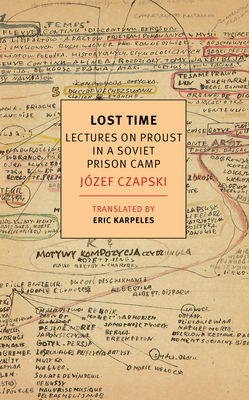
What would you do if you were in a prisoner camp of some kind, cut off from the world, with no way to entertain yourself, nothing to do with the adrenalized energy that can often keep us awake even after the most exhausting days of labor and stress and trauma? How would you pass the time? What would you do to stay sane? How would you feel human when everything around you is designed to make you feel like an object, something discarded, a piece of trash those in power saw fit to “rehabilitate?” Jozef Czapaski and his fellow prisoners in a Soviet War camp organized a lecture series, with each participant sharing something they were passionate and knowledgeable about, something that connected them to the outside world, something that shared the depth of themselves with the compatriots in incarceration. Czapski, a painter by trade, chose to lecture on In Search of Lost Time by Marcel Proust.
Despite giving the lectures by memory, with no copies of the book or any scholarship of the book to reference (or any books at all), and working from schematics that he created himself in preparation for the lectures, Czapski's presentation is extremely insightful, distilling the very essence of Proust into something that can be communicated verbally to those with no familiarity with the work. I doubt serious scholars of Proust will find anything earth shattering in Czapski's interpretation, but he does an amazing job of bringing the biggest and most important aspects of the book to his listeners. For example, he (correctly I think) describes that famous madeleine as, essentially, a set up or a foreshadowing for the moment the narrator stands on a pair of uneven paving stones and the mystery of memory—and the power that mystery generates—reveals itself to him. He also spends a fair amount of his time on what could be considered the climax of the novel, when, late in the final volume, after years of being out of society, the narrator attends a party with all of his old friends. As I remember it, the scene starts with the narrator feeling as though it is a costume party, and all of these people who were so important to his past, had come dressed up as old people. And then it hits him; they aren't in costume. They had just, like we all do, aged.
Czapski identifies something I'd forgotten about this amazing moment: the narrator sees the transience of life, sees mortality, understands at a profoundly emotional level that soon, all of these people will be gone and those who remember them will be gone and there will be essentially nothing left of the people he cared about. But he can do something. He can use his own memory to create something that immortalizes them, not as idealized images, or even as characters in the usual sense of the word, but as flawed, complicated, fascinating, and important people. And through this, after floundering around for years, the narrator discovers his purpose in life, the action that would make his life meaningful. He would save his friends and, through his exploration of memory, give us the tools we need to save ours. And, in an indirect way, give Gzapski the tools to save his own sanity and perhaps his own life.
Given the importance of memory in Proust, in some ways a lecture series based entirely on how the speaker remembers Proust might be the highest expression of the book. If memory were perfect it would be meaningless. Everything in our lives would have the same value or at least take up the same space in our brains. As the translator points out in his introduction, forgetting is what makes memory powerful. It would also be a very different presence in our lives if it were controllable, if we only remembered the memories we were specifically looking for and only when we were specifically looking for them. But memory is not perfect and often we cannot control it. The triggers that elicit certain memories are hidden from us until they happen. And it is exactly those undbidden memories that create the most powerful experiences. We are most moved and in many ways most able to learn when something we had completely forgotten comes flooding back as if we were experiencing it again. This is how we are unmoored from linear time. But that doesn't mean memory is completely chaotic or completely unresponsive.
One of the things that Czapski notes is that he remembered more and more of the book as he worked with his schematics and as he gave his lectures. The more he looked for Proust in his memory the more he found Proust. What follows is another idea about memory, different from anything directly expressed in Proust (at least as I remember it, though it's probably in there somewhere) but still akin to the madeleine and the uneven paving stones: we store much more than we realize. We don't know how much we know until we really start digging into our own memories. Fascism (and in many ways capitalism) argues that, as individuals, we are simply incapable of grandeur, of excellence, of power, of brilliance, of completeness, and it is only through the state (or through the purchase), only through giving ourselves over to the state, that human greatness is possible. But Czapski and his comrades made a powerful counter-argument in their lecture series. They proved that, even in a situation designed to crush them into a kind of singularity, they all still contained multitudes. And the point is not to admire Czapski and his comrades for their series, though it is admirable, but to realize that you are also capable. You can remember more than you think you can. You know more than you think you know. You are capable of more than you think you are. You could put up a fight in a prison camp. You can fight fascism so there are no more prison camps.
As much as the lectures themselves are about Proust and memory, Lost Time is a story about self-care. It is an artifact of survival. It is a statement of defiance. The lesson from Lost Time isn't really one about Proust or In Search of Lost Time, but that being passionate about something is a survival technique. Developing an expertise in something, in anything, is a bulwark against systems of power and powerful individuals who prefer compliance above all, who value those who do what they are told, who find ways to eliminate the asking of questions, because those systems of power cannot take your expertise, they cannot take your knowledge, they cannot take your memory. They can take everything else from you, but they can't get in your mind and excise what you know. That knowledge of furniture restoration, of string theory, of Buffy is yours forever.
What would you lecture on? And if you can't think of something, there are worse ways to spend a few weekends than developing an expertise in something that interests you.
Readers have an extra privilege. The point of books is to encapsulate our humanity in ways that make it easy for us to share with others what makes our lives worth living. Those of us who develop an expertise in books or in a specific book, also develop a constant reminder of what we put in the work for, of why we fight, of what makes life valuable, and also of how we work, how we fight, and how we make life valuable. Czapski is discussing Proust in particular, but his summation of what he believes Proust accomplished is a beautiful summation of what literature aspires to do and what we can achieve or access when we interact with literature: “With his revelatory form, Proust brings a world of ideas, to the reader, a complete vision of life that, by awakening his faculties of thought and feeling, requires the reader to revise his own scale of values.”
This post would have a very different tone if Democrats had not flipped the House of Representatives, if they had not taken back state houses and state legislatures all across the country, and if they had not succeeded with referendums as well. This sense of what we need to do, what we can do when all hope is lost is different when we have been given such tangible and immediate reasons to hope. But you could tell the history of America in the 20th and 21st centuries through the battles we assumed were over. At time of writing, Republicans in Wisconsin and Michigan are using their lame-duck sessions to completely undercut the Democratic gains in their states and further disadvantage Democrats in 2020. All of our great victories and all of our great progress has eroded without our constant attention. Our gains were chipped away, our progress diminished, the passions of radical reactionaries loud enough and inconvenient enough to extract concessions from those of us who felt we had better things to do with our time and now we find ourselves in a new version of the early 1900s; African-Americans and many other people of color live in a new Jim Crow, a handful of super-wealthy people control almost the entire economy with nearly everyone else in too precarious personal circumstances to put up much of a fight, and fascism is a threat here and around the world.
I have said this in other contexts, but while I think about Czapski and his comrades in a prison camp and I think about the children and families in concentration camps, complete with numbers being written on their arms, today in the United States, I remember that we have the privilege of memory. We are not yet Germany in the 1930s in large part because we can remember Germany in the 1930s. We are pushing back against the rise of white supremacy because we remember Jim Crow and we remember the lynchings. We can remember what happened and actually do something to stop it and to change it.
And one election is not going to save the world. We have to see the 2018 mid-terms as the very first step, not just in defeating Donald Trump, but in remaking American society to live up to the promises it made after World War II and to live up to new promises we can make with our new imaginations. We have to take Czapski's lessons about books and reading and maintaining your personhood in an impersonal world, not as just a kind of defense against the dark arts, not just as a barricade against those who would invade our minds, but also as the basis for what we build next, for seeing who we can be in the future and finding a way to get there, and for describing a new and better world and what we'll do to create it.
Thursday, December 6, 2018
Friday, November 9, 2018
2018 Midterm Debrief
Deep breath. We gave ourselves a
chance. We did not end the Trump administration, we did not stop the
rise of fascism in America, and we did not finally, finally, finally
wipe out the lingering Confederacy that the Republican party has
essentially become. Wednesday's firing of Jeff Sessions and
installation of Trump lackey as acting attorney general make that
abundantly clear. (Of course, we couldn't have one fucking day.) But
we gave ourselves a chance. And with the campaign infrastructure we
built over the course of this election, with some of the wins in
governors races, with some of the election reforms passed by
referendum, and with a more advantageous Senate map, we have a chance
to really eradicate this Republican party in 2020. The Republican
party has been building this particular system of power since Richard
Nixon's Southern strategy and it has been successful for decades.
We're not going to erase it in one election, especially when there
are so many structural impediments to the type of change we seek. But
we might be able to do it in in two. Deep breath.
Here are my thoughts about what
happened in the mid-terms and where we can go next.
Flipped the House!
We flipped the house in two distinct
ways. First and foremost, there is a Democratic majority, which means
that (assuming we can make it to January) we have saved Medicare and
Social Security for now, as well as what remains of Obamacare, and prevented
(well, we'll see what happens in the lame duck) more catastrophic tax
cuts. And it also means that there will actually be oversight of this
administration. There will at least be a
chance at confronting and controlling the rampant corruption in the
cabinet. At the very least, it's only a matter of time before Trump's tax returns become public. This was the knife-edge upon which democracy teetered and we
needed to flip the House Democrat, regardless of who those actual
democrats were, in order to keep us from falling completely over into
fascism.
But another flip happened in the House.
On Tuesday, the House took the single biggest step I think any of us
have ever seen in our lifetimes, and perhaps ever in American
history, towards actually looking like the population of America.
There are now Muslims in the House, as there are in America, and
Native Americans in the House, as there are in America, and Latinx in
the House, as there are in America, and refugees in the House, as
there are in America, and there are more women in the House, closer
to the actual number of women in America and more people of color in
the House, closer to the actual number of people of color in America.
The House even got slightly queerer.
There was a time in the not too distant
past when the argument that the Democrat and Republican parties were
essentially the same held water, but, today, all you need is your
eyes to know that is no longer the case. The Democratic Party looks
like America and the Republican party looks like the Confederacy. And
now the House looks more like America.
Flipped Governor's Races, State Houses,
DAs, and Newly Competitive Seats
The devastation of the 2010 midterm
wasn't really in Congress, but in the states where Republicans were
able to leverage the census year to insulate their power from all but
the most dramatic voter uprisings. 2010, in many ways, ended up being
a culmination of liberal, progressive, and Democratic neglect of
state and municipal politics, a neglect that allowed Republicans to
entrench themselves at all levels of state government and leverage
that entrenchment to create power at the national level they would
not otherwise have secured.
In 2018, Democrats, liberals, and
progressives paid attention to state and local politics and it
showed, with states flipping executive, legislative, and judicial
branches, progressive DAs being elected, and ballot referendums
successfully enacting a number of policies that will make it easier
to elect more Democrats the next time around. It is going to be hard
to know this and even harder to feel this in a meaningful way and
even harder to feel it with the same intensity as we felt the
disappointment in certain losses, but, in this election, we improved
the lives of millions of Americans. We saved lives. I'll say that
again, we literally saved lives.
Furthermore, even in some high profile
losses, the Democrats showed the power of a run-everywhere strategy.
An energetic campaign, especially one that draws on both national
resources and local volunteer energy, like Abrams (who at time of
writing still hasn't officially lost), Gillum (who at time of writing
might actually have won), and O'Rourke, can create victories
elsewhere. We can confidently attribute two flipped seats in the
House to O'Rourke's campaign and maybe two more to Abrams. I think
it's also fair to say that the enthusiasm for Gillum probably gave a
boost to Prop 4 in Florida. Run everywhere is effective even if you
can't win everywhere.
And the thing is: Independents,
Democrats, liberals, progressives, democratic socialists, even some
Republicans, and others want to save their fucking country from
Donald Trump and his brand of white nationalist fascism so why not
give all of those people the opportunity to do so by giving them
campaigns to work on. When the energy is there you can create
positive results beyond winning a specific seat this specific year.
And now, in 2020 when the demographics will be even more advantageous
for Democrats, there will be thousands of experienced campaign
volunteers in every single state ready to take the lessons they
learned in this election and apply them to the next one.
American Society is Center-Left
The majority of Americans voted for
Democratic governors. The majority of Americans voted for Democrats
in the House of Representatives. The majority of Americans voted for
Democrats in the Senate. Progressive values won races all over the
country, including in red states, in the form of referendums and
ballot initiatives. Medicare was expanded. Voting rights expanded.
Minimum wages raised. Gerrymandering ended. Marijuana legalized.
When you add it all up, you get a
population that is (essentially and, of course, not uniformly)
politically center-left. You get a population that, in general,
supports the social contract of the New Deal, wants to lower its
insane incarceration rate, and wants competitive elections, all of
which are core Democrat and center-left policies and ideologies. Why
red states consistently elect representatives that specifically, even
aggressively, oppose the policies the people themselves support is
one of the great mysteries of American politics (if you ask me, it's
a heady mix of good old fashioned American racism with Republican
identity politics, but that's a post for a different time) but it
still contributes to the same conclusion: by and large the American
people want Democratic policies even if they don't always vote for
Democratic representation.
The Polls Are Alright
For the most part, the election looked
like we expected it to look. Of course, there were some surprises
both for the Democrats and for the Republicans, but, by and large,
the results reflected what pollsters and history suggested: the
Democrats would take the House and make gains in other places, while
the Republicans would hold the Senate and maintain control in others.
For some reason, we seem to treat polls as though they are
predictions, when they are really just educated guesses that are
useful for assessing political strategies and interesting to interact
with in the same way sports statistics are interesting to interact
with.
When Donald Trump won the Presidential
election, defying all of the prevailing predictions, we reacted as if
the very act of polling was somehow invalidated and perhaps even
fraudulent. This is another example of jumping to a conclusion in a
moment of trauma to find an explanation (any explanation!) for what
the fuck just happened. And just like the whole narrative of the
white working class and just like the narrative of the flaws of
Hilary Clinton's campaign, once every vote was counted (more on
this soon), once we got the full story we realized that, in fact,
Trump's campaign threaded that handful of a percent needle he needed
to win. Literally tens of thousands of votes in three states.
Oh, and there was a sophisticated
foreign-lead misinformation and manipulation campaign that
(allegedly) coordinated with the Trump campaign itself to boost his
campaign. Almost by definition a
this-crazy-shit-has-never-happened-before event isn't going to be
factored into 538's latest projections.
Polls are not perfect and never will
be, and really, aren't supposed to be. They are impressions. They are
guesses. They are spectra. They are one of the many different kinds
of tools campaigns can use to strategize and people can use to
understand our country and our politics. 2016 was an aberration
because shit happened that had never fucking happened before. And
that's not the fault of polls and pollsters. That's the fault of
criminals who defrauded and conspired to defraud the United States.
Results Before All the Votes Are
Counted
At time of writing, the odds that
Andrew Gillum actually won the governor's race in Florida continue to
rise. A recount for Florida's senate seat is all but guaranteed and a
recount for the governor's race in Georgia also looks increasingly
likely. As the denser, more populated districts with more mail-in and
absentee ballots to process continue to work through their ballots,
more and more votes for Democrats are added to the totals. It's
looking like the number of flipped seats in the House will land
closer to 40 than to 30. And two of the three Big Emotional
Disappointments on election night, might actually turn out to be Big
Significant Victories.
Will that change the narrative that
Tuesday was an overall disappointing performance for the Democrats?
Even if they eventually hold on to the Senate seat in Florida? Even
as all those Democratic votes in California keep getting piled on top
of the totals?
Of course not. Once a narrative sticks,
even if it is based on data that is eventually proven inaccurate it
is almost impossible to change it. It gets even harder when that
incorrect narrative benefits those in power (Republicans) and/or fits
neatly into pre-existing narratives (the mainstream media idea that
there is something fundamentally wrong with the Democratic Party).
Just like in 2016, when we called the election and drew conclusions
from it before seeing exactly how many more votes Clinton received
than Trump and before seeing how razor-thin his margins in the
rust-belt were and before seeing the actual composition of his
voters, we are likely to continue to discuss Tuesday's election is if
it were something far less impressive than it was.
There is, of course, an easy way to fix
this: do not release the results until all the votes have been
counted. Honestly, it should be a law.
We Built the Tools, We Learned the
Tricks, On to 2020
Hundreds of thousands of Americans
learned, over the course of this summer, the amount of and the kind
of work it takes to win elections in this country. Hundreds of
thousands of us have learned to canvas, to call, to text, and to
organize. Democrats had to develop unprecedented capacities to absorb
and deploy volunteers. Progressive think tanks pioneered new data
driven fundraising initiatives, developed new Get Out the Vote
techniques, and found new ways to tell their story. They found ways
to replace Super PAC money with volunteer energy. (For example, I
was one of a mass of volunteers who did remote data entry for the
O'Rourke campaign.)
But we also know where we need to do
more work. We need to start registering voters now for 2020 and be
willing to spend the money and time to get them all through the
registration process. We need to have the resources to respond to new Republican suppression tactics. We need to be
in high schools now, because today's 16-year-olds are 2020's
18-year-olds. We need to give all those thousands upon thousands of
volunteers opportunities to keep contributing to the world they want
to see. We need to start organizing ballot initiatives that drive
Democrat voters to the polls.
And we need to keep fighting now to
even get to January. Rick Scott is calling the counting of every vote
in Florida fraud. The President is moving to end the Mueller
investigation. And I haven't checked the internet in a few minutes so
who knows what's being cooked up for the lame duck session.
But I am not exhausted. I am not
overwhelmed. I am not deterred. Perhaps the most important thing we
learned on November 6 was the work is worth it. Small donations,
grassroots organizing, and thousands of volunteers engaging with an
aware public can overcome Super-PACs, gerrymandering, and other
structural impediments to Democracy.
The work is worth it. Deep breath. On to the next
fight.
Monday, October 22, 2018
Why You Should Canvas
There are four weekend days left before
the election that, to me at least, will decide whether we will
continue our slide into fascism or not. You should use at least one
of those days to canvas for a Democrat somewhere. It could be in a
swing district like ME-02, but it could also be for a sure thing,
(like Elizabeth Warren) or a long shot (like Jay Gonzales).
Door-to-door, person-to-person canvasing has been shown to be themost effective way to turn out votes for your candidate and if you
don't like what the Republicans have been doing with their power, the
best thing you can do is turnout votes for Democrats. But, canvassing
is one of those activities where you get out almost as much as you
put in, and whatever value you bring to the campaign, you get back in
other ways. So, here are some reasons why you should canvas—on top
of the whole defending the country against white nationalist
misogynist fascism thing of course—for yourself, followed by a few observations from my last turfs.
A Good Walk
I know this sounds like one of the
hokey things recruiters will tack on at the end of a pitch, but
seriously, canvassing is walking and you, you're not walking enough.
Walking is good for you. Being outside is good for you and you're not
outside enough either. Well, here you go: a good walk outside. For me anyway there are few activities as
fulfilling as walking through a new landscape and canvassing is
inherently that.
A Look Inside a Campaign
Politics is almost a parodoxical
combination of the simple and the complex. You vote and a candidate
wins. (Or you don't vote and a candidate wins without any input from you.) In nearly
every instance you will have a choice between a Republican and a
Democrat and in an even higher percentage of instances even when you
have other choices, you're only meaningful choice will be between a
Republican and a Democrat. (Except for you folks in Maine, who now
have ranked-choice voting!) And most of us already knew which one we
were going to choose, because we've been making the same choice for
years. Simple.
But getting more people to vote for
your candidate is a massively complex challenge that involves
volunteer management, workflow, data collection, data processing,
writing, editing, graphic design, coding, polling, fundraising,
financial management, and more with dozens, hundreds, or even
thousands of people. When you canvas, you get a peek at all of that.
You get to see what's on the walls of the offices, how many people
are working, and what kind of snacks they have. From whose doors you
knock on and where those doors are and the script and talking points you're given, you can get a sense of the
campaign's strategy, of how big their canvassing effort is, and of
who they think they can turn out on election day and how they think they can be turned out.
If you're at all interested in the
mechanics of elections and politics (and you really
should be) canvassing is a great way to get a glimpse of that
machinery.
Get Out of Your Bubble, But Not in the
Stupid Fucking Soft-Focus NYT Piece Set in a Hardscrabble Bar in
Northern Kentucky Bullshit Way (Not that I Have Anything Against Said Bar & Its Kindred Bars.)
By the last two weekends of the
election, you will most likely be knocking on Democratic doors (at
least suggested by the campaign's data), but that doesn't mean you'll
only be talking to like-minded people. In fact, there's a good chance
you'll end up talking to one of the (for me and probably for you)
strangest animals on the planet: the semi-aware American
sometimes-voter. Like, dude, this isn't Bill Clinton era political
triangulation, this is children in fucking cages, this is the most
corrupt administration we have ever seen, this is a President
obviously aligned or at the very least amenable to some of the most
repressive regimes in the world, including one was the villain in, like, half the action movies in the 80s. This is an obvious partisan hitman on the
Supreme Court. This is someone who at the very least had a drinking problem in his life that he refuses to confront but is probably also a serial sexual assaulter. This is lying from the Oval Office at an unprecedented
rate. This is a Republican party who's only policy commitment is
keeping itself in power by any means necessary. (And they give themselves bonus points when they get to hurt people they don't like along the way.) How the fuck are you
lukewarm about any of this? I can kind of understand devotees to the
cult of Fox News and though I don't understand why you would ever
feel this way, I at least understand why white supremacists are
supporting the Republican party. Same goes for all those fucking
asshole misogynist men who felt seen and spoken for by Grassley's,
Graham's, and Kavanaugh's temper tantrums. I don't understand what
the fuck is wrong with you, but I understand how being such a piece
of shit would lead you to certain actions. But to see all of that and
still think, “I just don't know?” Or, worse, to see all of that
and think, “Meh?”
What this tells me is that contemporary
mainstream political journalism has failed--at a level far worse than I imagined--in its primary goal of
informing citizens on the state of political power in our country. In
order to project some strange definition of “balance,” mainstream
media has downplayed the threat the contemporary Republican party
poses to America, while overemphasizing the flaws in the Democratic
party. I mean, the few times I was able to discuss specific issues
with people while canvassing they wanted to talk about health care,
so we did. OK. Fine. In Maine, I saw an a Bruce Poliquin ad arguing
that he was in favor of protecting patients with preexisting
conditions, despite voting to repeal the ACA with no replacement
legislation to protect the patients repealing the ACA would leave
vulnerable. And this isn't isolated. Somehow, Republicans around the
country are trying to run on fucking healthcare. They believe they
can get away with this because they know our political journalism
will not be able to respond.
A current in this failure is how “get
out of your bubble” was leveraged by the right to mean, “Let
another white guy from the Midwest talk at you.” Somehow, our media
has allowed the right to control the debate on connecting and
listening to other perspectives to somehow only mean that all
liberals have a responsibility to listen to a specific range of
conservatives. (And if we don't listen in the exact right way
and do exactly what they ask of us no matter how damaging it might be
to other populations it's our fault, not theirs if they help elect Trump and Trump-like Republicans.) Somehow, the
media has helped create another one-way street in which certain white
men get to talk at the rest of us as much of they want and
without any meaningful responsibility for their own actions. Which is
really tragic, because there are lots of different ways to get out of
your bubble. It doesn't just mean talking to your political opposite.
It doesn't just mean listening to someone who doesn't believe you are
fully human. It doesn't just mean another fluff piece on Rust Bowl
Trump voters. There are lots of different types of people you can
meet and perspectives you can interact with once you're there.
Political belief is a spectrum, in terms of policy and intensity and
it is always good to find ways to talk to people on different parts
of both spectra.
Canvassing might be the easiest way to do that.
They're All Crooks!
A corollary to the “Meh,” voter is
the “They're all crooks!” voter. It is undeniable that the
Democratic party has its flaws and that it is influenced by its
donors. It is also true, that there have been times in our recent
political memory (Bill Clinton's triangulation and Al Gore's
subsequent campaign) where there wasn't much to distinguish between
public statements and no small amount of enacted legislation. (Again,
Bill Clinton era crime bill & welfare reform and some
post 9/11 security state stuff. Oh yeah, and the wars in Iraq and Afghanistan.) It is also true that there have been
corrupt Democrats and that there will certainly be corrupt Democrats
in the future, but there is nothing in modern memory anywhere close
to what Trump and the Republicans are doing. This, of course, goes
back to how “balanced” journalism works. There's a negative story
about a Republican being a fucking fascist, well, run a negative
story about a Democrat and present them as equal in scale even if
they are not even remotely of equal scale.
I should also note, that this is a
consequence of “horse race journalism” as much as it is of
“balanced” journalism. In terms of what a journalist does, it
shouldn't fucking matter whether Republicans claiming to protect
preexisting conditions is an effective election strategy because it's
a fucking lie. But, instead, the various policies and positions of
both parties are presented neutrally, as being equally valid
arguments conducted in equally valid ways and the only thing of
interest is which one ends up more popular. So voters, especially
voters who don't dive deeper than the headlines, come away with the
sense that the two parties are both equally bad and so why bother. In
fact, one person I talked to was visibly angry that both campaigns
were “bothering” him, so he was going to vote independent. Of
course, HIS name wasn't the name I had on my list, which brings me to
my next observation...
Special Report for the Department of
Shocking but Not Surprising
Holy shit there are still a lot of men
who will not hesitate to speak for their wives. The last house I
stopped at yesterday a man, roughly my age (38) saw my button and
said, “We're Republicans here,” which was especially interesting
because the woman's name I had on my list was, according the
state registration information, a registered Democrat. For all I
know, that person had honestly changed her mind at some point in her
life and just hadn't bothered to update her registration. That is, of
course, a “perfectly rational explanation.” But, much more
likely, this guy is a fucking Republican so his family is fucking
Republican and that's fucking it. There are a lot of forces, both
historic and contemporary that have created Trump's 38-42% approval
rating, but a big chunk of it has to be men who believe it is their
right to speak for their household and Donald Trump is overtly
protecting, shit, even celebrating, that power. (Should also note that
“shocked but not surprised” is perhaps my most common emotion in
2018.) (I should also note that if you're not planning on voting at the moment, maybe you could just to deal this asshole a loss. You know the smugness liberals are accused of having? This fucker oozed it, but with that extra dose of 'I can't be smug because I'm a Republican' smugness. Wouldn't you like to ruin his day?)
It's All Rigged
One of the more interesting responses
was someone who told me he never votes because it's all rigged.
Canvassing really isn't the time for a long conversation about
anything, so I wasn't able to drill down to what he actually meant,
as that could mean anything from a version of “They're all crooks,”
above to, “the Illuminati controls the world.” I bring him up
only because, later I realized I should have said to him, “I'm not
here to convince you, but, just ask yourself, who wins because you
don't vote?” Seems like a pretty good question for anyone thinking
of sitting this election out to answer for themselves.
Rays of Hope
My lists the past two Sundays were of
infrequent voters; people who had not voted in the last few elections
or in the last few midterm elections. This included Democrats,
Undeclared voters, Independents, and some Republicans. This means
that the campaign has the resources to go after unknowns, to expand
its potential base, and to reach votes the Democrats haven't reached
in the last couple of election cycles. And a good number of people I
actually talked to are voting Democrat! Like, a little over a third
of the people I actually talked to. Sure, that's maybe 10 people, but
if you all canvas on at least one of the remaining four weekend days,
that hundreds or even thousands of Democrat voters. I don't know if that's
enough, but it's either do something or don't.
Canvasing Links (Because you're definitely going to canvas now.)
Canvas for Democrat candidate for MAgovernor Jay Gonzalez (Because, last I checked, Charlie Baker was still fine being a member of a misogynist white nationalist fascist party.)
Thursday, September 27, 2018
Your Hero Opportunity
Most of the time, it's hard to know the
real value of what you do. For most of us, we know that
whatever we did today was good enough or at least not bad enough that
we kept our jobs for another day, that our marriages stayed together
another day, that we got the kids back and forth to school, and as
important is it is to do all of those things, it's hard to know
exactly whether what we said was good or just good enough, whether
what we did was right or just not so wrong someone would say
something about it. With the exception of professions like nurses,
doctors, EMTs, soldiers, fire fighters, pilots, and a few others and
very rare cases like car accidents and natural disasters, we can only
guess at whether or not what we did was the best thing we could have
done.
And, that's fine. For me, one of the
primary skills we need to develop to live fulfilling lives is a base
level of comfort with ambiguity. Honestly, I'd go even further and
say some of the most destructive forces in human society, fascism,
racism, theocracy, are based in creating a false sense of certainty.
They are supported by and destructive because they create these
certainties upon which people then live their lives, regardless of
the consequences or impacts their actions may have on others.
Which is a long way to say that
ambiguity is not a problem and not something I routinely try to
remove from my life and my writing.
There is no ambiguity here. There is no
doubt. Even in this postmodern, post-structuralist, deconstructed
world, there is a right thing to do.
We've all wondered, in various lexicons
and with various fantastic or realistic scaffolding, what we would do
if we were put in a life and death situation, if we were given a
dramatic choice, if we were called on to be a hero.
There may not be an actual ticking time
bomb, their may not be flames or car chases or dearly beloveds
dangling from cliffs, but this is your life or death moment, this is
your hero opportunity and what you must do is clear.
You must vote Democrat in every race
this election. If you always vote Democrat, if you always vote
Republican, if you mix it up, if you vote third party, if you don't
vote, if you've never voted before, the right thing for you to do,
the heroic thing for you to do is vote for every Democrat on your
ballot.
If you're reading this, odds are you
already planning on doing that. I don't know if I have the eloquence
and insight to breakthrough to those of you who are not already
planning to vote Democrat this fall, but you can't succeed if you
don't try. That said, I know there are some of you who will never
vote Democrat, who will always vote Republican, and this is the part
where I'm supposed to say that I respect you and that we're supposed
to find common ground, but I don't, there is no meaningful common ground, and
though I will applaud those of you who undertake the long and
difficult personal journey away from this current incarnation of
Republicanism, right now your votes are literally tearing families
apart, literally destroying our system of government, literally
traumatizing millions of your friends, neighbors, and family members,
and literally killing people and if Fox News is protecting you from
that truth my little blog post isn't going to bust in.
So I'm going to focus on three types of
people who might not vote for Democrats in November.
I Oppose the Two-Party System
How much has voting third-party or
abstaining from elections done to diminish the power of the two-party
system over the last twenty years or so? How many Green Party members
are there in Congress? Governors? State legislatures?
Listen the two-party system is
undemocratic, has pushed American policy far to the right of the
American public actually believes, and fundamentally stifles the
conversation around policy and legislation, but how does helping
Republicans maintain power, despite the fact that most Americans do
not support the Republican agenda, push us towards a multi-party
system? In fact, because Republicans are actually disenfranchising
voters, specifically progressive voters, on top of everything else,
empowering Republicans by voting third-party or abstaining from
voting actually hinders our ability to transition to a multi-party
system.
If you really want to begin diminishing
the power of the two-party system, vote for very Democrat on your
ballot and then do whatever you can in your state to reform your
elections to include ranked choice voting or instant run-off
elections. It is a popular idea, it won on the ballot in Maine, and
it is the first step in breaking through the two-party system.
The Democrats Are Whores to [Insert
Special Interest Here]
With the exception of radical
conspiracy theorists, you're also probably right. Contemporary
politics is a money game and in contemporary American capitalism very
few good people have the kind of money it takes to influence
politics. Look behind your favorite Democrat politician and there's
probably at least one really bad corporation or industry (probably
pharma) donating to them.
But does that put them on par with what
Republicans do? Really? Does the fact that many (but not all!)
Democrats take money from problematic corporations really mean that
the Trump administration is acceptable? Is your ideological purity
worth all of this collateral damage?
Furthermore, as above, how does helping
Republicans remain in power by voting third-party or abstaining from
voting help get money out of politics? Do you see any Republicans at
any level advocating for campaign finance reform? Cause I don't.
So, vote for every Democrat on your
ballot this Fall and help get money out of politics by donating to
politicians that reject corporate and PAC donations and pushing for
campaign finance reform in your state.
I Don't Care
Someone you love does.
The most important voters in America
are nonvoters, those who are eligible, but don't. There are lots of
reasons for this, many of which come from structural impediments to
voting (many of which are intentional) so I'm not really talking to
those who are logistically prevented from voting (but let me break in
here to say, do whatever you can. Lyft will take you to the polls,
Get out the Vote organizations will get you there, coordinate with
your boss, your coworkers whatever, because, honestly, you might not
get another chance to vote.).
Whatever reason you have for not
caring, whether it's that feel as though your vote doesn't matter, or
that no politicians represent you specifically, or whatever is fine
and I'm not going to try to argue against that idea. I don't know
what matters to you so I have no idea how to make you care.
Someone you love cares. Someone you
love was traumatized by what happened yesterday in the Kavanaugh
hearing. Someone you love was traumatized when the Access Hollywood
tape didn't end Trump's campaign. Someone you love is terrified
because they emigrated here recently or are first generation or just
happen to have a Hispanic sounding name and there is a real chance
ICE could sweep them up. Someone you love is scared of the uptick in
hate crimes, someone you love is scared of LGBT information being
scrubbed from federal websites, someone you love is scared their
asthma will become unmanageable if the air quality regulations are
eliminated, someone you love is scared of dying from an illegal
abortion. Someone you love has gained weight and lost sleep and felt
a pit with sharp edges in their stomachs for what feels like forever
and someone you love will never be the same again the way our
grandparents who lived through the Great Depression would keep old junk in
their basements because they could never quite shake the fear of
bread lines.
Maybe politics doesn't actually affect
you. Maybe you have good reasons to not care. Maybe those reasons are
good enough for whatever logistical challenges you face to voting to
count as a hassle.
Fine. Whatever.
But you are not the only person in your
life. If you're not going to vote Democrat for yourself, vote
Democrat for someone you love. And let's put a rational self-interest
spin on this too. If Republicans hold on to the House and Senate,
someone you love will look up from weeping and ask you if you voted
yesterday and your relationship with them will never be the same if
you say, “no.” Shit, vote Democrat for someone I love. I mean, if
it really and truly doesn't matter to you, why not make my
grandmother's day?
Your Opportunity
So this is your opportunity to be a
hero. I won't say we're lucky to have this opportunity and I won't
say we should be thankful our opportunity is so easy to capitalize
on, but here it is. Our chance to do something great.
Monday, September 10, 2018
Turinng the NHL Into a Two-Tier League
For fun, let's
imagine restructuring the NHL into two-tiers, sort of like
professional soccer leagues around the world. There would be a
Premier League (or Prince of Wales division, see what I did there.)
and a Second League (or Adams division). Reorganizing the league this
way would greatly reduce the number of “meaningless games” during
the regular season and reduce the value of “tanking,” while
producing more potentially exciting games and more interesting
interactions between the teams, and, give the league a structure for
incorporating all the expansion they're desperate to do. You'll see
how all of that could happen as I get in to the details.
36
teams, 18 in the Prince of Wales Division and 18 in the Adams
Division. Each division would be divided into an East and West
conference of 9 teams each. (This will also work just fine with a 32
team league, though the playoff structure would have to be redone.)
Only the teams in the Prince of Wales (or Adams, doesn't really
matter to me what the premier division is called) will be eligible to
compete for the Stanley Cup (more on the playoff structure soon). (Obviously, the Adams division will have it's own playoffs, again more on that later.) All the teams will play every
other team in the league at least once, but no team will play any
team in the other division more than twice. (With the extra game
being for “natural rivalries” between teams in different
divisions, say, going from this year, Calgary and Edmonton.) In
theory, once this is in place, you could keep adding teams as much as
you want. Just keep the PoW at 18 and stick as many expansion teams
as you want the Adams division and adjust the playoff structure
accordingly. In theory, you could even add another tier if you
wanted to.
The draft lottery
would work essentially the same as it does now, with the entire
league drafting together, so the last place team in the Adams would
have the best chance at the first pick. Trades could also happen
between divisions (more on that later.) Every team makes the playoffs
within its division with one exception (more on that later). There
will be a system of relegation and promotion (more on that later).
That's pretty much the basics.
Let's get into the
weeds.
EXPANSION
Let's start hashing
things out by getting the League up to 36 teams and dividing them
into the two divisions. The league has 31 teams at the moment, so
we'll need five more to get there. Here are the cities that I think
should get teams: Seattle (since it seams like they're going to get
one anyway), Quebec City and Hartford (since they already had teams),
Hamilton (since there has been some momentum around a team in
Hamilton for years now, but for some reason we care about what the
Sabers think), and...
a team owned by the
NHL located in some city that wins some crazy-ass year long
competition. Does Montreal have room for a second team? (Maybe.) Does
Boston? (No.) Could somewhere small, but with hockey history like
Saskatoon (birth place of Gordie Howe) make a case? Is there another
Las Vegas hiding somewhere? (Branson?) PEI? Madison? A team shared by the
Dakotas? Lake Superior? New England? And if, after some reasonable
amount of time (5 years, let's say), that city, can't support an NHL hockey team, well, they just hold the contest
again. The operations of the team would be independent of the NHL,
but the NHL could potentially use it as a kind of ambassador team.
Moving it around North America (or beyond), and trying out new
things (ticket packages, carbon neutral arenas, municipal stakes a la
the Green Bay Packers). Maybe this makes it hard to keep top talent
and compete, but, well somebody's got to be last and if somebody's
got to be last it might as well be a team that is also doing
interesting things for the game of hockey.
Once we have all the
teams we'll need to divide them into the two divisions. So, the PoW
division would be composed of the original 6, plus the next 12 teams
with the highest total of regulation and overtime wins over the last,
say, five seasons. Yes, this means that an undeserving team or two
might get bumped for an original-6 team that's had a bad run of late,
but I honestly can't imagine starting out with any number of
original six teams without a shot at the Stanley Cup. If they play
their way into regulation after the league has been reorganized,
well, that's on them. (Every redemption story, starts with a fall.)
The long term wins
total, as opposed to say, the end of season ranking, is a way to
reward long term success and prevent a good franchise that just
happens to be going through a rebuilding year or two from being relegated
and a bad franchise that happens to get a few good bounces down the
stretch from being promoted.
With the divisions
and conferences set, the regular season plays as it does now, with
the scheduling exception described above. Oh, and while I've got you:
3 points for a regulation win, 2 points for an overtime win, 1 point
for an overtime loss, and...1.5 points for a shootout win.
PLAYOFFS
The first thing one
might object to, to this current structure is there isn't really a
playoff race. Every team will end up in some form of playoff, either
for the Stanley Cup or whatever the Adams division trophy is called.
(The Kenora Cup, perhaps.) The only thing the regular season will
decide, in terms of the specific season, is the seeding going into
the playoffs. But that seeding will be significant and whether a
franchise is safely in the PoW or in jeopardy of being relegated will
be determined by their seeding. Let's see how that works.
First of all, the
top seeds in the Adams East & West conferences will play the 9th
seeds in the PoW East & West conferences in a one game playoff.
We could have both games played on the same day, maybe a Sunday, one
in the afternoon and one in the evening. This essentially creates a
hockey holiday, in which pretty much all hockey fans are watching
both games and both games are absolutely vital for both teams. Think
of how much money the bars in Canada would make on this day. Think of
the parties. Think of how much fun that would be, to be with a group
of neutrals and just pick a team to root for. Think of the parties
the winning teams' fans throw. Think of the parties the losing teams'
fans throw! The NHL could even throw a whole bunch of weird and
awkward ceremonies all over the place and it would still be about as
much fun as you can possibly have as a hockey fan.
The winners of these
one-game playoffs, face the 8th seeds in the PoW East and
West conferences in a best of five series. The winner of that series
enters the official Stanley Cup Playoffs as the 8th seed.
Depending on the situation, what happens in those playoff games and
in that series, could have huge implications for the teams involved,
but I'll get into the more when I get to relegation and promotion.
And then it's a regular 8 team playoff. 1 plays 8, 2 plays 7 and so
forth.
I want to point out
one other benefit to this playoff structure: ta da! We have created a
bye-week at the end of the season for seeds 1-7. One of the things no
one really acknowledges about the Stanley Cup Playoffs is that, often, it's
the good team that happens to be healthiest that wins. A bye-week
doesn't solve all of the health problems that can impact the results
of the playoffs but it mitigates them, at least a little bit. Every
1-7 team will have a week to give their legs a chance to rest, to
recover from small injuries, to get their goalies off their feet a
little bit. And since there will be hockey going on during that time,
it's not like it would be dead time for the league or the fans.
And how about the
difference between the 7th seed and the 8th
seed? Significant games indeed.
Most of the new
significance, though, will come from the relegation and promotion
system, so let's do that now.
.
RELEGATION AND
PROMOTION
First of all, the
Stanley cup winner is protected from relegation for two years.
(Success should be rewarded.) Conference champs will be protected for
one year. (So, you know, they can finally all touch the conference
trophies.)
If an Adams Division
team wins its way into the Stanley playoffs, it is promoted to PoW
and the 9th seed of the PoW is relegated to the Adams. Now
the difference between the 8th and 9th seed in
the PoW conferences is massive. Furthermore, in the Adams division, the
difference between 1 & 2 is huge, as 2 doesn't even get a shot at promotion. But wait, there's more.
As above, the
Stanley Cup winner is protected from relegation for two years. So
they are not eligible for relegation, even if they end up 9th
in their conference, and even if they lose that one game playoff. If
that happens, the 8th seed is made eligible for
relegation. If they lose that subsequent playoff series, they are
relegated instead. So, if a Stanley Cup winner struggles at the
beginning of the season, the significance between 7 & 8 is huge
(on top of the significance of the by-week), as the 8th
seed could become eligible for relegation. But, also from above, it
is possible for a PoW conference to have two teams protected from
relegation in the same season; the Stanley Cup champ from two seasons
ago, and the conference champion from the preceding season.
What happens if
they're both terrible? And the 1 seed from the Adams beats them both.
We can't have that team play the 7th place team to settle
the relegation issue, as that would wreck the playoff structure. So
in that (most likely) rare case, if the Adams team wins more total
playoff games than the 7th seed PoW team, they are
promoted and the 7th PoW team is relegated. This means,
that not only is difference between 6 & 7 significant, but, we
could find ourselves with two playoff series where 4-1 is
significantly different from 4-0. We could also see (again highly
unlikely) a conference final in which the winner is protected from
relegation for one year and goes on to the Stanley Cup finals and the
loser is relegated.
In the Adams
division, teams that would normally be churning through their season
without a shot at either the playoffs or the top draft choice, will
have something to play for as the difference between 2nd
and 1st will also be huge. The 2nd place team, settles for playing for the Kenora Cup (look it up!) and the first place team gets
a shot at promotion.
The primary goal of
this reorganization of the NHL is the create more meaningful games
over the course of the season and the playoffs, and so we could see a
last week of the season or even last day of the season, in which
massive rewards are played for, and playoff wins that are significant
even in playoff series losses. Sure, there might still be some
tanking, but that would only be at the bottom of the Adams division.
And you know what, that's fine. They're the bottom of the Adams
division.
As you can see,
promotion is actually pretty difficult to achieve. You could have a
team do well for several seasons, and just choke in the one-game
playoff. Likewise, you could have a team hanging out in 9th
place for awhile, getting saved from relegation over and over again
by 8th place teams. Or who knows what else could happen?
So, I'm also totally on board with the idea of a semi-regular
reassessment of the tiers, maybe every five or six years, in which
some quorum of significant members of the league (owners, managers,
coaches, players, scouts, journalists, etc.) get together and,
through some formalized and transparent process, consider promoting
and relegating teams outside of this structure.
TRADES AND THE
SALARY CAP
For the most part,
trades and the salary cap would work in the exact same way they do
now. (However that is.) There would be trade deadlines and trades could happen across divisions. Free agency would work the
same way, though, of course, Adams division teams would have a
tougher time signing top name players, but, for the most part, things
would look the same. But I would introduce one wrinkle, specifically
around “rental” players.
A “rental”
period would be open sometime after the formal trade deadline, but,
only trades between the divisions would be allowed. This would give
PoW teams a chance to stock up for the playoffs AND give good players
stuck on Adams division teams an extra chance to end up in the
playoffs. But let's add another wrinkle. PoW would be able to include
“cash considerations” in their trade, however, that cash paid to
the Adams division team would count against their cap for the year.
(Who knows, maybe that's how it works already. I certainly don't
understand all the cap rules and well, I'm not going to look it up.)
But it will be different for the Adams team.
The Adams team would
tag that as cap-free salary and as long as they apply it to players
salaries it is excluded from cap considerations until it is “spent.”
Here's how that would work. Say a PoW team sends a prospect and $10
million in cash to an Adams team. The Adams team could then use that
money to bump up the salary of a youngish top-pair defenseman
approaching the end of his contract by $5 million a year for two
years. Or if they think they can play themselves into promotion with
one big free agent signing, they can pay someone an extra $10 million
the next year without any cap consequences. You could actually see a
smart GM in the Adams division, draft well for a couple of years,
make a couple of “rental” trades every year for a few years and
end up with enough cap free salary to build a promotion team in one
off-season. The important thing about this, is it
provides a way for Adams divisions teams to compensate for the
natural disadvantage they have in signing free agents.
It should also be
noted, “rental” players wouldn't just be for teams looking to
stock up for a serious Cup run. It could also be for teams trying to
jump up to 8, 7, or 6. More teams would have motivations to make some
kind of play near the end of the season to protect their place in the
PoW and so more of these deals would happen, redistributing a fair
amount of wealth downward.
Furthermore, the
fact that inter-division trading exists and that there will be some
incentive for Adams division teams to trade their players in rental
deals, means that Adams division players, along with playing for the
success of their teams, will also, essentially, always be trying out
for the PoW division. Even if your particular team doesn't have the
combined talent to do anything more than languish in the bottom of
the division, you don't have to. You can play your way into the PoW
division and perhaps right on to a Stanley Cup contender.
ADAMS DIVISION
PLAYOFFS
The Adams division
will also have a playoffs, which, I think, will be great for
everyone. More hockey, with more significance. Maybe there's a fan
base somewhere that just needs to see playoff hockey to get excited.
Maybe there's a player who will thrive in that environment but never
gets the chance because he's on a shitty team. The NHL is good at
trophies, so why not have another. (The Kenora Cup. I made up this
whole thing, so I can name the trophy.)
The Kenora Cup
playoff structure will be the inverse of the Stanley Cup playoff. If
the number one seed in the division plays its way into the Stanley
Cup playoffs (one-game playoff, plus best of five series) it has
essentially moved out of the Adams division, meaning that its
conference will now have eight teams in it and a good old fashioned
8-team playoff will start. If the number one seed does not advance
into the Stanley Cup playoffs, the 8th and 9th
seeds in the conference will play a best of five series to become the
8th seed and then we'll be back to the regular 8 team
playoff structure.
CONCLUSION OF SORTS
And there you have
it. More significant games. More playoff hockey. More story lines.
New rivalries. More fan bases will have the opportunity to celebrate
a kind of success. Better teams will play each other more often. More
games with playoff implications would happen. There'd probably be
more trades at the deadline. And the league can keep adding teams as
long as they want without potentially compromising any of that. And
we get a hockey holiday. It may be an impossible dream, but it's a
good dream.
Also, 3 points for a
regulation win, 2 points for an overtime win, 1 point for an overtime
loss, 1.5 points for a shootout win. Think about it.
Subscribe to:
Posts (Atom)
